
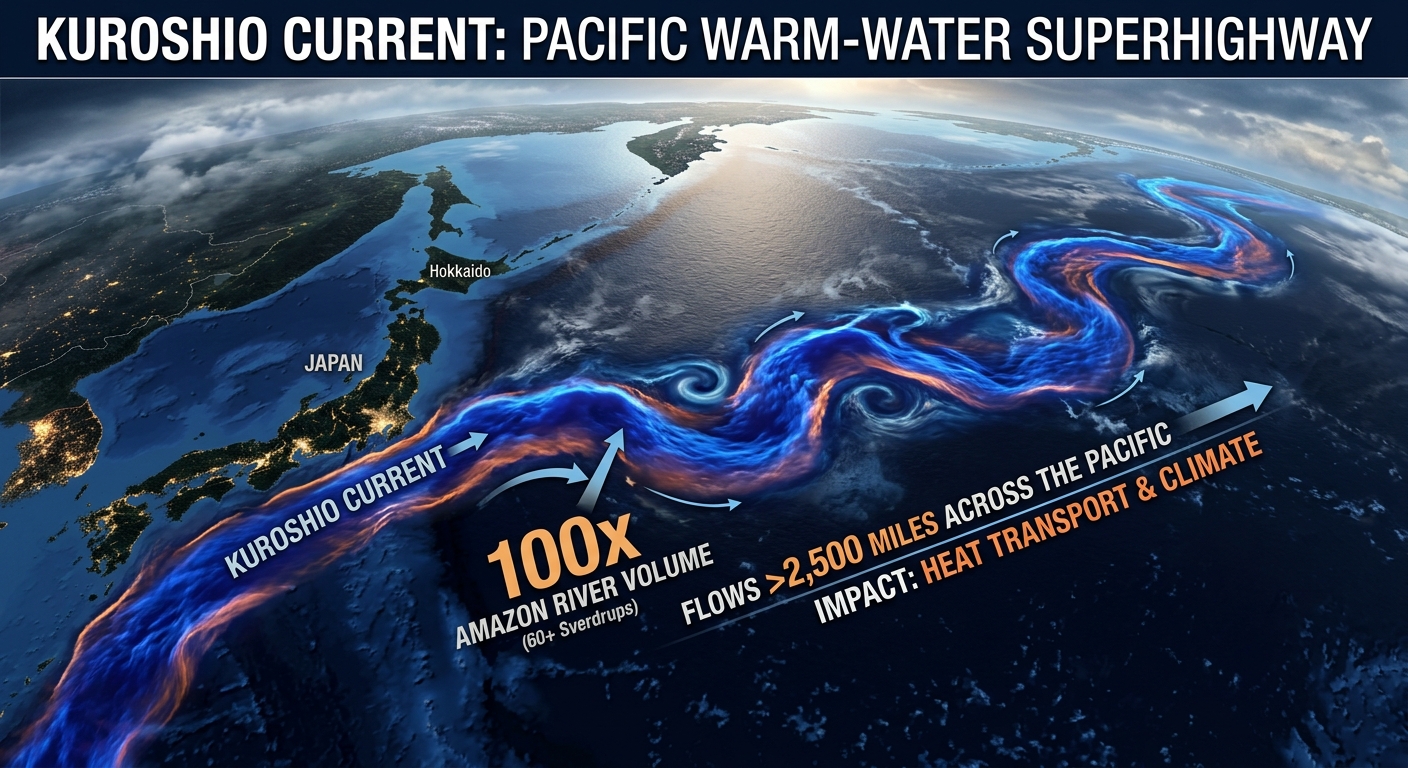
Imagine a river so massive that it carries 100 times more water than the mighty Amazon, yet remains completely invisible to the naked eye. This isn’t science fiction: it’s the Kuroshio Current, a colossal underwater highway that flows through the Pacific Ocean with a force that defies comprehension.
While most of us think of ocean currents as gentle, meandering flows, the Kuroshio Current represents something entirely different: a liquid superhighway that transports an estimated 42 million cubic meters of water per second. To put this staggering number in perspective, the Amazon River, Earth’s largest river by volume, carries a mere 420,000 cubic meters per second at its peak flow.
The Numbers That Defy Belief
The scale of the Kuroshio Current challenges our understanding of what’s possible in nature. This oceanic giant moves approximately 42 sverdrups of water, where one sverdrup equals one million cubic meters per second. For comparison:
- The Amazon River: 0.42 sverdrups
- The Mississippi River: 0.016 sverdrups
- The Nile River: 0.003 sverdrups
- The Kuroshio Current: 42 sverdrups
This means that in a single day, the Kuroshio Current transports enough water to fill Lake Superior nearly four times over. The sheer volume moving through this current every second could supply the entire United States with fresh water for over three years.
Journey of the Pacific’s Invisible Giant
The Kuroshio Current begins its epic journey near the Philippines, where warm tropical waters start their northward migration along the eastern coast of Taiwan and Japan. This oceanic river stretches approximately 3,000 kilometers, making it one of the longest and most powerful western boundary currents on Earth.
Unlike surface rivers that carve visible channels through landscapes, the Kuroshio flows as a distinct mass of water within the ocean itself. It maintains its identity through differences in temperature, salinity, and density, creating what scientists call a “river within the sea.”
The Engine Behind the Giant
What drives this underwater colossus? The Kuroshio Current owes its existence to a complex interplay of forces that operate on a planetary scale:
Trade winds push surface waters westward across the Pacific, creating a pile-up of warm water in the western Pacific basin. This accumulated water must find a way to return eastward, and the Kuroshio Current serves as one of nature’s pressure release valves.
The Coriolis effect, caused by Earth’s rotation, deflects moving water to the right in the Northern Hemisphere, helping to concentrate the flow along Japan’s eastern coast and maintain the current’s coherent structure.
Density differences between warm, less dense tropical water and cooler, denser water at higher latitudes create a natural gradient that helps drive the current’s northward flow.
A Marine Superhighway of Life
The Kuroshio Current isn’t just a massive water transport system; it’s a crucial lifeline for marine ecosystems throughout the western Pacific. The warm waters it carries northward create a climate-modifying influence similar to the Gulf Stream’s effect on Europe.
This oceanic river supports some of the world’s richest fishing grounds. The current brings nutrient-rich waters from tropical regions and mixes them with cooler, nutrient-dense waters from the north, creating perfect conditions for marine life to flourish. Species from microscopic plankton to massive bluefin tuna depend on the Kuroshio’s consistent flow patterns for feeding, breeding, and migration.
Temperature Control for an Entire Region
The Kuroshio Current acts as a massive heating system for East Asia. Without this warm water highway, Japan’s climate would be far colder and more similar to regions at comparable latitudes, such as northern Canada or Siberia. The current moderates winter temperatures and influences precipitation patterns across the region.
Measuring the Unmeasurable
How do scientists measure something so vast and invisible? Modern oceanography employs an arsenal of sophisticated tools:
- Satellite altimetry measures sea surface height differences that reveal current boundaries
- Deep-sea moorings with current meters provide continuous flow data
- Autonomous underwater vehicles map current structure in three dimensions
- Temperature and salinity sensors track the current’s chemical signature
These technologies have revealed that the Kuroshio Current isn’t constant. Like a river during flood season, its flow varies significantly, sometimes carrying 50% more water than average during peak periods.
Climate Connection and Future Mysteries
The Kuroshio Current plays a crucial role in global climate regulation, transporting heat from the tropics toward the poles and helping to moderate Earth’s temperature distribution. Climate scientists are intensely studying how this current might change as global temperatures rise.
Recent research suggests that warming oceans could intensify the Kuroshio Current, potentially altering weather patterns across the Pacific Rim. Understanding these changes is crucial for predicting future climate scenarios and their impacts on billions of people living in coastal Asia.
A Hidden Force Shaping Our World
The next time you look at the Pacific Ocean, remember that beneath its surface flows a river more powerful than any on land. The Kuroshio Current represents one of Earth’s most impressive displays of fluid dynamics in action, moving water on a scale that humbles even our mightiest terrestrial rivers.
This invisible giant reminds us that our planet’s most powerful forces often operate beyond our direct perception, shaping climate, supporting life, and maintaining the delicate balance that makes Earth habitable. In the vast blue expanse of the Pacific, the Kuroshio Current continues its ancient journey, carrying 100 times the Amazon’s flow in an endless circulation that connects tropical warmth with polar cold, demonstrating once again that truth is often far stranger and more magnificent than fiction.



This is such a cool example of how ocean currents are basically the planet’s circulatory system, kind of like how a cleaner shrimp depends on the fish it’s cleaning – everything’s interconnected and relying on something bigger than itself. I’m curious whether the phytoplankton and fish populations along the Kuroshio have evolved specific adaptations to ride these currents, because that would be such a elegant form of mutualism between organism and environment. The climate regulation part is wild too, since I imagine countless species have become *dependent* on that current’s temperature and nutrient delivery over millions of years.
Log in or register to replyYou’re so right about that interconnectedness, Steve – it’s exactly what Jane Goodall taught us by studying chimp communities and how they depend on their environment. I wonder how much the Kuroshio Current’s changes might be affecting marine mammals and fish populations that primates in coastal areas indirectly rely on through trade and food systems, since we’re all part of one interconnected web just like those cleaner shrimp you mentioned.
Log in or register to replyhonestly this gets me every time – like 42 million cubic meters *per second* and most people have no idea its even there, you know? the kuroshio is basically this massive conveyor belt carrying heat and nutrients from the tropics all the way up, and the creatures living in its path at like 1000+ meters down are literally depending on the food particles it delivers. the bioluminesence displays you get in those deeper waters at night are partly sustained by currents like this bringing resources down and tbh it never stops being magical to me that such a powerful force is invisible to us on the surface.
Log in or register to reply