
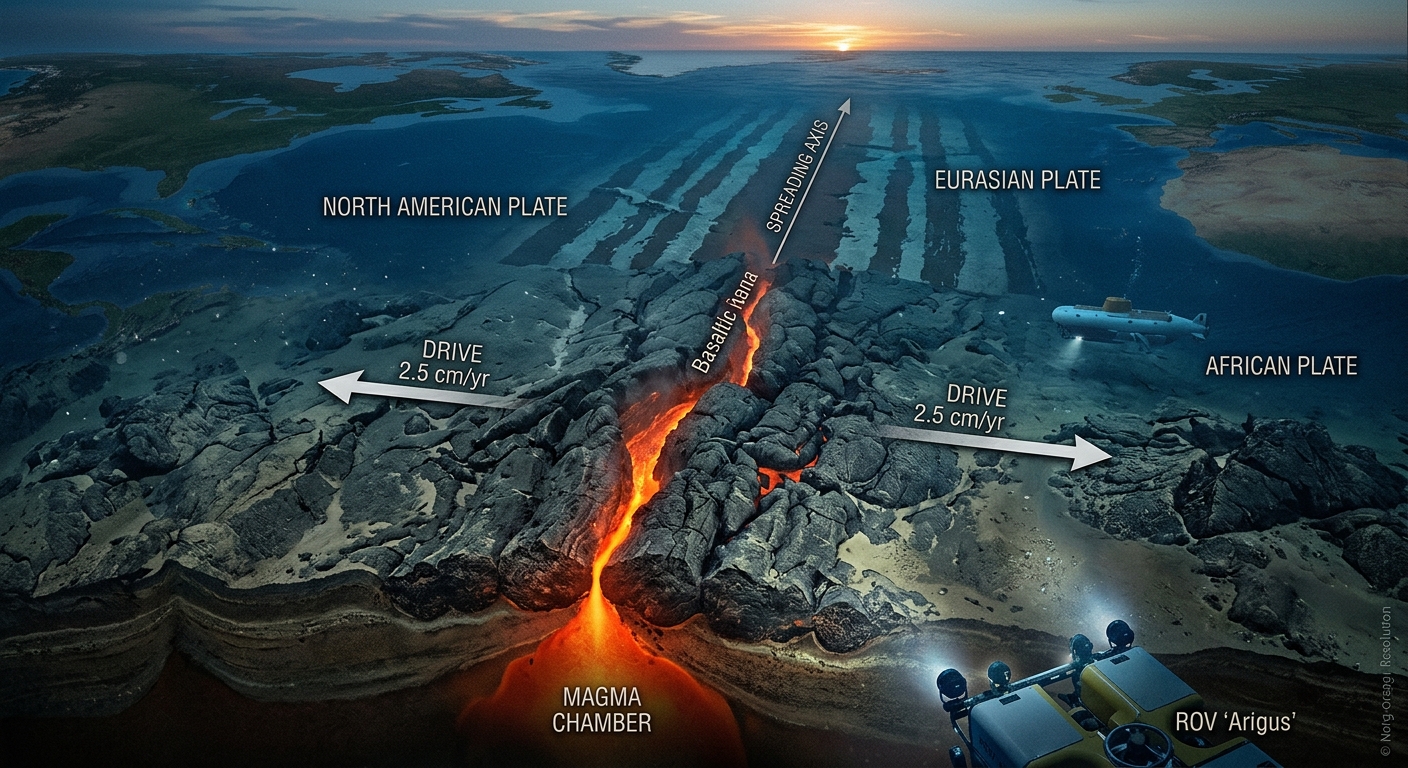
Deep beneath the churning waters of the Atlantic Ocean, an invisible force is literally pulling North America and Europe apart. Every single year, without fanfare or headlines, these massive continents drift further away from each other by 2.5 centimeters. That might not sound like much, but this seemingly tiny measurement represents one of the most powerful geological processes on our planet.
The Atlantic Ocean’s Secret Growth Spurt
While you’re reading this sentence, the Atlantic Ocean is getting wider. By the time you finish this article, it will have expanded by a microscopic amount. Over the course of a human lifetime, the ocean widens by roughly two meters. To put this in perspective, since the founding of the United States in 1776, the Atlantic has grown wider by about six meters, roughly the length of a school bus.
This phenomenon isn’t just a curious geological fact: it’s evidence of one of the most fundamental processes that shapes our planet. The Atlantic Ocean is essentially a giant crack in the Earth’s crust that continues to widen as new seafloor is born along the Mid-Atlantic Ridge.
The Mid-Atlantic Ridge: Earth’s Longest Mountain Range
Hidden beneath miles of ocean water lies the Mid-Atlantic Ridge, a massive underwater mountain range that stretches for over 10,000 miles from the Arctic Ocean to the southern tip of Africa. This ridge marks the boundary between tectonic plates and serves as the engine driving the Atlantic’s expansion.
At the ridge’s center, molten rock from deep within the Earth rises up through cracks in the seafloor. When this magma meets the cold ocean water, it solidifies instantly, creating new oceanic crust. As more magma pushes up from below, it forces the newly formed rock away from the ridge, literally pushing the continents apart.
A Conveyor Belt of Creation
Think of the Mid-Atlantic Ridge as a massive conveyor belt. Fresh seafloor is continuously manufactured at the ridge and then transported away in both directions. The western half moves toward North and South America, while the eastern half travels toward Europe and Africa. This process, called seafloor spreading, has been occurring for approximately 200 million years.
Why 2.5 Centimeters Matters More Than You Think
The rate of 2.5 centimeters per year might seem insignificant, but it’s actually quite fast in geological terms. To understand the true impact of this measurement, consider these mind-bending facts:
- In 10 million years, the Atlantic will be 250 kilometers (155 miles) wider
- The expansion rate is roughly the same speed at which your fingernails grow
- Since humans first evolved, the Atlantic has widened by approximately 15 kilometers (9 miles)
- By the time the sun begins to die in 5 billion years, the Atlantic could be 125,000 kilometers wider
The Ripple Effects of an Expanding Ocean
The Atlantic’s growth doesn’t occur in isolation. This expansion has profound effects on global climate patterns, ocean currents, and even the length of our days. As the ocean widens, it changes the circulation patterns of major currents like the Gulf Stream, which plays a crucial role in regulating temperatures across Europe and North America.
Impact on Satellite Communication
Modern technology must account for continental drift. GPS satellites require constant recalibration to maintain accuracy as the continents slowly shift positions. The European Space Agency and NASA regularly update their measurements to compensate for these tiny but significant movements.
The Birth and Death of Oceans
The Atlantic Ocean is relatively young compared to other geological features. It began forming about 200 million years ago when the supercontinent Pangaea started breaking apart. Before the Atlantic existed, you could have walked from New York to Morocco without getting your feet wet.
However, the Atlantic’s expansion won’t continue forever. Eventually, the forces driving seafloor spreading will weaken, and the ocean may begin to close. Some scientists predict that in the distant future, new subduction zones could form, causing the Atlantic to shrink and potentially bringing the continents back together.
Measuring the Unmeasurable
How do scientists measure such tiny annual changes across thousands of miles of ocean? The answer lies in sophisticated satellite technology and GPS systems. By placing precise receivers on both sides of the Atlantic and tracking their positions over time, researchers can detect movements as small as millimeters.
Iceland, which sits directly on the Mid-Atlantic Ridge, provides a unique natural laboratory for studying this process. The island is literally being pulled apart, with the western half moving toward North America and the eastern half toward Europe. Visitors to Thingvellir National Park can actually stand in the rift valley between the North American and Eurasian tectonic plates.
The Future of Continental Drift
The slow dance of the continents continues today just as it has for millions of years. While 2.5 centimeters per year seems impossibly slow, it represents the awesome power of geological forces that have shaped our planet’s surface and will continue to do so long after humanity is gone.
Understanding these processes helps scientists predict future changes in climate, ocean circulation, and even the formation of new mountain ranges. The next time you look at a map of the Atlantic Ocean, remember that it’s not a static feature but a dynamic, growing body of water that connects and simultaneously separates our continents.




Ha, love this perspective! Though I gotta say, if you really want to feel the planet’s dynamic power in real time, get your hands dirty and observe a handful of healthy soil – you’ve got entire ecosystems restructuring themselves on a daily basis as fungal networks expand, bacteria colonize new spaces, and nematodes migrate through the pores. The Mid-Atlantic Ridge works on a geological timescale, but the soil food web is doing equally mind-bending work right under our feet at a pace we can almost witness, which makes it the perfect teaching complement to plate tectonics imo.
Log in or register to replyWhat a wonderful reminder that we’re literally living on a dynamic, restless planet / the Mid-Atlantic Ridge is one of my favorite examples to show students because it makes plate tectonics feel *real* in a way that diagrams in textbooks never quite manage. Two and a half centimeters might sound negligible until you realize that same process is also why Iceland exists as this incredible natural laboratory where you can walk between continental plates. Have you come across any recent research on how seafloor spreading rates vary along different ridge segments, or is that getting too deep into the weeds for this post?
Log in or register to replyThis is such a cool way to frame deep time and planetary forces! Though I gotta say, it reminds me of what’s happening in real time in places like the Amazon and Congo Basin, where we’re literally dismantling these incredibly complex ecosystems faster than they can restructure themselves – it’s the opposite of that 2.5cm/year patience nature usually operates on, and honestly it keeps me up at night.
Log in or register to reply