
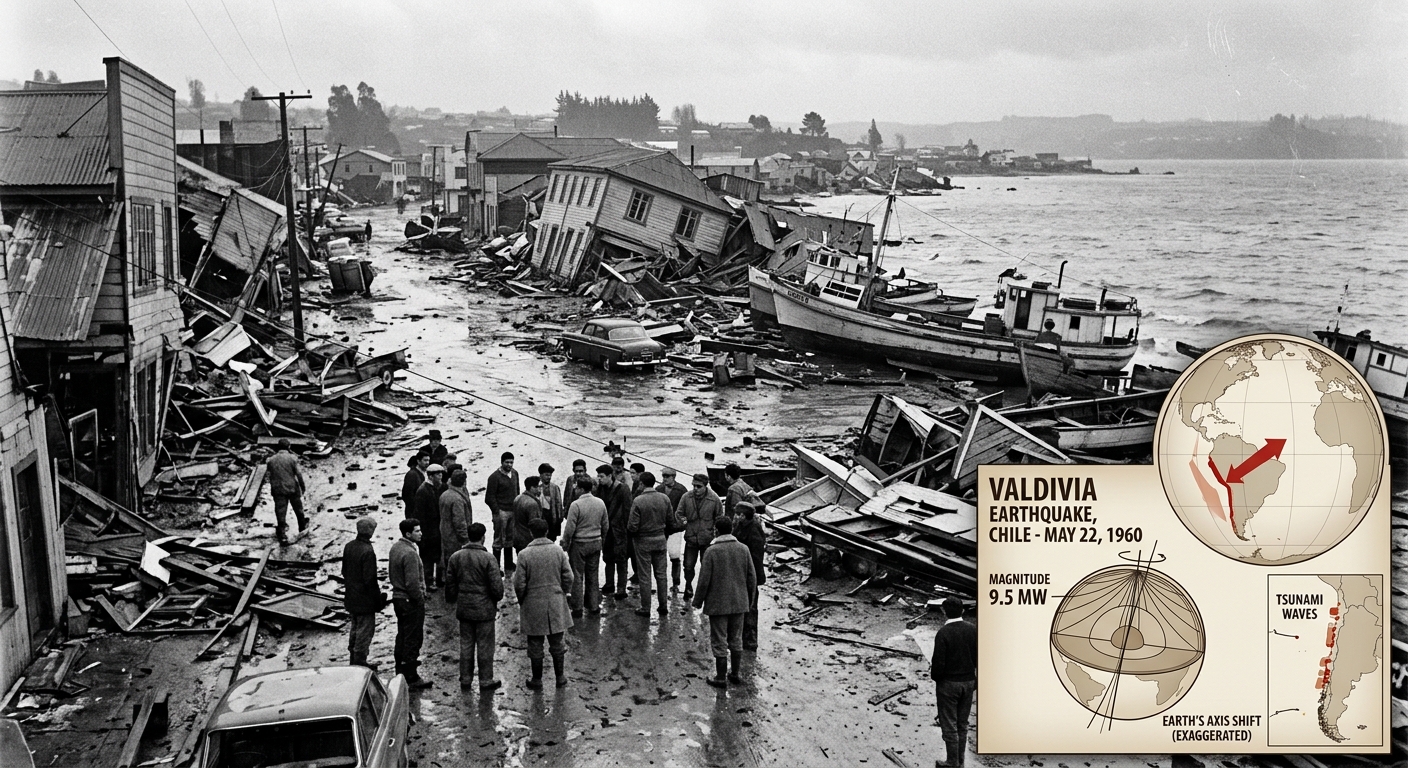
On March 11, 2011, something extraordinary happened beneath the Pacific Ocean off the coast of Japan. The Great East Japan Earthquake didn’t just devastate coastal communities and trigger a devastating tsunami. It accomplished something that seems almost impossible to comprehend: it actually shifted Earth’s axis and changed the length of our days forever.
This wasn’t just another earthquake. This was a force so massive that it moved our entire planet, demonstrating the incredible power that lies dormant beneath our feet and reminding us that Earth is far more dynamic than most people realize.
The Monster Beneath the Waves
The 2011 Tōhoku earthquake registered a staggering magnitude 9.1 on the Richter scale, making it one of the most powerful earthquakes ever recorded. To put this in perspective, the energy released was equivalent to approximately 600 million times the energy of the atomic bomb dropped on Hiroshima.
But raw power alone doesn’t tell the whole story. What made this earthquake particularly significant was its location and the way it moved the seafloor. The quake occurred along a megathrust fault, where the Pacific Plate slides beneath the North American Plate. When the fault ruptured, it displaced massive amounts of rock along a fault line stretching over 500 kilometers.
The Unprecedented Rupture
The earthquake caused the seafloor to move horizontally by up to 50 meters in some areas, while simultaneously lifting it by several meters vertically. This massive displacement of material in Earth’s crust was what ultimately led to the planet’s wobble. The redistribution of mass was so significant that it affected Earth’s moment of inertia, the measure of how mass is distributed relative to the axis of rotation.
How Do You Move a Planet?
The concept might seem impossible at first glance. How can an earthquake, no matter how powerful, actually shift the axis of an entire planet? The answer lies in the fundamental physics of rotation and mass distribution.
Earth’s rotation is governed by the same principles that apply to a spinning figure skater. When a skater pulls their arms closer to their body, they spin faster. When they extend their arms, they slow down. This happens because changing the distribution of mass affects the moment of inertia.
The Axis Shift Explained
According to calculations by NASA’s Jet Propulsion Laboratory, the Japanese earthquake shifted Earth’s axis by approximately 17 centimeters (6.7 inches). This shift occurred because the earthquake redistributed mass within the planet. The movement of rock and sediment during the quake effectively changed Earth’s balance point.
Dr. Richard Gross, a geophysicist at JPL, used complex computer models to calculate these changes. The models showed that the earthquake moved so much mass that it affected the planet’s rotation in measurable ways. The shift might seem small in cosmic terms, but for a planet, any measurable change is remarkable.
Shortening Our Days
Perhaps even more fascinating than the axis shift is the fact that the earthquake actually shortened the length of Earth’s days. The redistribution of mass caused the planet to spin slightly faster, shortening each day by 1.8 microseconds.
While 1.8 microseconds might seem insignificant, it represents a permanent change to Earth’s rotation. Every day since March 11, 2011, has been fractionally shorter than it would have been otherwise. Over the course of a year, this adds up to about 0.66 milliseconds of “lost” time.
The Physics Behind the Change
The mechanism behind this change is the same principle that governs a spinning ice skater. When the earthquake moved mass closer to Earth’s rotational axis, it reduced the planet’s moment of inertia. With less rotational inertia, Earth began spinning slightly faster, just like the ice skater pulling in their arms.
This effect was calculated by analyzing how the earthquake changed the distribution of mass in Earth’s crust and mantle. The movement of rock during the quake shifted billions of tons of material, creating a new mass distribution that favored faster rotation.
Earth’s Dynamic Nature
The 2011 earthquake wasn’t the first to affect Earth’s rotation, nor will it be the last. Large earthquakes have been subtly changing our planet’s rotation throughout geological history. However, it was one of the first times scientists had the sophisticated instruments necessary to measure these changes accurately.
Other major earthquakes have had similar effects:
- The 2004 Indian Ocean earthquake shortened days by 2.68 microseconds
- The 2010 Chilean earthquake shortened days by 1.26 microseconds
- The 1960 Chilean earthquake, the most powerful ever recorded, likely had an even greater effect
Measuring the Immeasurable
The ability to detect these minute changes represents a triumph of modern science. Using atomic clocks accurate to billionths of a second and satellite measurements precise to millimeters, scientists can now track Earth’s rotation with unprecedented accuracy.
These measurements come from a global network of observatories that monitor Earth’s orientation in space. The International Earth Rotation and Reference Systems Service coordinates these observations, tracking not just the length of days but also the precise position of Earth’s rotational axis.
The Bigger Picture
While the changes caused by the Japanese earthquake are permanent on human timescales, they’re just tiny fluctuations in Earth’s long-term evolution. Our planet’s rotation is constantly changing due to various factors including tidal forces from the Moon, atmospheric pressure changes, and the movement of water and ice.
The Moon’s gravitational pull, for example, is gradually slowing Earth’s rotation by about 1.7 milliseconds per century. Climate change is also affecting rotation as melting ice redistributes mass from polar regions to the oceans.
The 2011 earthquake serves as a powerful reminder that Earth is not the stable, unchanging rock we sometimes imagine it to be. Our planet is a dynamic system where massive forces constantly shape and reshape not just the surface we see, but the very motion of the world through space. Every earthquake, every landslide, every movement of mass contributes to the complex dance of our rotating world, making Earth a constantly evolving cosmic performer in the vast theater of space.






dude this is so cool, the interconnectedness thing really gets me thinking about how complex systems respond to massive disruptions. like, ant colonies do something similar where a single traumatic event, say losing a major forager pathway to a predator, can actually shift the whole colonies labor distribution and communication patterns in ways that ripple through the entire superorganism for weeks. its the same principle right, one major shock to the system and suddenly everythings recalibrating itself? makes you wonder if earths axis shift actually triggered cascading responses in other natural systems beyond just the ice cycles you mentioned
Log in or register to replyThis is fascinating stuff about planetary mechanics, though I gotta say it makes me think about how these massive geophysical disruptions might cascade through ecosystems in ways we’re still figuring out. Like, the 2011 quake altered salmon migration patterns in the Pacific for years afterward, which totally affected predator populations downstream – the Lamar Valley wolves in Yellowstone depend on that Pacific salmon input during certain seasons. It’s wild how you can draw a line from the Earth’s axis literally shifting to a wolf pack’s hunting success thousands of miles away, all through these interconnected systems.
Log in or register to replyThis is absolutely wild to think about, though I’m more used to worrying about how Earth’s wobble affects Arctic ice cycles than the other way around! It really puts into perspective just how interconnected everything is, right? Makes me think about how those massive seismic shifts can trigger cascading changes in ocean currents and atmospheric patterns, which then ripple up to affect polar regions that are already hanging by a thread with climate change. The Arctic doesn’t need any more disruptions, honestly.
Log in or register to reply