
Deep in the crystal-clear waters off the coast of Belize lies one of Earth’s most spectacular natural formations—and perhaps its most haunting historical archive. The Great Blue Hole, a massive underwater sinkhole stretching 300 meters across and plunging 125 meters into darkness, has been quietly collecting evidence of humanity’s greatest catastrophes for millennia.
What scientists discovered in its sediment layers reads like a timeline of civilization’s most dramatic collapses, from the fall of the Maya to the decline of ancient Rome. This underwater time machine doesn’t just showcase geological wonder—it reveals the terrifying pattern of how great societies crumble.
A Portal to the Past Hidden Beneath Paradise
The Great Blue Hole began forming during the last ice age, when sea levels were dramatically lower than today. What started as a limestone cave system eventually collapsed, creating the circular chasm we see now. As the oceans rose, this geological marvel became a perfect sediment trap, capturing particles, pollen, and chemical signatures from thousands of years of environmental history.
Unlike other bodies of water that experience regular mixing and disturbance, the Blue Hole’s unique structure creates an almost airless environment in its depths. Below 100 meters, there’s virtually no oxygen, creating perfect preservation conditions for whatever settles on its floor. Think of it as nature’s most exclusive filing cabinet—one that’s been meticulously organizing evidence for over 4,000 years.
The Sediment Tells Tales of Collapse
When researchers from Rice University and Louisiana State University drilled core samples from the Blue Hole’s bottom in 2012, they uncovered something extraordinary. The sediment layers contained clear markers of massive droughts that coincided perfectly with the collapse of major civilizations.
The Maya Collapse (800-900 CE)
The sediment cores revealed devastating drought conditions during the Terminal Classic period, when Maya civilization experienced its most dramatic collapse. Cities that had thrived for centuries were suddenly abandoned. The evidence shows that rainfall decreased by 40-50% during this period, with some areas experiencing drought conditions for decades.
The chemical composition of the sediment layers from this time period shows increased aluminum and titanium—minerals that become concentrated when lake and river levels drop dramatically. Pollen analysis reveals the disappearance of corn and other crops, replaced by drought-resistant plants as agricultural systems failed catastrophically.
The Roman Climate Crisis (200-400 CE)
Even more surprising was evidence of climate upheaval during the late Roman Empire period. The sediment shows signs of significant environmental stress that correlates with the empire’s decline and eventual fall. During this time, the Western Roman Empire struggled with invasions, economic collapse, and political instability—all potentially exacerbated by climate change recorded in Belizean sediment.
The Late Bronze Age Collapse (1200-1150 BCE)
Perhaps most dramatically, the cores revealed evidence of the mysterious Late Bronze Age Collapse, when civilizations across the Mediterranean and Near East suddenly crumbled. The Mycenaean Greeks, the Hittite Empire, and numerous other advanced societies all fell within a relatively short period—and the Blue Hole’s sediment shows corresponding environmental catastrophe.
How a Caribbean Sinkhole Records Global Climate
You might wonder how a hole in the Caribbean could record climate events affecting civilizations thousands of miles away. The answer lies in global atmospheric circulation patterns and the interconnected nature of Earth’s climate systems.
The Intertropical Convergence Zone (ITCZ), a belt of low pressure that circles the Earth near the equator, plays a crucial role. When this zone shifts due to global climate changes, it affects rainfall patterns across vast regions. The Blue Hole sits in a perfect position to record these shifts through changes in sediment deposition and chemical composition.
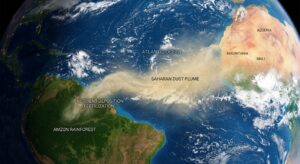
During major climate events, dust from Africa’s Sahara Desert travels across the Atlantic, carrying chemical signatures that eventually settle in the Blue Hole. Volcanic eruptions, solar variations, and other global phenomena all leave their fingerprints in the sediment layers, creating a remarkably detailed record of Earth’s climate history.
The Frightening Pattern of Civilizational Vulnerability
What makes these discoveries truly unsettling is the pattern they reveal. Time and again, sophisticated civilizations with impressive achievements in architecture, mathematics, agriculture, and governance have proven vulnerable to relatively short-term climate changes.
The Maya, for instance, had survived previous drought periods, but the Terminal Classic drought was different—longer, more severe, and coinciding with other social stresses. Similarly, the Roman Empire had weathered various challenges, but climate stress appears to have been a critical factor in its eventual inability to maintain control over its vast territories.
Modern Implications
Perhaps most concerning is what this record suggests about our own civilization’s vulnerability. The Blue Hole’s sediment layers show that significant climate changes can occur relatively quickly and persist for decades or even centuries. They also demonstrate that even the most advanced societies of their time proved fragile when faced with sustained environmental stress.
Ongoing Research and Future Discoveries
Scientists continue to analyze sediment cores from the Great Blue Hole, refining our understanding of past climate events and their relationship to human societies. New techniques allow researchers to extract increasingly detailed information from tiny samples, revealing everything from ancient precipitation patterns to the types of vegetation that grew in the region thousands of years ago.
Current research focuses on understanding the precise mechanisms that linked climate change to societal collapse, providing insights that could prove invaluable for modern civilization planning and resilience strategies.
The Great Blue Hole stands as more than just a stunning natural wonder—it’s a profound reminder of the delicate relationship between human civilization and Earth’s climate systems. In its dark depths lies a warning written in sediment and time, telling us that even the mightiest empires are ultimately subject to the whims of weather and the long cycles of our planet’s changing climate.
This is a really cool connection Wendy’s making, and it ties directly into chemical ecology in a way that doesn’t usually get discussed with these paleoclimate archives. The sediment layers are basically recording shifts in everything from trace metals to organic biomarkers that tell us what organisms were thriving or dying off during each collapse period, so we’re literally reading the chemistry of past ecosystem stress. What gets me is that we’re now changing ocean chemistry (pH, oxygen levels, trace element cycling) at rates that don’t leave time for the geological record to even form properly, so future researchers won’t have that same layered narrative to work from, assuming they’re even around to read it.
Log in or register to replyThis is absolutely fascinating, but I can’t help thinking about how the ocean itself is writing an entirely different kind of time capsule right now, and we’re the ones creating the disaster. The sediment layers you’re describing took millennia to form, yet the changes happening in our oceans (especially affecting whale populations and their migration patterns) are occurring in just decades. Humpback whales have survived ice ages and civilizational collapse, but their song frequencies are literally changing because of ocean acidification and noise pollution from shipping. It’s sobering to study how the ocean records our past while simultaneously recording our present failures in real time.
Log in or register to replyThis is a really compelling thread you two are building here. While I’m more in the spider lane than paleoclimate, the ecological interconnectedness Pete’s pointing to reminds me of how we track ecosystem collapse in other ways, too – like how spider populations and web architecture actually shift dramatically when environmental conditions destabilize. Those sediment layers are basically nature’s data logs, and yeah, the fact that we’re actively writing our own crisis layer right now is sobering stuff.
Log in or register to reply