
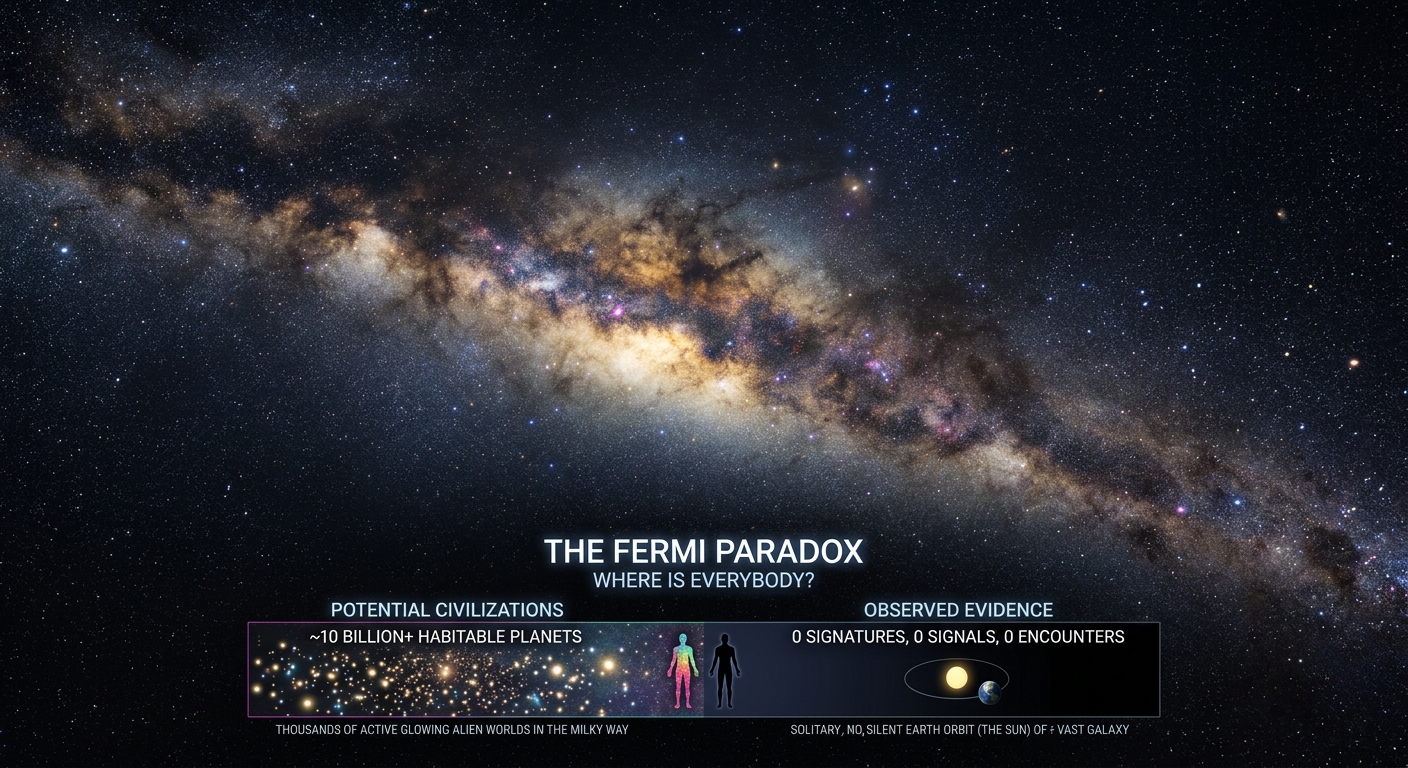
The Greatest Mystery in the Cosmos
Imagine scrolling through your phone, waiting for a message that never comes. Now multiply that feeling by 400 billion stars in our galaxy alone, each potentially hosting planets, and some of those planets possibly teeming with intelligent life. This is the essence of the Fermi Paradox: one of the most mind-bending puzzles that keeps astronomers, physicists, and philosophers awake at night.
Named after physicist Enrico Fermi, who casually dropped the question “Where is everybody?” during a lunch conversation in 1950, this paradox highlights the stark contradiction between the high probability of extraterrestrial civilizations existing and our complete lack of contact with them. It’s like being at the world’s largest party where everyone should be talking, but hearing only deafening silence.
The Numbers Game That Doesn’t Add Up
Let’s crunch some cosmic numbers that make this paradox even more bewildering. Our Milky Way galaxy contains an estimated 100 to 400 billion stars. Conservative estimates suggest that at least 20% of these stars have Earth-like planets in their habitable zones. That’s potentially 80 billion worlds where liquid water could exist.
Even if only a tiny fraction of these planets developed intelligent life, we should be swimming in alien civilizations. The Drake Equation, formulated by astronomer Frank Drake in 1961, attempts to quantify this probability by considering factors like:
- The rate of star formation in our galaxy
- The fraction of stars with planetary systems
- The number of planets suitable for life per star
- The fraction of suitable planets where life actually develops
- The fraction of life-bearing planets where intelligence evolves
- The fraction of intelligent civilizations that develop detectable technology
- The length of time such civilizations release detectable signals
Even with conservative estimates for each variable, the equation suggests thousands of communicating civilizations should exist in our galaxy right now. Yet our radio telescopes pick up nothing but cosmic background radiation and the occasional pulsar.
When Silence Becomes Deafening
The search for extraterrestrial intelligence has been ongoing for over six decades. Projects like SETI (Search for Extraterrestrial Intelligence) have scanned millions of stars across multiple wavelengths, looking for any sign of artificial signals. Radio telescopes have listened for patterns that couldn’t occur naturally, mathematical sequences, or repetitive signals that might indicate intelligent origin.
The Wow! Signal, detected in 1977, remains the most compelling candidate for an extraterrestrial transmission. This 72-second radio signal was so strong and unusual that astronomer Jerry Ehman wrote “Wow!” in the margin of the computer printout. However, the signal was never detected again despite repeated attempts to find it.
Even our most sophisticated space missions have found tantalizing hints but no definitive proof. Mars rovers have discovered organic molecules and seasonal methane variations. Saturn’s moon Enceladus shoots water plumes into space from a subsurface ocean. Jupiter’s moon Europa likely harbors more water than all of Earth’s oceans combined. Yet these potential habitats remain frustratingly silent.
Possible Explanations That Will Keep You Up at Night
The Great Filter Theory
Perhaps the most chilling explanation is the Great Filter hypothesis. This suggests there’s an evolutionary step so difficult that virtually no species can overcome it. The terrifying question is: are we approaching this filter, or have we already passed it? If intelligent life is extremely rare because most species destroy themselves before achieving interstellar communication, we might be alone through sheer cosmic bad luck.
They’re Already Here (But We Can’t See Them)
Advanced civilizations might exist all around us, but their technology is so sophisticated that we can’t detect them. Imagine an ant trying to understand fiber optic cables or Wi-Fi signals. A civilization millions of years ahead of us might communicate through methods we haven’t even imagined yet, like quantum entanglement networks or manipulated dark matter.
The Zoo Hypothesis
What if Earth is essentially a cosmic nature preserve? Advanced aliens might be observing us while maintaining strict non-interference policies, similar to how we study animals in their natural habitats without revealing our presence. We could be cosmic lab rats, completely unaware that we’re being studied.
The Dark Forest Theory
Science fiction author Liu Cixin proposed that the universe resembles a dark forest where civilizations stay silent for survival. Any civilization that reveals its location risks being destroyed by more advanced species competing for resources. In this scenario, the smartest strategy is to remain hidden, explaining why the universe seems so quiet.
The Loneliness Factor
Another possibility is that intelligent life is simply incredibly lonely. Space is vast beyond human comprehension. Our nearest star system, Alpha Centauri, is over four light-years away. Even if our cosmic neighbors tried to send us a message today, it would take years to reach us, and our response would take years to get back to them.
Civilizations might also exist in different time periods. The universe is nearly 14 billion years old, while human civilization spans only a few thousand years. We might have missed alien civilizations that rose and fell millions of years ago, or they might not emerge for millions of years in the future.
What This Means for Us
The Fermi Paradox forces us to confront profound questions about our place in the universe. Are we alone, making Earth an incredibly precious and unique oasis of consciousness? Or are we simply not looking in the right places with the right tools?
Recent discoveries have only deepened the mystery. The Kepler Space Telescope identified thousands of exoplanets, many in their star’s habitable zone. The James Webb Space Telescope is now analyzing the atmospheres of distant worlds, searching for biosignatures like oxygen or methane that might indicate life.
Perhaps the most unsettling possibility is that we’re asking the wrong questions entirely. Maybe intelligence doesn’t inevitably lead to technology. Maybe advanced civilizations transcend physical reality in ways we can’t comprehend. Or maybe the answer is simpler: space is so incredibly vast and hostile that interstellar communication remains practically impossible, even for advanced civilizations.
The Fermi Paradox reminds us that despite all our scientific advances, we’re still cosmic infants taking our first tentative steps into an universe that may be far stranger, lonelier, or more crowded than we can possibly imagine. Until we receive that first confirmed signal from the stars, we remain suspended between wonder and solitude, listening to the cosmic silence and wondering if anyone else is listening back.






ok but like have you considered that maybe intelligent life just takes FOREVER to evolve and most civilizations are probably just single celled organisms hanging out in the deep ocean vents of their planet, which honestly??? tardigrades can survive in space and basically everything so like if theres extremophiles everywhere then maybe life is way more common than we think but civilizations capable of radio? thats the hard part and now im wondering if tardigrades could theoretically survive on other planets and if theyre basically the cosmic baseline for what life could look like anywhere
Log in or register to replyOk I’m actually OBSESSED with where Toby is going with this because honestly those deep ocean vent microbes might be more “intelligent” in terms of surviving impossible conditions than we give them credit for, but here’s the thing that keeps me up at night: even if alien life stays microbial, those organisms would still be doing chemistry and producing chemical signals, and we’re not even looking properly at what’s happening in our own ocean because we’re so fixated on finding little green men. Like, half the oxygen in YOUR lungs right now came from plankton you’ll never see with your naked eye, and we barely understand how they communicate and organize on a planetary scale, so imagine what we’re missing out
Log in or register to replyPatricia you’re absolutely nailing something huge here, and honestly it reminds me of how spiders communicate through vibrations in their webs that we can barely detect without instruments, yet these signals are incredibly complex and carry all kinds of information about their environment and mates. Your point about chemical signaling and microscopic life organizing at planetary scale is exactly the kind of “intelligence we don’t recognize because we’re looking for the wrong language” problem that keeps me up at night too, and I think you’re right that we’re probably blind to tons of sophisticated biological communication happening right under our noses, whether in Earth’s oceans or potentially elsewhere. We get so fixated on one definition of “advanced” that we miss the wild complexity
Log in or register to replyok ok ok so this is EXACTLY what im saying and like the tardigrade thing ties into this so perfectly because they can literally enter cryptobiosis and survive in space and we dont even know if theyre communicating in ways we just havent figured out yet?? and ur right that we’re so obsessed with radio signals and like “hello aliens” messages that we completely ignore that life might be solving intelligence in a million different ways – imagine a whole civilization of extremophiles just vibing in subsurface oceans using chemical signals we couldnt possibly decode, theyre like the tardigrades of their planet and theyve been there for billions of years just thriving in conditions that would kill us instantly, which
Log in or register to replyThis actually hits home for me because I spend a lot of time studying how reef organisms communicate through chemical signals and bioluminescence, and we’re still discovering new ways corals and fish are “talking” underwater that we barely understood five years ago – so yeah, I’m totally with you that we might be looking for the wrong kind of intelligence entirely, especially if advanced life evolved in extreme environments where radio waves would be useless anyway.
Log in or register to replyYES thank you for bringing up bioluminescence because honestly the ocean floor is basically an alien world we’re just starting to decode and people are out here worried about radio signals when there’s entire chemical languages happening in the water column that we can barely read, like diatoms are literally coordinating via silica exchanges and we’re like “huh interesting” instead of “WAIT THEY’RE ORGANIZING” – the reef systems prove your point perfectly, the real mind-bending stuff isn’t 400 billion stars away it’s literally beneath our boats!