
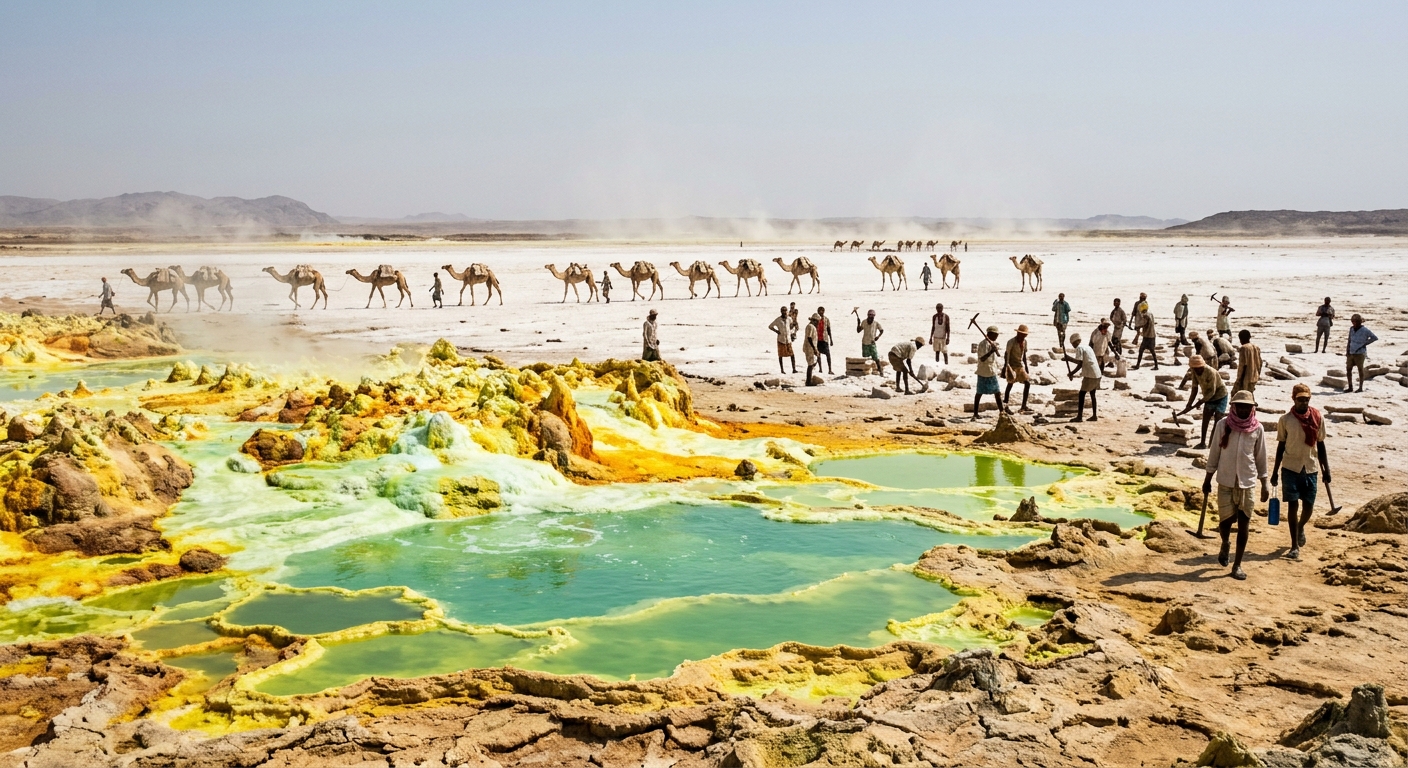
Imagine living in a place where the ground beneath your feet bubbles with sulfur springs, where temperatures regularly soar above 125°F (52°C), and where the air itself seems to shimmer with deadly heat. Welcome to the Danakil Depression in Ethiopia, officially recognized as the hottest inhabited place on Earth. This otherworldly landscape challenges everything we think we know about human survival and adaptation.
A Geological Furnace Like No Other
The Danakil Depression, also known as the Afar Depression, sits at a staggering 410 feet (125 meters) below sea level, making it one of the lowest points on our planet. But its elevation is just the beginning of what makes this place extraordinary. Located in the Horn of Africa, this depression lies at the junction of three tectonic plates that are actively pulling apart from each other.
This geological activity creates a natural furnace that produces some of the most extreme conditions found anywhere on Earth. The area experiences an average annual temperature of 95°F (35°C), but daily temperatures frequently climb to 125°F (52°C) or higher. During the hottest months, ground temperatures can exceed 160°F (70°C), hot enough to seriously burn exposed skin within seconds.
The Science Behind the Scorching Heat
Several factors combine to make the Danakil Depression a living hell of heat. First, its position below sea level creates a natural heat trap where hot air becomes trapped and concentrated. Second, the ongoing volcanic activity in the region continuously pumps geothermal energy into the environment.
The depression sits along the East African Rift, where the African continent is slowly splitting apart. This process creates numerous active volcanoes, hot springs, and geysers that contribute to the oppressive temperatures. The Erta Ale volcano, known as the “smoking mountain,” maintains one of only a few permanent lava lakes on Earth, adding to the region’s infernal atmosphere.
A Landscape That Defies Belief
The extreme heat is just one aspect of this alien landscape. The Danakil Depression features:
- Salt formations that create stunning white and yellow crystalline structures
- Sulfur springs that paint the ground in brilliant yellows and greens
- Acid hot springs with pH levels so low they can dissolve metal
- Vast salt flats that stretch to the horizon like frozen white seas
- Hydrothermal fields that release toxic gases into the air
The Incredible People Who Call Hell Home
Despite these seemingly impossible conditions, the Afar people have not only survived but thrived in the Danakil Depression for thousands of years. These remarkable individuals have developed extraordinary adaptations and survival strategies that allow them to live in what most would consider uninhabitable conditions.
The Afar people have evolved both cultural and physiological adaptations to their extreme environment. Their traditional clothing consists of loose, light-colored garments that reflect heat and allow for maximum airflow. They have also developed an intricate understanding of when and where to travel, often moving during the cooler nighttime hours and resting in whatever shade they can find during the scorching days.
The Salt Mining Tradition
One of the most remarkable aspects of life in the Danakil Depression is the ancient tradition of salt mining. For over 1,000 years, the Afar people have harvested salt from the depression’s vast salt flats. They cut rectangular blocks of salt by hand, load them onto camels, and transport them across hundreds of miles of desert to markets in highland Ethiopia.
This backbreaking work takes place in temperatures that would be considered dangerous by any modern safety standard. Workers often labor in conditions exceeding 120°F (49°C), with minimal water supplies and no protection from the sun except for traditional head coverings.
Physiological Marvels of Human Adaptation
Scientists studying the Afar people have discovered fascinating physiological adaptations that help them survive in extreme heat. These include:
- Enhanced sweating efficiency that allows for better heat regulation
- Increased blood plasma volume to maintain circulation in extreme heat
- More efficient kidney function to conserve water
- Genetic variations that may provide heat tolerance advantages
- Modified sleep patterns that align with temperature fluctuations
These adaptations represent thousands of years of evolutionary pressure, creating a population uniquely suited to survive in one of Earth’s most hostile environments.
A Window into Alien Worlds
The extreme conditions of the Danakil Depression have attracted the attention of astrobiologists and researchers studying the possibilities of life on other planets. The combination of extreme heat, high salinity, acidic conditions, and toxic gases creates an environment that closely resembles what scientists believe early Mars may have looked like.
Remarkably, even in these harsh conditions, life persists. Extremophile bacteria and archaea thrive in the hot springs and salt formations, providing valuable insights into how life might exist in similarly extreme environments elsewhere in the universe.
Climate Change and an Uncertain Future
As global temperatures continue to rise, the Danakil Depression serves as both a warning and a laboratory for understanding human adaptation to extreme heat. The traditional ways of life that have sustained the Afar people for millennia are increasingly under pressure from climate change, which is making even this already extreme environment more challenging.
The Danakil Depression stands as a testament to the incredible adaptability of human beings and the remarkable diversity of environments where life can persist. In a world facing unprecedented climate challenges, the lessons learned from the hottest inhabited place on Earth may prove more valuable than ever before.




This is a fascinating lens for thinking about phenological shifts – I wonder if there’s any research on how the Afar’s traditional timing systems (for migration, breeding livestock, water source access) have responded to the documented warming in that region over recent decades. The Danakil has always been extreme, but even small shifts in when the hottest periods occur or how long heat waves last could cascade through their ecological knowledge systems. Would love to know if anyone’s tracking changes in their pastoral calendars the way we track bird migration dates up north.
Log in or register to replyThat’s a really thoughtful connection, Claudia – the phenological angle here is something I hadn’t quite considered in that context, though I’ve definitely seen similar cascades in my own wetland work over the past couple decades. I’d be curious whether anyone’s actually documenting shifts in Afar pastoral timing systems the way we track amphibian breeding migrations, because those traditional calendars represent such deep ecological knowledge that changes could signal real shifts in regional hydrology and vegetation. The scary part is those systems evolved over millennia to work within a specific envelope of variability, so even if the Afar are incredibly adaptable, pushing beyond their historical range of conditions could create mismatches we don’t fully anticipate yet
Log in or register to replyGreat question about phenological shifts, Claudia – it really does mirror what we’re learning about cave ecosystems responding to temperature changes. I’ve noticed in my local cave systems that even slight warming affects the timing of when certain organisms emerge or breed, and the Afar people’s relationship with their environment probably has that same intricate web of dependencies. The difference is they can adapt their practices across generations, whereas the blind fish and cave crickets I study are locked into these incredibly specific niches that don’t have much give, so I’d be curious if any researchers have looked at whether traditional Afar knowledge systems are actually tracking changes we’d otherwise miss with just our modern scientific instruments.
Log in or register to reply