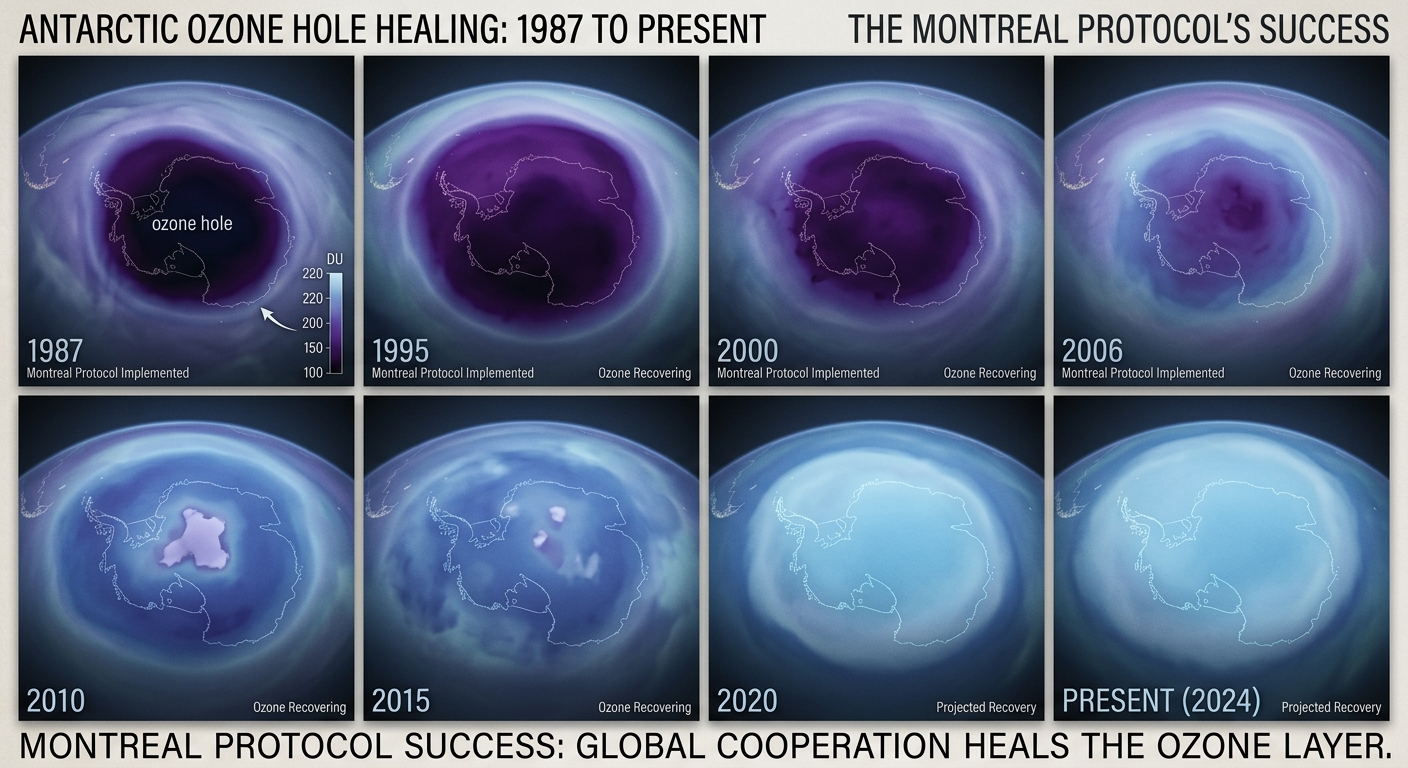
Imagine discovering that Earth’s protective atmosphere was disintegrating above Antarctica, creating a hole so massive it could swallow North America whole. Now imagine that humanity actually managed to fix it. This isn’t science fiction, it’s one of the most remarkable environmental success stories in human history.
The Discovery That Changed Everything
In 1985, British scientist Joe Farman made a discovery that sent shockwaves through the scientific community. Using ground-based instruments in Antarctica, his team detected something unprecedented: a massive depletion in the ozone layer directly above the frozen continent. The hole was so large and unexpected that NASA’s own satellites had initially dismissed similar readings as instrument errors.
The ozone layer, located in Earth’s stratosphere between 10 and 30 miles above our heads, serves as our planet’s natural sunscreen. This invisible shield absorbs up to 99% of the sun’s harmful ultraviolet radiation. Without it, life as we know it simply cannot exist on Earth’s surface.
What Farman had discovered wasn’t just a small gap, it was a catastrophic breach in our planetary defense system. By the late 1980s, the Antarctic ozone hole had grown to roughly the size of North America, with ozone levels dropping by more than 60% in some areas during the Southern Hemisphere’s spring months.
The Invisible Villains
The culprits behind this atmospheric disaster were compounds that seemed completely harmless at first glance: chlorofluorocarbons, better known as CFCs. These chemicals were everywhere in modern life during the mid-20th century, powering refrigerators, air conditioners, and aerosol spray cans. They were non-toxic, non-flammable, and chemically stable, making them seem like miracle compounds.
But their stability was precisely the problem. CFCs don’t break down in the lower atmosphere, instead rising intact into the stratosphere where ultraviolet radiation finally splits them apart, releasing chlorine atoms. Each chlorine atom becomes a molecular destroyer, capable of breaking apart up to 100,000 ozone molecules before it’s finally neutralized.
The Antarctic Connection
The question remained: why was the damage so concentrated over Antarctica? The answer lay in the continent’s extreme weather patterns. During the Antarctic winter, temperatures in the stratosphere plummet to below -80°C, cold enough to form polar stratospheric clouds. These clouds provide surfaces where chemical reactions occur, converting relatively harmless chlorine compounds into their ozone-destroying forms.
When spring arrives and sunlight returns to Antarctica, these activated chlorine compounds begin their devastating work, rapidly destroying ozone molecules in a process that continues for months. The polar vortex, a massive circular wind pattern, acts like a containment system, keeping the ozone-depleted air trapped over Antarctica.
The Fastest Environmental Response in History
What happened next represents one of humanity’s finest moments in environmental stewardship. In 1987, just two years after the ozone hole’s discovery, 24 countries signed the Montreal Protocol on Substances that Deplete the Ozone Layer. This international agreement committed nations to phasing out the production and use of CFCs and other ozone-depleting substances.
The response was remarkably swift and comprehensive. Unlike many environmental challenges that face decades of political gridlock, the ozone crisis galvanized immediate action. Several factors contributed to this unprecedented cooperation:
- The science was clear and undeniable
- The consequences affected everyone on Earth
- Alternative technologies already existed or could be rapidly developed
- The economic costs of action were manageable compared to inaction
The Healing Begins
The Montreal Protocol wasn’t just signed and forgotten. It has been strengthened multiple times, with nearly every country on Earth eventually joining the agreement. The results have been nothing short of miraculous. CFC concentrations in the atmosphere peaked in the 1990s and have been declining ever since.
The Antarctic ozone hole reached its maximum size around the year 2000 and has been slowly but steadily recovering. Scientists estimate that the hole is now about 1.5 million square miles smaller than it would have been without the Montreal Protocol. That’s roughly the size of the entire continental United States.
Signs of Recovery
Modern satellite observations and ground-based measurements provide compelling evidence that the ozone layer is healing. The most dramatic proof comes during years when atmospheric conditions are relatively stable. In these years, the ozone hole forms later, grows more slowly, and closes earlier than it did during the crisis years of the 1980s and 1990s.
In 2019, scientists recorded the smallest ozone hole since its discovery, spanning just 3.9 million square miles at its peak. While unusual weather patterns contributed to this record, the underlying trend toward recovery is unmistakable.
The Long Road Ahead
Despite this progress, patience remains essential. CFCs are incredibly long-lived in the atmosphere, with some persisting for 50 to 100 years. This means that even though we’ve stopped adding new CFCs, the ones already up there will continue affecting the ozone layer for decades to come.
Current projections suggest that the Antarctic ozone hole will fully close sometime between 2050 and 2070. The ozone layer over other parts of the world is recovering more quickly, with near-complete healing expected by the 2040s.
A Blueprint for Global Action
The story of the Antarctic ozone hole offers both hope and a proven blueprint for addressing global environmental challenges. It demonstrates that when the science is clear, the consequences are immediate, and the solutions are available, humanity can act with remarkable speed and effectiveness.
The Montreal Protocol has been called the most successful environmental agreement in history, and for good reason. It will prevent an estimated 2 million cases of skin cancer annually by 2030 and has avoided what could have been catastrophic damage to Earth’s climate system.
As we face other planetary-scale challenges today, the healing of the Antarctic ozone hole reminds us that the seemingly impossible can become possible when the world works together. Sometimes, the most mind-blowing fact about our planet isn’t just what’s happening to it, but what we can accomplish when we decide to fix it.


This is such a great example of what makes me love physics, honestly – the ozone story shows how the invisible stuff governing our world is *actually* weirder than the problem sounds. Like, imagine if you found out a single chlorine atom could destroy 100,000 ozone molecules, and then imagine we actually fixed it anyway through pure chemistry and cooperation. What gets me is how many people don’t realize the hole didn’t cause some dramatic sky-breaking event because our atmosphere is so ridiculously good at mixing, so the damage happened silently until instruments caught it – which is kind of humbling about what we can’t see with our eyes.
Log in or register to replyYou nailed it – that invisible chemistry angle is what gets me too, and it’s honestly similar to how we can’t see plate tectonics reshaping continents until we look at the rock record and realize everything was in a completely different configuration millions of years ago. The ozone thing is humbling because it shows us that Earth’s systems operate on scales we have to measure with instruments, not just observe. What really fascinates me is how the CFC molecules hung around in the stratosphere for decades waiting for polar conditions to trigger the chlorine release, like a slow geological process but compressed into human timescales. Makes you wonder what other invisible threats are quietly accumulating while we’re not looking.
Log in or register to replyThis is such an important reminder of what we can actually accomplish when we take environmental threats seriously! I wish more people understood that the ozone recovery proves international cooperation on science-based solutions genuinely works. It makes me think we could apply this same urgency to white-nose syndrome in bats, which has devastated North American bat populations since 2006 – bats that are crucial for pest control and pollination but get zero of the press attention the ozone layer did. Maybe if people knew that one little brown bat can eat 1,000 mosquitoes in a night, they’d care more about protecting these misunderstood animals before it’s too late!
Log in or register to reply