
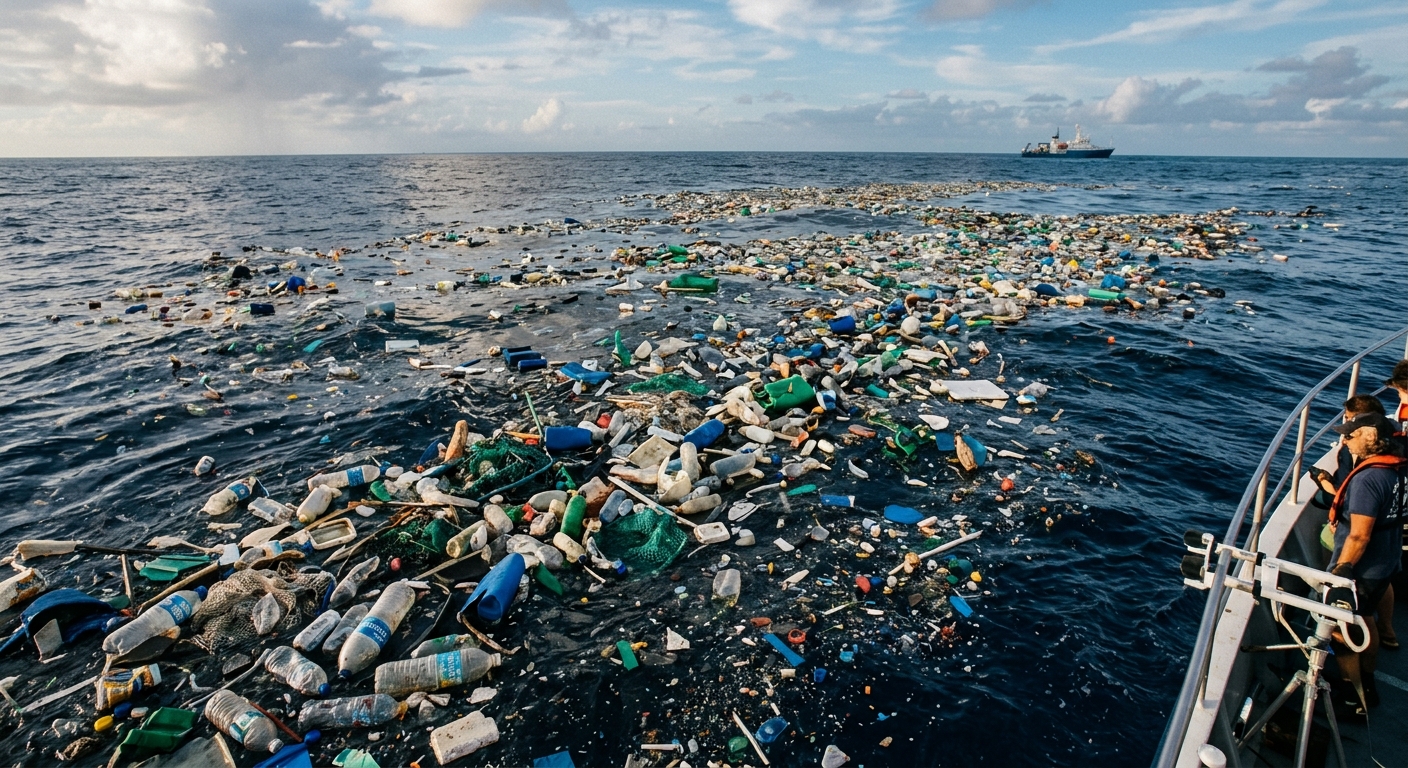
Somewhere in the middle of the Pacific Ocean, between California and Hawaii, floats one of humanity’s most disturbing creations: a swirling mass of plastic debris so massive it defies comprehension. The Great Pacific Garbage Patch isn’t just big, it’s monumentally, mind-bogglingly enormous. To put its size into perspective, this floating wasteland covers an area three times larger than France, making it roughly twice the size of Texas.
The Numbers That Will Make Your Head Spin
When scientists first began studying the Great Pacific Garbage Patch in detail, the results were staggering. This aquatic nightmare spans approximately 1.6 million square kilometers (617,000 square miles) and contains at least 80,000 metric tons of floating plastic waste. To visualize this colossal accumulation, imagine 500 jumbo jets worth of plastic debris swirling endlessly in our ocean.
But here’s where it gets even more mind-bending: despite its massive size, the garbage patch isn’t a solid island you could walk on. Instead, it’s a diffuse collection of debris, with concentrations varying dramatically across the area. In some spots, you might find 5 kilograms of plastic per square kilometer, while in the densest areas, that number jumps to an astounding 100 kilograms per square kilometer.
The Invisible Ocean Highways That Created This Monster
The Great Pacific Garbage Patch didn’t form by accident. It exists because of a fascinating and terrifying confluence of ocean currents known as the North Pacific Subtropical Gyre. This massive circular current system acts like a slow-motion whirlpool, trapping floating debris in its center.
Think of it as nature’s most unfortunate conveyor belt. Plastic waste from across the Pacific, including debris from North America, Asia, and countless ships, gets caught in these currents and slowly spirals inward. Once trapped, the plastic can circulate for years or even decades, breaking down into smaller and smaller pieces but never fully disappearing.
The Four Gyres: A Global Problem
The Pacific garbage patch isn’t alone. Scientists have identified similar accumulations in four other major ocean gyres:
- North Atlantic Subtropical Gyre
- South Atlantic Subtropical Gyre
- South Pacific Subtropical Gyre
- Indian Ocean Subtropical Gyre
However, the Great Pacific Garbage Patch remains the largest and most studied, earning its reputation as the poster child for our global plastic pollution crisis.
What Exactly Is Floating Out There?
If you could take a submarine tour through the garbage patch, you’d encounter a bizarre underwater landscape of human-made debris. The largest items include abandoned fishing nets (called “ghost nets”), plastic bottles, food containers, and miscellaneous plastic fragments. These ghost nets alone account for nearly half of the patch’s total mass.
But the most insidious components are the microplastics: tiny fragments smaller than 5 millimeters that result from larger plastic items breaking down under the relentless assault of sun, salt, and waves. These microscopic pieces vastly outnumber larger debris, creating a plastic soup that permeates the water column.
The Plastic Time Capsule
Perhaps most unsettling is what this garbage patch tells us about human consumption patterns. Researchers have found plastic items dating back decades, creating an unwanted archaeological record of our throwaway culture. Items manufactured in the 1970s still float alongside debris from recent tsunamis, all slowly photodegrading but never truly biodegrading.
The Ecological Nightmare Unfolding
The environmental impact of this floating continent extends far beyond its shocking size. Marine life throughout the Pacific encounters this plastic wasteland with devastating consequences. Sea turtles mistake plastic bags for jellyfish, seabirds fill their stomachs with bottle caps and plastic fragments, and marine mammals become entangled in ghost nets.
The microplastic problem creates an even more pervasive threat. These tiny particles enter the food chain at the most basic level, consumed by plankton and small fish, then biomagnifying as they move up the food web. Eventually, these plastics end up on our dinner plates, completing a toxic circle from human consumption back to human consumption.
The Race Against Time: Cleanup Efforts
Despite the overwhelming scale of the problem, innovative minds are fighting back. Organizations like The Ocean Cleanup have developed ambitious technologies to tackle the garbage patch head-on. Their approach involves massive floating barriers that use ocean currents to concentrate plastic debris, making collection more efficient.
However, cleanup efforts face enormous challenges. The sheer size of the area, the dispersed nature of much of the debris, and the need to avoid harming marine life make this one of the most complex environmental remediation projects ever attempted.
Prevention: The Ultimate Solution
While cleanup efforts continue, scientists and environmentalists emphasize that prevention remains our best hope. This means:
- Dramatically reducing single-use plastic consumption
- Improving waste management systems globally
- Developing biodegradable alternatives to conventional plastics
- Implementing stricter regulations on plastic waste disposal
- Educating communities about proper waste management
A Wake-Up Call Floating in the Pacific
The Great Pacific Garbage Patch stands as a sobering monument to human impact on our planet. Its existence, three times the size of France and growing, forces us to confront uncomfortable truths about our consumption habits and waste management practices.
Yet within this environmental catastrophe lies an opportunity. The garbage patch has become a powerful catalyst for change, inspiring innovations in recycling, alternatives to plastic, and global cooperation on environmental issues. It reminds us that our oceans, despite their vastness, are not infinite dumping grounds.
As we continue to study and attempt to remediate this floating wasteland, one thing becomes clear: the Great Pacific Garbage Patch isn’t just an environmental problem, it’s a mirror reflecting our relationship with the planet we call home.

The scale of this is genuinely haunting to me, especially thinking about what we’re doing to the chemistry and biology of our oceans when we know so little about what’s actually thriving down there. I keep coming back to the Perseverance rover looking for signs of ancient microbial life on Mars while we’re actively poisoning the one place we know for certain harbors incredible biodiversity. We don’t even need a telescope to see what matters most, and yet here we are.
Log in or register to replyI hear you on the haunting scale of it, Sophie. What really keeps me up at night is that we’re seeing similar plastic accumulation in freshwater systems now, and rivers are basically the conveyor belts feeding all that ocean trash downstream. I’ve been monitoring a tributary of the Columbia that used to be crystal clear for macroinvertebrates, and now I’m finding microplastics in the tissues of juvenile steelhead. If we don’t address what’s happening in our rivers and stop treating them like waste disposal systems, the ocean patches are only going to grow.
Log in or register to replyYeah, the freshwater connection Rachel mentions is something I think about a lot too – though I’d add that we’re also still pretty uncertain about how microplastics move through sediment and interact with microbial communities in ways that might shift nutrient cycling in unexpected ways. Sophie’s right that ocean chemistry is getting altered in real time, and honestly it feels like we’re conducting an experiment we don’t have permission to run.
Log in or register to reply