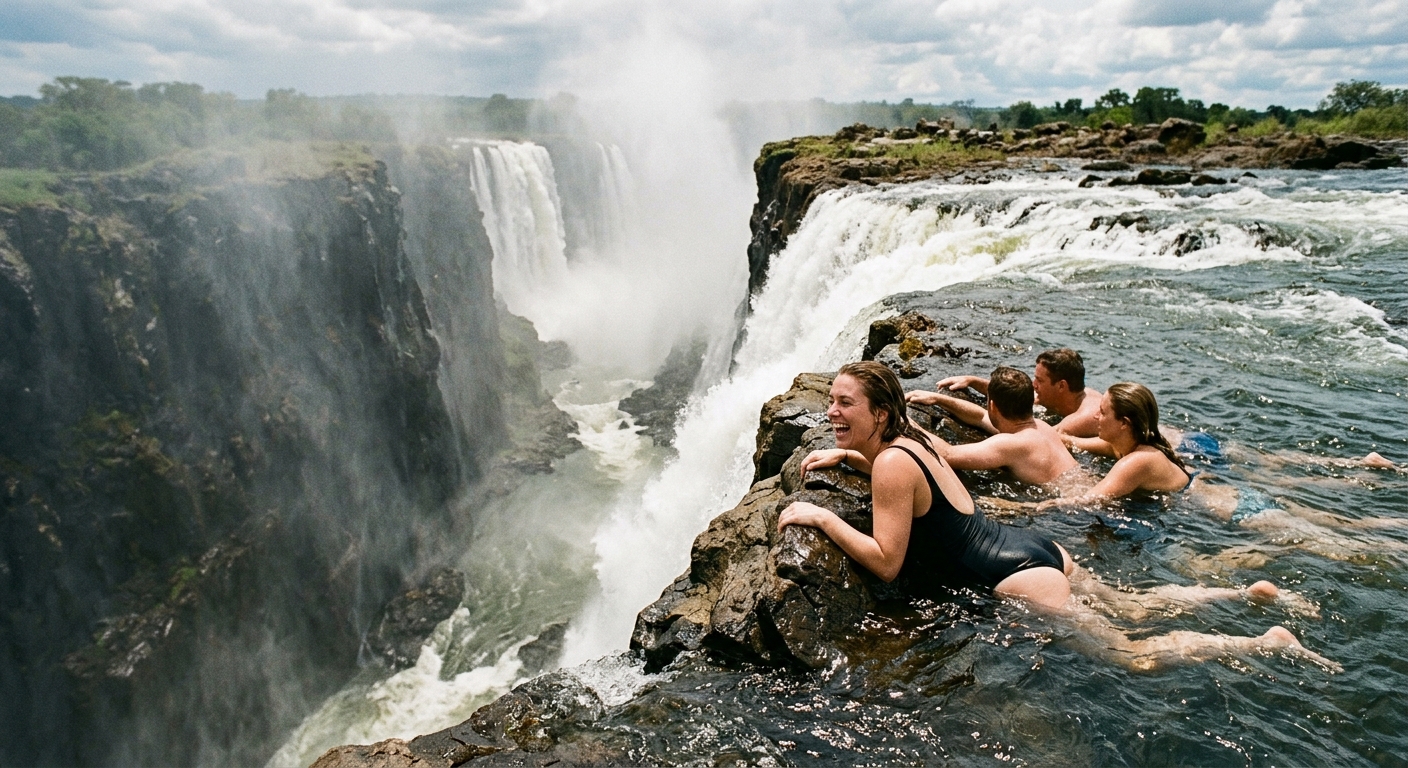
Imagine standing at the very edge of one of the world’s most powerful waterfalls, feeling the thunderous roar of 38,000 cubic feet of water per second plummeting into the abyss below. Now imagine taking a leisurely swim in that exact spot. Welcome to Devil Pool, a natural rock formation that transforms the terrifying edge of Victoria Falls into nature’s most extreme swimming hole.
The Ultimate Edge of the World Experience
Located on the Zambian side of Victoria Falls, Devil Pool is a geological marvel that defies every instinct of self-preservation. During the dry season, when water levels drop significantly, this natural rock barrier creates a swimming pool literally at the precipice of one of the world’s Seven Natural Wonders. The pool sits just meters away from a 355-foot drop into the Batoka Gorge below.
What makes this experience possible is a quirk of geology and seasonal water flow. The rock lip that forms Devil Pool acts as a natural dam, creating a relatively calm pocket of water while the main torrent of Victoria Falls thunders past just inches away. The optical illusion is complete: swimmers appear to be floating in mid-air above the massive gorge.
A Dance with Geological Forces
The formation of Devil Pool is a testament to the incredible power of water over time. Victoria Falls sits on the Zambezi River, where millions of years of erosion have carved through layers of basalt rock. The falls themselves have been slowly retreating upstream as the river continues its relentless carving process, creating the dramatic gorge system visible today.
During the rainy season from February to July, Devil Pool becomes completely inaccessible and invisible, submerged under the massive flow of the swollen Zambezi River. The falls during this period become a thundering wall of water that would make swimming not just impossible, but instantly fatal. It’s only during the dry season, particularly from mid-August to mid-January, that water levels drop enough to reveal this natural phenomenon.
The Science Behind the Safety
While swimming at Devil Pool looks absolutely terrifying, the experience is surprisingly safe when conditions are right and proper precautions are taken. The key lies in understanding the water dynamics at play:
- Rock Barrier Protection: The natural rock lip creates a physical barrier that prevents swimmers from being swept over the edge
- Current Patterns: During low water periods, the current in Devil Pool flows away from the main falls, creating a natural safety zone
- Water Depth: The pool maintains sufficient depth to allow swimming while keeping swimmers well below the level where currents become dangerous
- Professional Guidance: All Devil Pool experiences are conducted with trained local guides who understand the ever-changing conditions
The Journey to the Edge
Reaching Devil Pool is an adventure in itself. The journey begins on Livingstone Island, a small rocky outcrop in the middle of the Zambezi River upstream from the falls. Visitors must first take a boat ride across the river, navigating carefully to avoid the increasingly strong currents as they approach the falls.
From Livingstone Island, the path to Devil Pool involves a careful walk across wet, slippery rocks with the roar of the falls growing ever louder. Local guides, who have intimate knowledge of every rock and current pattern, lead small groups along routes that have been used safely for decades. The approach requires good physical fitness and a head for heights, as parts of the journey involve scrambling over rocks with the gorge yawning below.
Seasonal Timing is Everything
The window for Devil Pool swimming is surprisingly narrow and entirely dependent on natural conditions. Water levels must be low enough to reveal the rock formations but high enough to create the pool itself. This delicate balance typically occurs for only a few months each year, making the experience both rare and highly sought after.
During peak dry season, usually September through December, conditions are most reliable. However, even within this window, daily conditions can vary based on recent rainfall upstream, making each Devil Pool expedition unique. Some days the pool is crystal clear and inviting, while others may see it temporarily inaccessible due to slight changes in water flow.
More Than Just an Adrenaline Rush
Beyond the obvious thrill factor, Devil Pool offers visitors a unique perspective on one of Earth’s most impressive natural phenomena. From the pool, swimmers gain an unparalleled view of the main falls, the rainbow mists that give Victoria Falls its local name ‘Mosi-oa-Tunya’ (The Smoke That Thunders), and the vast African landscape stretching to the horizon.
The experience also provides insight into the incredible forces that shape our planet. Feeling the vibrations of thousands of tons of water hitting the rocks below, witnessing the constant mist that supports unique ecosystems, and literally sitting on the edge of an active geological process offers a profound connection to Earth’s dynamic systems.
Conservation and Cultural Significance
Devil Pool exists within a delicate ecosystem that requires careful management and respect. The Victoria Falls area supports unique plant and animal communities adapted to the constant mist and seasonal flooding. Local communities have lived alongside these falls for generations, developing deep cultural and spiritual connections to the site.
Tourism to Devil Pool, when managed responsibly, provides crucial income for local communities while funding conservation efforts. However, the increasing popularity of this extreme swimming experience has raised concerns about environmental impact and safety standards. Sustainable tourism practices ensure that future generations can continue to experience this natural wonder.
Devil Pool represents the perfect intersection of geology, hydrology, and human adventure. It’s a reminder that our planet continues to offer experiences that challenge our perceptions and push the boundaries of what seems possible. For those brave enough to take the plunge, it offers not just an unforgettable swim, but a profound encounter with the raw power and beauty of the natural world.

I’ve been tracking water levels and seasonal shifts in my region for over a decade, and what strikes me about Devil Pool is how much it depends on those dry season conditions staying predictable, which they’re doing less and less with climate shifts. Connie’s right about the fragility of natural barriers too, they’re dynamic systems not fixed walls, so I’d be curious how often that rock formation actually changes year to year and whether swimmers realize they’re visiting a temporary window that might not stay open the same way it always has.
Log in or register to replyhonestly this is so cool but also makes me nervous thinking about what’s in that water – i’ve done some gnarly dives in places with crazy currents and one thing i learned is that nature’s barriers are way more fragile than they look. that rock barrier probably gets compromised every season. still, if i ever get the chance i’d want to experience it, just with a healthy respect for what could go wrong. have you been there or just researched it?
Log in or register to replyThe fragility angle is so real, and honestly it reminds me of how mycologists think about resilience in ecosystems – those rock barriers are like the fruiting bodies of a much larger system of geological forces that can shift unpredictably. I haven’t been to Devil Pool itself, but I’ve noticed that a lot of extreme natural sites seem to assume stability that climate instability is genuinely undermining, kind of like how certain mushroom species are shifting their fruiting times and ranges as conditions change. Sandra’s point about dry seasons becoming less predictable hits different when you’re actually standing at the edge of something that depends on that precision. Your instinct about healthy respect is spot on, that’s the same caution I
Log in or register to replyyeah this ecosystem resilience framing really resonates with me, and you’re hitting on something i think about a lot with iNaturalist observations too – like when people are tracking species shifts and seasonal timing changes, it becomes super obvious how dependent a lot of these “stable” natural features are on conditions that arent actually that stable anymore. the mushroom analogy is perfect because those fruiting bodies are telling us something about the whole system, and devil pool’s rock barrier is kind of doing the same thing if were paying attention. i’d be really curious to see if anyone’s documenting water level changes there through repeated observations or photos over time – that kind of citizen science data could actually tell us something important about whether these conditions are
Log in or register to replyyeah this is exactly what keeps me up at night when i’m planning dives in places that used to be reliable – i’ve watched dive sites shift dramatically in just a few years, and you’re totally right that those “stable” features are basically canaries in the coal mine. the iNaturalist angle is perfect because citizen scientists are often the ones catching these changes before official monitoring catches up, and honestly we need more people doing exactly that at places like Devil Pool. someone documenting those water levels and barrier conditions year after year could actually help us understand how fast these systems are changing, which might be the only way to convince people that this isn’t just about an extreme thrill anymore, it’s about what we’re losing.
Log in or register to replyOkay but here’s what really gets me, you’re talking about monitoring physical changes while barely anyone’s even LOOKING at what’s actually living in those waters – like, the diatoms and dinoflagellates in that pool are basically the canaries’ canaries, they shift their populations weeks before you’d see obvious barrier erosion, and half those microorganisms are producing oxygen we literally breathe. If citizen scientists documented the plankton communities at Devil Pool year over year the way they do birds or butterflies, we’d have an early warning system for ecosystem collapse that’s WAY more sensitive than just watching water levels, so honestly I’m here for this monitoring idea but let’s not sleep on the microscopic stuff