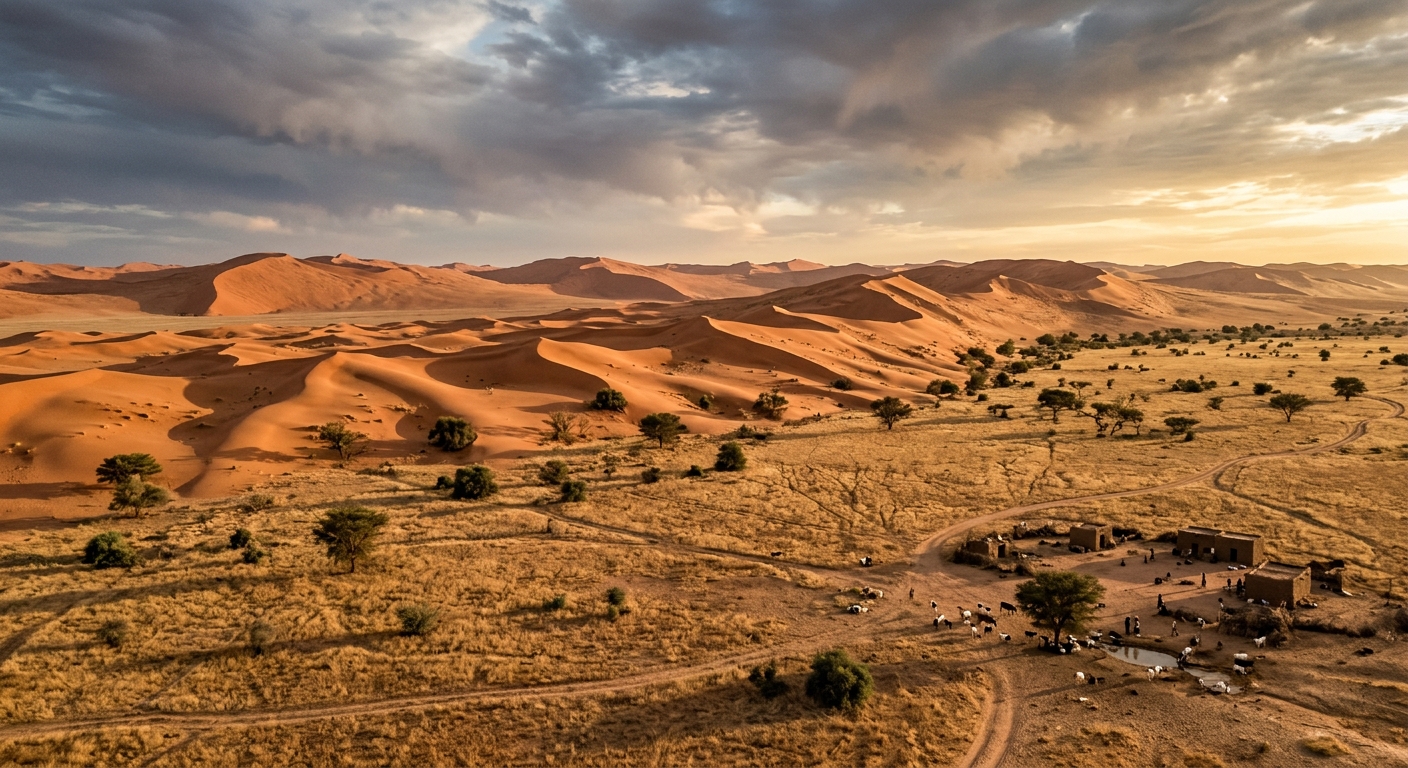
Imagine a wall of sand advancing relentlessly southward, consuming everything in its path at a rate of 48 kilometers per year. This isn’t science fiction or a natural disaster movie plot – it’s the terrifying reality of the Sahara Desert’s southward expansion, a process called desertification that is literally reshaping the African continent before our eyes.
The Unstoppable March of Sand
The Sahara Desert, already the world’s largest hot desert at 9 million square kilometers, isn’t content with its massive size. Every year, this colossal expanse of sand and rock pushes 48 kilometers further south into the Sahel region, converting fertile land into barren wasteland. To put this in perspective, that’s roughly the distance between Manhattan and the Bronx being swallowed by desert annually.
This relentless advance means the Sahara has grown by approximately 10% since 1920, adding an area roughly the size of South Dakota to its already enormous footprint. The desert’s southern boundary, which once seemed fixed, is now a moving frontier of environmental destruction that threatens entire nations.
What Drives This Desert Monster?
The Sahara’s expansion isn’t a simple case of sand dunes rolling southward like tumbleweeds. It’s a complex environmental process driven by multiple interconnected factors that create a perfect storm of desertification.
Climate Change: The Primary Culprit
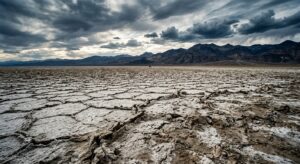
Rising global temperatures have fundamentally altered rainfall patterns across Africa. The Sahel region, which serves as a buffer zone between the Sahara and the more fertile lands to the south, receives less rainfall each year. As precipitation decreases, vegetation dies, soil becomes loose and vulnerable, and the desert conditions creep southward.
Human Activity: Accelerating the Inevitable
While climate change provides the underlying conditions, human activities act as an accelerant. Overgrazing by livestock strips away protective vegetation, while deforestation for fuel and construction removes the trees that help bind soil together. Poor farming practices deplete soil nutrients, making it easier for desert conditions to take hold.
The Feedback Loop of Destruction
Perhaps most frightening is how desertification creates its own momentum. As vegetation disappears, less moisture is released into the atmosphere, reducing local rainfall even further. Bare soil reflects more sunlight than vegetation, increasing local temperatures and creating hot, dry conditions that favor further desert expansion.
Countries Under Siege
The Sahara’s southward march isn’t just an abstract environmental concern – it’s an existential threat to entire nations. Countries across the Sahel region are watching helplessly as their territories shrink year by year.
Niger has lost approximately 200,000 square kilometers of arable land to desertification since 1960. Chad sees its southern regions becoming increasingly arid, forcing farmers to abandon their ancestral lands. Mali and Burkina Faso struggle with advancing sand dunes that bury villages and agricultural areas.
In Mauritania, the situation is so severe that the country is essentially racing against time to develop its economy before the desert consumes what remains of its habitable land. The capital city of Nouakchott regularly battles sand dunes that threaten to bury neighborhoods entirely.
The Human Cost: A Migration Crisis in the Making
The Sahara’s expansion creates what scientists call “climate refugees” – people forced to flee their homes due to environmental changes. As farmland becomes desert, entire communities must relocate, often sparking conflicts over resources in their new locations.
The United Nations estimates that desertification affects the livelihoods of over 1 billion people globally, with the Sahara’s expansion being a major contributor. Traditional herding routes become impassable, ancient oases dry up, and agricultural communities that have existed for centuries simply vanish beneath the advancing sand.
Fighting Back: The Great Green Wall
Faced with this environmental catastrophe, African nations have launched one of the most ambitious ecological projects in human history: the Great Green Wall. This initiative aims to plant a 8,000-kilometer belt of trees across the width of Africa, from Senegal in the west to Djibouti in the east.
The project isn’t just about planting trees – it’s about creating sustainable land management practices, providing alternative livelihoods for affected communities, and essentially building a living barrier to stop the Sahara’s advance. While progress has been slower than hoped, success stories in countries like Niger show that desertification can be halted and even reversed with proper intervention.
A Race Against Time
The Sahara’s relentless 48-kilometer annual advance represents one of the most dramatic examples of how our planet’s geography is constantly changing. Unlike geological processes that unfold over millions of years, desertification happens fast enough that we can literally watch it occur within human lifetimes.
Understanding this process isn’t just about satisfying scientific curiosity – it’s about recognizing one of the greatest environmental challenges of our time. As the world’s largest desert continues its unstoppable march southward, it serves as a stark reminder that our planet’s landscapes are far more dynamic and fragile than they appear.
The next time you look at a map of Africa, remember that the boundaries you see are temporary. Somewhere along the Sahara’s southern edge, another 48 kilometers of land is being transformed from green to brown, from life to emptiness, continuing an advance that reshapes our world one grain of sand at a time.
ok but heres what really gets me, like have you ever thought about what microscopic life is doing in those expanding desert zones?? because tardigrades and extremophile bacteria are literally thriving in conditions that would kill basically everything else, and theyre probably evolving in real time to handle even MORE extreme desiccation as the sahara creeps south. its wild that we’re watching this ecological catastrophe unfold for humans while these impossibly tiny organisms are just like “this is fine, this is our moment” and honestly thats kind of mind blowing when you think about how resilience works across different scales of life
Log in or register to replyomg this is absolutely fascinating tbh, its like watching that bbc doc on the sahel region unfold in real time. the way desertification creeps across the landscape is honestly terrifying when you think about it – those poor pastoral communities getting squeezed out of their grazing lands. do you know if climate change is accelerating this or has the sahara always advanced at this rate? i read somewhere that soil degradation and overgrazing create this vicious cycle but id love to know your take on whats driving the 48km/year figure specifically!
Log in or register to replyyeah this is genuinely important stuff, and toby’s point about extremophiles is solid, but i’d add that desert ecosystems support way more life than people realize – reptiles especially thrive out there, from sidewinder rattlesnakes to various gecko species that are perfectly adapted to those harsh conditions. the sahara’s expansion is definitely a crisis for human communities, but the wildlife already living in those regions often handles the stress better than we’d expect, which honestly just reinforces how resilient cold-blooded animals are when everyone’s usually out here fearing them instead.
Log in or register to reply