
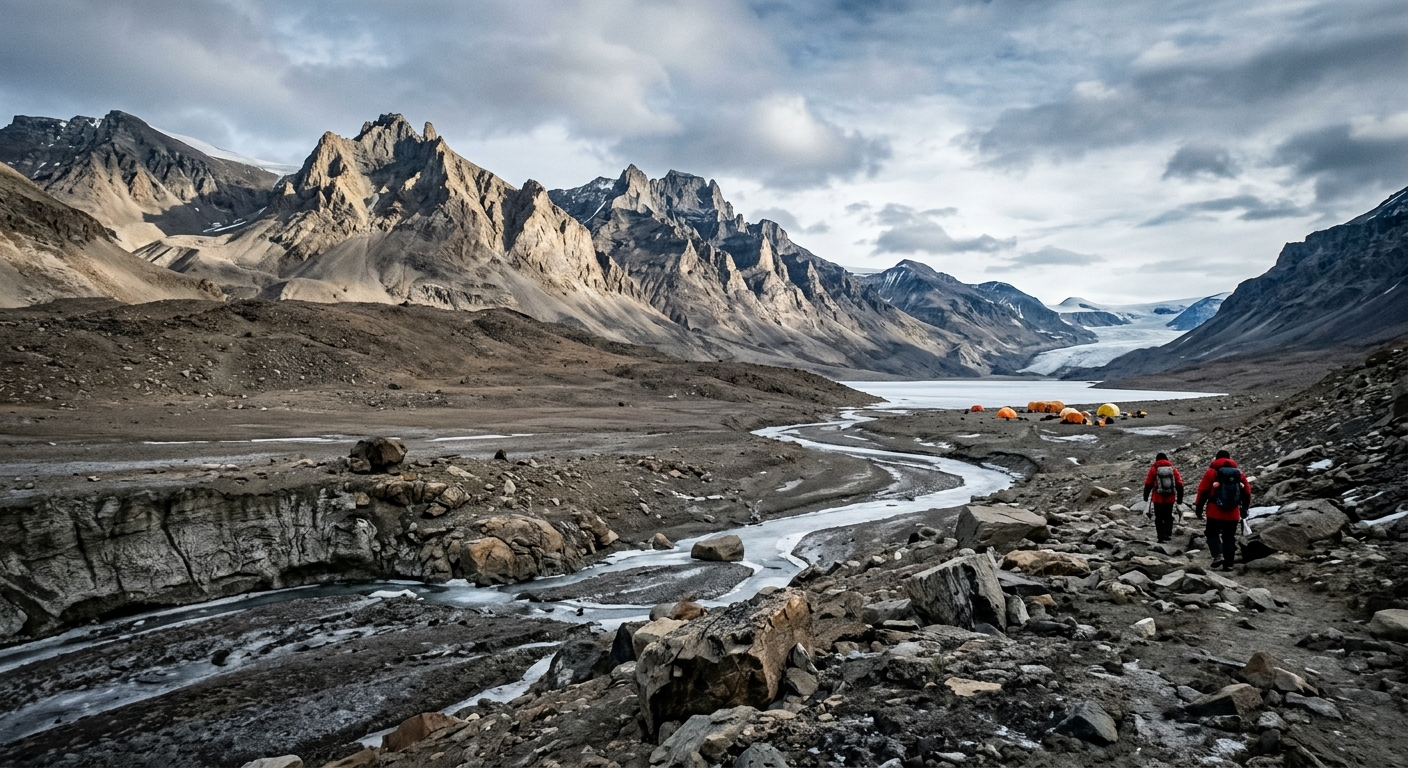
In the heart of Antarctica, where you’d expect endless fields of snow and ice, lies one of the most alien landscapes on our planet. The McMurdo Dry Valleys stretch across 1,900 square miles of barren rock, sand, and gravel, completely devoid of snow, ice, or any form of precipitation. For 2 million years, not a single raindrop or snowflake has fallen on this extraordinary terrain.
A Desert More Extreme Than the Sahara
While Antarctica holds 70% of the world’s freshwater locked in ice, the Dry Valleys represent the complete opposite extreme. With humidity levels often dropping below 1%, these valleys are technically drier than the Sahara Desert. The landscape is so harsh and otherworldly that NASA has used it as a testing ground for Mars missions, considering it the closest thing to Martian conditions found anywhere on Earth.
The valleys consist of three main areas: Victoria Valley, Wright Valley, and Taylor Valley. Combined, they form the largest ice-free region in Antarctica, creating a stark contrast against the continent’s typical frozen wasteland. The exposed soil and rock formations reveal geological features that have been hidden beneath ice sheets for millions of years elsewhere on the continent.
The Science Behind the Impossible Dryness
The extreme aridity of the McMurdo Dry Valleys results from a perfect storm of meteorological phenomena. Katabatic winds, which are gravity-driven winds flowing from the high Antarctic plateau, play the starring role in this natural drama.
The Wind Factor
These katabatic winds can reach speeds of up to 200 miles per hour, creating a natural barrier that prevents moisture from entering the valleys. The winds are so powerful and consistent that they literally blow away any snow or ice that attempts to accumulate. The air becomes superheated as it descends and compresses, creating a foehn effect that further dries out the atmosphere.
The Rain Shadow Effect
The surrounding mountain ranges create what meteorologists call a rain shadow effect. As moist air masses approach from the coast, they’re forced upward by the mountains, cooling and dropping their moisture before reaching the valleys. By the time any air mass reaches the Dry Valleys, it has been completely stripped of its water content.
Life in the Impossible
Despite conditions that would seem to prohibit any form of life, the Dry Valleys aren’t completely sterile. Scientists have discovered some of the most extreme organisms on Earth thriving in this seemingly lifeless environment.
Cryptobiotic Communities
Microscopic life forms, including bacteria, algae, and fungi, have been found living inside rocks, where they’re protected from the harsh surface conditions. These cryptogams form what scientists call “cryptobiotic crusts” that can survive in a state of suspended animation for decades or even centuries, becoming active only when trace amounts of moisture become available.
The Onyx River Phenomenon
During the brief Antarctic summer, some areas experience a remarkable transformation. The Onyx River, Antarctica’s longest river at 20 miles, flows during the summer months from glacial melt. This temporary water source supports algae mats and bacterial communities in an ecosystem unlike anywhere else on Earth.
Blood Falls: A Crimson Mystery
One of the most striking features of the Dry Valleys is Blood Falls, a dramatic red waterfall that flows from the Taylor Glacier. For decades, scientists puzzled over the source of the blood-red coloration. Recent research revealed that the red color comes from iron-rich brine that has been trapped beneath the glacier for over 2 million years.
This ancient water source contains no oxygen and has a salt content three times higher than seawater. Remarkably, it supports a unique ecosystem of bacteria that survive without sunlight or oxygen, processing sulfur and iron compounds for energy. These organisms represent some of the most extreme life forms known to science.
A Window into Deep Time
The Dry Valleys serve as a natural laboratory for understanding both past and potential future climates. The absence of liquid water for such an extended period has preserved geological features and even organic materials that would have been destroyed elsewhere.
Paleoclimate Insights
Scientists have discovered mummified seal carcasses that are thousands of years old, preserved in the dry conditions like natural time capsules. These remains provide invaluable insights into past climate conditions and help researchers understand how Antarctic ecosystems have changed over millennia.
Mars Analog Research
The extreme conditions make the Dry Valleys an ideal testing ground for Mars exploration technology. The combination of extreme cold, dryness, and UV radiation closely mimics conditions on the Red Planet. Research conducted here has directly informed the development of instruments for Mars rovers and has helped scientists understand what signs of life to look for on other worlds.
Climate Change and the Future
Despite their extreme stability over millions of years, the Dry Valleys are not immune to climate change. Recent studies have detected subtle changes in temperature and wind patterns that could potentially alter the delicate balance that maintains these unique conditions.
Scientists continue to monitor the region closely, as any changes to the Dry Valleys would represent a significant shift in one of Earth’s most stable and extreme environments. The valleys serve as a benchmark for understanding how climate change affects even the most seemingly unchangeable places on our planet.
The McMurdo Dry Valleys stand as a testament to the incredible extremes our planet can produce. In a world where water seems ubiquitous, these valleys remind us that Earth still holds mysteries and environments that challenge our understanding of what’s possible for life and landscape alike.





ive never made it down to mcmurdo myself but ive heard from birders who have and honestly the avifauna situation is so limited it breaks my heart, like you’re basically looking at just skuas and a few penguin species if you’re lucky. the habitat preservation angle here is wild though – these valleys are so extreme that theyre basically frozen in time, which makes them invaluable for understanding how life adapts. i cant help but think about how were losing habitats way faster than theyre disappearing naturally, so at least we have one place on earth that shows us what true desolation looks like without human interference.
Log in or register to replySuper interesting point about the limited bird diversity, Beth – those extreme conditions really do act as a bottleneck for most fauna. What fascinates me from a biochemistry angle is how the organisms that DO survive there, like certain nematodes and tardigrades, have evolved antifreeze proteins and cryptobiotic mechanisms that are honestly wild, like their cell chemistry basically shifts into a completely different operating mode. The Dry Valleys are basically a natural lab for studying how life can strip down to absolute essentials, which is why astrobiologists are so obsessed with them for understanding potential Mars life. I’d love to know if any of those researchers you’ve talked to have mentioned the microbial mats that manage phot
Log in or register to replyok but like imagine if some massive unknown creature was lurking in those valleys and we just… haven’t found it yet? tbh thats probably not whats happening lol, but if cryptids exist anywhere on earth its gotta be the most inhospitable places right? tho realistically the nematodes and extremophile bacteria are way more interesting then any legendary monster, kinda like how giant squid were “mythical” until we actually found them and they’re way cooler then the kraken ever was imo
Log in or register to reply