
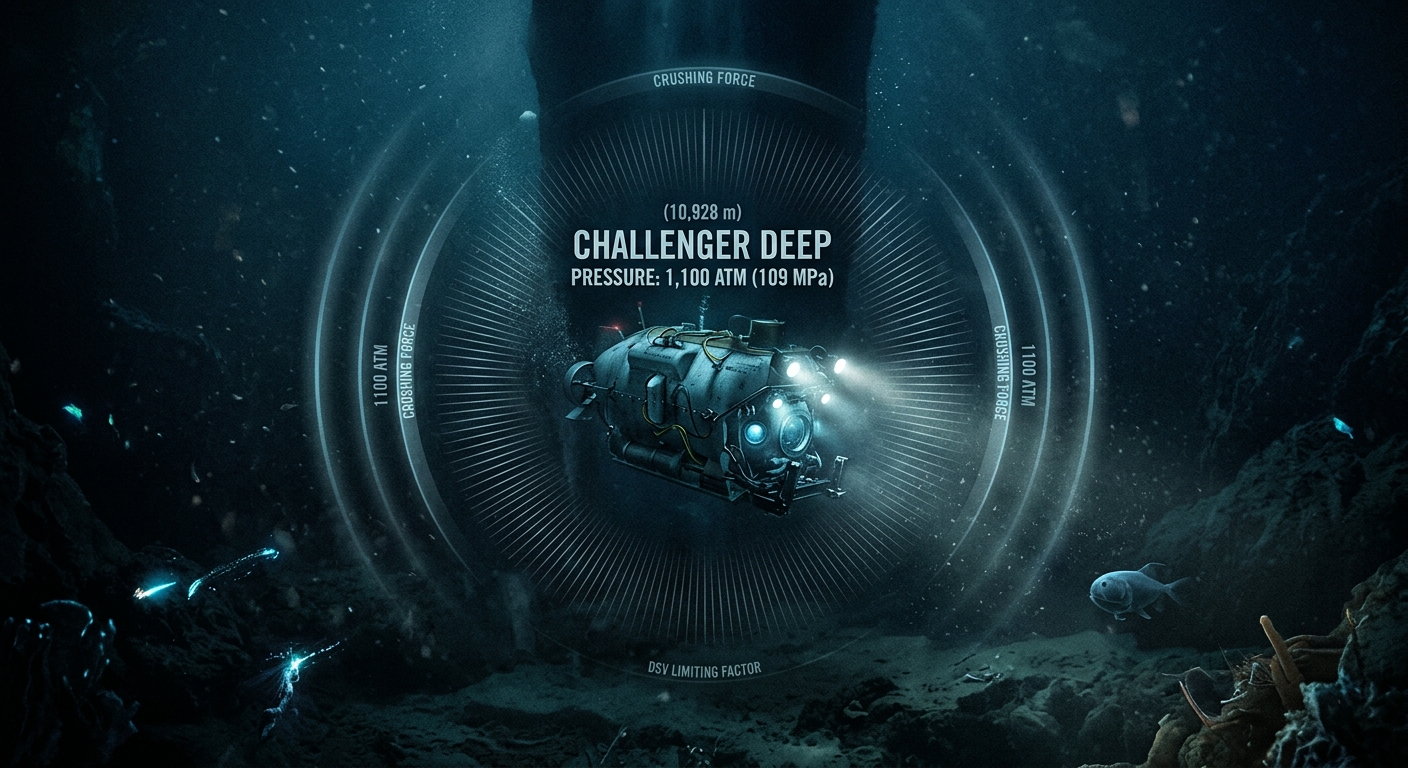
Imagine being pressed down by the weight of 50 jumbo jets stacked on top of you. That’s exactly what happens at the deepest point on Earth, where crushing pressure creates an alien world that makes outer space look hospitable.
The Ultimate Pressure Cooker: Challenger Deep
Located in the Mariana Trench in the Pacific Ocean, Challenger Deep plunges down 36,200 feet (11,034 meters) below sea level. At this mind-boggling depth, the pressure reaches an astounding 1,086 times greater than what we experience at sea level. To put this in perspective, every square inch of surface area experiences about 15,750 pounds of pressure, equivalent to having a large elephant standing on every square inch of your body.
This extreme pressure exists because water, unlike air, doesn’t compress significantly. As you descend deeper into the ocean, more and more water sits above you, and all that weight has to go somewhere. The pressure increases by approximately one atmosphere (14.7 pounds per square inch) for every 33 feet of depth. By the time you reach Challenger Deep, you’re supporting the weight of nearly seven miles of water above you.
What This Crushing Force Actually Does
The pressure at Challenger Deep is so intense that it would have catastrophic effects on anything from the surface world. A human body, if somehow transported instantly to this depth, would be crushed in about three hundredths of a second. The air-filled spaces in our bodies, including our lungs, would collapse completely, and our cellular structure would be destroyed almost instantaneously.
Even man-made materials struggle against this force. Regular submarines would be compressed into metallic pancakes. Only specially designed vessels with incredibly thick titanium spheres can withstand these pressures. The famous submersible Limiting Factor uses a titanium sphere with walls nearly four inches thick to protect its occupants during dives to Challenger Deep.
The Foam Cup Experiment
Scientists often demonstrate deep-sea pressure using styrofoam cups attached to their equipment. When retrieved from extreme depths, these cups have been compressed to the size of thimbles, with their original designs still intact but shrunk to miniature proportions. This simple experiment perfectly illustrates the immense compressive forces at work in the deepest parts of our oceans.
Life Thrives Where It Shouldn’t Exist
Perhaps the most astounding fact about Challenger Deep isn’t the pressure itself, but that life actually thrives there. Scientists have discovered remarkable creatures that have evolved specifically to handle these extreme conditions:
- Xenophyophores: Single-celled organisms that can grow up to 8 inches across, making them among the largest single-celled life forms on Earth
- Amphipods: Shrimp-like creatures that scavenge the deep-sea floor
- Snailfish: Translucent fish that hold the record for the deepest-living fish ever recorded
- Barophilic bacteria: Microorganisms that not only survive but require high pressure to function properly
These creatures have developed extraordinary adaptations to survive. They produce special proteins that maintain their shape under pressure, have flexible cell membranes that don’t rupture, and often lack gas-filled organs that would collapse. Some even have pressure-resistant enzymes that allow their metabolism to function normally in conditions that would destroy surface life.
Comparing Pressures: From Space to the Abyss
Interestingly, it’s actually easier for humans to survive in the vacuum of space than in the deepest parts of the ocean. In space, the main challenge is the lack of pressure and oxygen, but a human could survive for about 15 seconds in a spacesuit malfunction. At Challenger Deep, death would be nearly instantaneous due to the crushing forces.
The pressure difference is so extreme that if you could somehow create a tube from the ocean’s surface to Challenger Deep, water would shoot up through it with incredible force, like a natural geyser powered by the pressure differential.
Engineering Marvels: Conquering the Pressure
Only four crewed expeditions have ever reached Challenger Deep, a feat that’s been accomplished fewer times than landing on the moon. The first was Jacques Piccard and Don Walsh in 1960 aboard the Trieste, followed by James Cameron in 2012, and most recently, Victor Vescovo in multiple dives starting in 2019.
These expeditions require engineering that pushes the absolute limits of materials science. The viewing windows must be made of extremely thick acrylic or glass, and every seal must be perfect, because even the tiniest leak would result in catastrophic implosion.
Mysteries Still Being Uncovered
Despite the extreme conditions, Challenger Deep continues to surprise scientists. Recent expeditions have found plastic pollution even at these impossible depths, discovered new species of bacteria that could have applications in biotechnology, and identified geological processes that help us understand how our planet’s crust moves and changes.
The pressure at Challenger Deep represents one of the most extreme environments on our planet, yet it harbors life and continues to teach us about the incredible adaptability of biology and the remarkable engineering required to explore our own world’s final frontier. In many ways, the deepest parts of our oceans remain more mysterious and less explored than the surface of Mars.



okay but heres the thing – the deep ocean *is* literally alien in ways caves just cant match, and i mean that respectfully. at 11000 meters down there’s no sunlight ever reaching those creatures, zero photosynthesis possible, so they invented bioluminescence instead and ngl that gets me emotional every time. the pressure alone creates a completely different physics for how proteins fold and enzymes work, so these organisms are genuinely operating under alien rules in a way cave life, while extreme, isnt quite experiencing. caves are extreme but theyre still on land, still bound by earths surface conditions – the deep sea is its own planet basically, and we’ve explored like 5% of it.
Log in or register to replyYou’re touching on something I think about a lot, actually – how we’re collectively mesmerized by the alien-ness of deep ocean life while totally overlooking the fungal networks that basically ARE the nervous system of cave ecosystems. The mycelial communities down there are processing nutrients in conditions that sound just as hostile, quietly running the whole show while we’re fixated on bioluminescent fish. Both deserve way more awe, but fungi barely get a mention in either conversation.
Log in or register to replyThis is fascinating stuff, though I gotta say the deep ocean gets way more publicity than cave ecosystems that are equally extreme in their own ways. I’ve explored passages where the pressure and chemical conditions are almost as brutal as the deep sea, and the blind fish and albino crustaceans down there show the same kind of wild adaptations, yet nobody’s funding cave biology research like they fund ocean expeditions. Would love to see more coverage of how these extreme environments, whether vertical or horizontal, force evolution into such bizarre and beautiful directions.
Log in or register to reply