
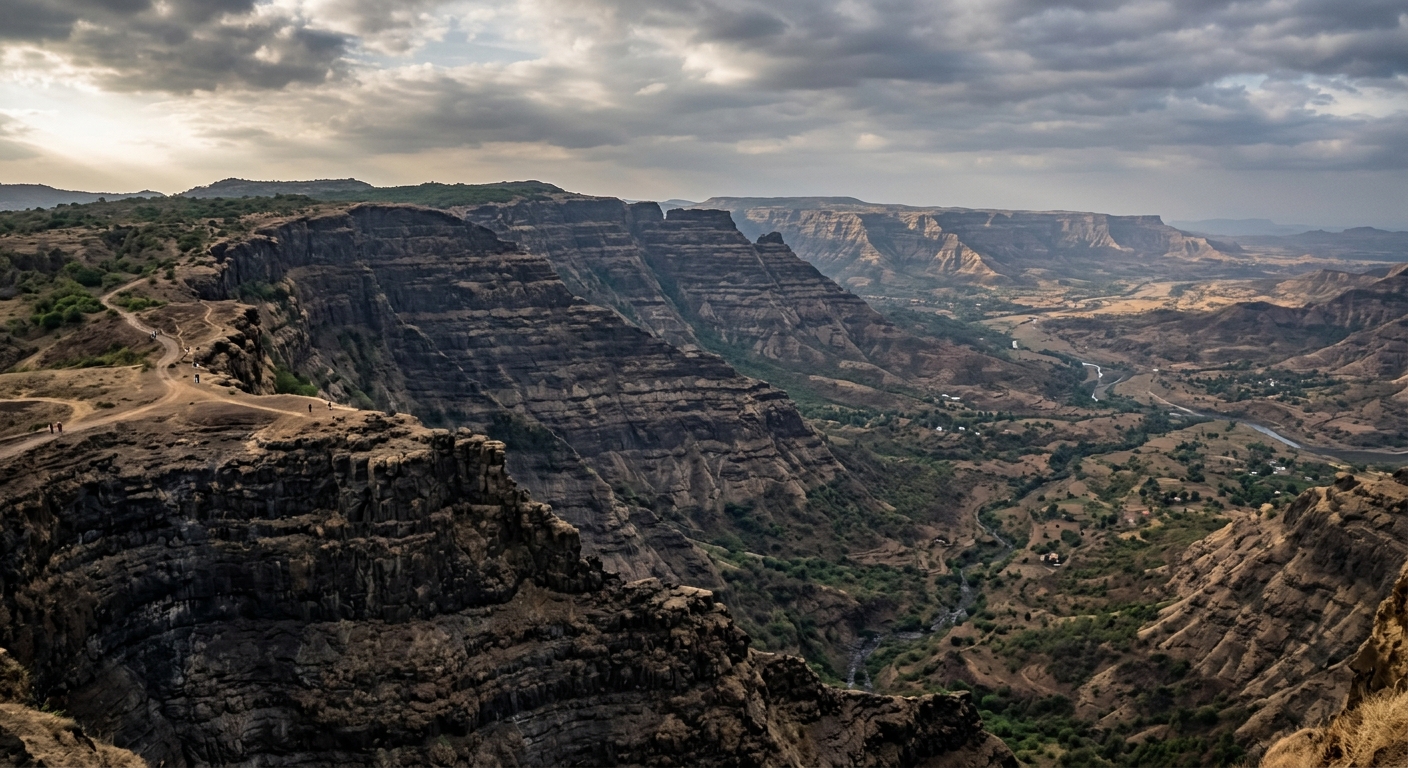
Imagine a volcanic eruption so massive it could bury all of France under two kilometers of solid lava. Now imagine this isn’t science fiction, but geological reality. Welcome to the Deccan Traps, one of Earth’s most mind-bending geological features and a sobering reminder of our planet’s violent past.
A Lava Field the Size of a Country
The Deccan Traps stretch across western and central India, covering an area of approximately 500,000 square kilometers. To put this in perspective, that’s roughly the same size as France, or about twice the size of the United Kingdom. But size alone doesn’t capture the true magnitude of this geological wonder.
What makes the Deccan Traps truly extraordinary is their thickness. In some areas, the accumulated lava reaches depths of over 2 kilometers (1.2 miles). That’s enough molten rock to completely submerge the Empire State Building twice over. The total volume of lava that erupted during the formation of the Deccan Traps is estimated at over 1 million cubic kilometers, making it one of the largest volcanic features on Earth.
When Earth’s Fury Was Unleashed
The Deccan Traps weren’t formed by a single catastrophic eruption, but rather through a series of massive volcanic events that occurred approximately 66 million years ago. This timing is particularly significant because it coincides almost exactly with the Cretaceous-Paleogene extinction event, the same period when dinosaurs vanished from Earth.
These eruptions didn’t happen overnight. The main phase of volcanic activity lasted for roughly 30,000 years, with some estimates suggesting the entire formation process took up to 800,000 years. During the peak periods, the amount of lava flowing from fissures in the Earth’s crust would have been absolutely staggering.
The Mechanics of Destruction
Unlike the explosive eruptions we typically associate with volcanoes like Mount Vesuvius or Mount St. Helens, the Deccan Traps were formed through flood basalt eruptions. These involve enormous volumes of relatively fluid lava pouring out of long cracks in the Earth’s surface, spreading across vast areas like a molten sea.
The lava flows weren’t uniform. Scientists have identified multiple distinct layers, each representing a separate eruption event. Some individual flows extended for hundreds of kilometers, creating the stepped landscape that gives the Deccan Traps their name (‘traps’ comes from the Swedish word ‘trappa,’ meaning steps).
A Climate Catastrophe 66 Million Years in the Making
The environmental impact of the Deccan Traps formation was nothing short of catastrophic. The volcanic eruptions released enormous quantities of sulfur dioxide, carbon dioxide, and other gases into the atmosphere. This triggered severe climate change on a global scale.
The immediate effects would have included:
- Acid rain caused by sulfur compounds
- Global cooling due to volcanic ash blocking sunlight
- Subsequent global warming from greenhouse gas emissions
- Massive air pollution affecting respiratory systems
- Disruption of food chains as plant life struggled to survive
The Dinosaur Connection
While the asteroid impact at Chicxulub is widely accepted as the primary cause of dinosaur extinction, many scientists believe the Deccan Traps eruptions played a crucial supporting role. The volcanic activity had already stressed global ecosystems for thousands of years before the asteroid delivered the final blow.
Some researchers even propose that the asteroid impact may have intensified the Deccan volcanism, creating a one-two punch that sealed the fate of the dinosaurs and many other species.
Modern Day Marvels
Today, the Deccan Traps form some of India’s most distinctive landscapes. The Western Ghats, a UNESCO World Heritage site, are largely composed of Deccan basalt. The region’s characteristic stepped hills and plateaus are direct results of differential erosion of the ancient lava flows.
The fertile black soil of the Deccan Plateau, known as regur or black cotton soil, is derived from weathered basalt. This soil supports agriculture for millions of people, turning an ancient catastrophe into a modern blessing.
Geological Detective Work
Scientists continue to study the Deccan Traps to understand both past and future volcanic threats. By analyzing the chemical composition of different lava layers, researchers can reconstruct the sequence of eruptions and their environmental effects. This research helps us understand how large igneous provinces form and what triggers such massive volcanic events.
Putting It All in Perspective
The Deccan Traps represent one of the most extreme examples of Earth’s volcanic power. To truly grasp their scale, consider that the entire volume of lava erupted could create a layer 10 meters thick covering the entire continental United States. The eruption rate during peak activity may have exceeded 1 cubic kilometer of lava per year.
This geological giant serves as a humbling reminder of the forces that have shaped our planet. While we worry about individual volcanic eruptions today, the Deccan Traps show us what Earth is truly capable of when its internal fires are fully unleashed. They stand as monuments to our planet’s violent past and sobering evidence of the geological processes that continue to operate beneath our feet.





Great post on the Deccan Traps, this stuff is genuinely mind-blowing! I’m curious if you touched on how the massive volcanic ash and sulfur dioxide would’ve affected insect populations back then, because honestly that’s where things get wild for understanding ecosystem collapse – even though spiders and other arthropods proved way more resilient to extinction events than larger animals, the initial toxicity from those eruptions must’ve been brutal. The fact that modern spider silk is being studied for its strength and flexibility makes you wonder what kinds of incredible adaptations we lost when megafauna went extinct, since predator-prey relationships shape everything about how a species evolves.
Log in or register to replyHey Stan, that’s a really solid question about the insects since they’re often overlooked in these extinction discussions. I’d add that whatever wiped out the non-avian dinosaurs probably hit reptiles hard too, though some like crocodilians and early squamates managed to survive those sulfur dioxide clouds better than others. The Deccan eruptions were absolutely catastrophic on a scale that’s hard to wrap your head around, and yeah, the cascading effects on the whole food chain from insects up would’ve been insane.
Log in or register to replyMan, this makes me think about how modern cave systems actually preserve records of past volcanic activity, and honestly the Deccan eruptions would’ve created some wild underground refugia for whatever creatures could survive those conditions! I’ve explored caves with volcanic ash layers still visible, and it’s crazy to think about how subterranean ecosystems might’ve been some of the few places where insect populations could shelter from that sulfur dioxide nightmare while surface life was getting hammered. The food chains in caves already operate on such a knife’s edge with limited nutrients filtering down, so I wonder if a global catastrophe like that would’ve created a temporary underground boom for scavengers before everything stabilized again.
Log in or register to reply