Deep beneath the iconic geysers and hot springs of Yellowstone National Park lies one of the most powerful and terrifying geological forces on our planet. The Yellowstone hotspot isn’t just another volcanic system: it’s a stationary column of superheated rock that has been systematically punching holes through the North American continent for over 16 million years, leaving behind a trail of destruction that stretches across three states.
A Blowtorch Beneath the Earth’s Crust
Imagine a massive blowtorch pointed upward from deep within the Earth, so powerful that it can melt through solid rock like butter. That’s essentially what the Yellowstone hotspot represents. This geological phenomenon originates from a mantle plume, a column of hot rock that rises from nearly 1,800 miles below the surface, close to the boundary between Earth’s core and mantle.
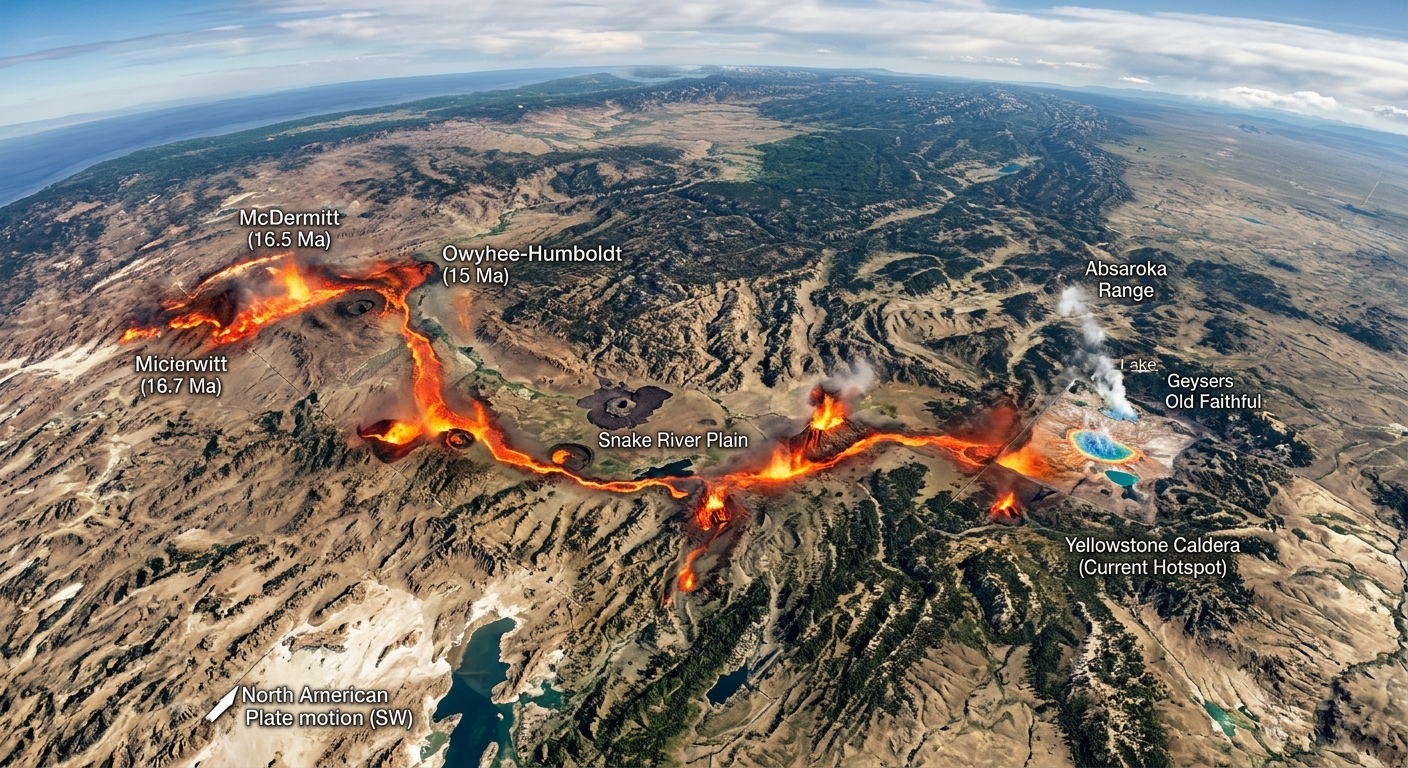
Unlike typical volcanoes that form along tectonic plate boundaries, the Yellowstone hotspot is what scientists call an intraplate hotspot. It remains relatively stationary while the North American Plate slides over it at a rate of about 1 to 1.5 inches per year. As the plate moves southwest, the hotspot continuously burns through new sections of crust, creating a chain of volcanic calderas that tells the story of this underground titan’s relentless journey.
The Snake River Plain: A Scar Across the Continent
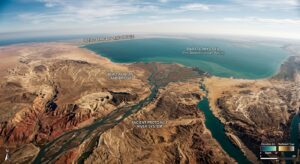
The evidence of the Yellowstone hotspot’s destructive path is written across the landscape in the form of the Snake River Plain, a 400-mile-long depression that cuts through southern Idaho. This isn’t just any valley: it’s literally a burn scar left by the hotspot as it melted through the continental crust over millions of years.
The track begins in Nevada and Oregon with the McDermitt volcanic field, created about 16.1 million years ago. From there, the trail of destruction includes:
- The Bruneau-Jarbidge caldera (12.8 million years ago)
- The Twin Falls caldera (10.4 million years ago)
- The Picabo caldera (10.2 million years ago)
- The Heise calderas (6.6 to 4.5 million years ago)
- The current Yellowstone caldera (2.1 million years ago to present)
Each of these represents a moment when the hotspot’s immense heat overwhelmed the overlying crust, creating massive volcanic eruptions that fundamentally altered the landscape.
Supervolcanic Catastrophes That Shaped North America
The Yellowstone hotspot doesn’t just create ordinary volcanic eruptions. It produces supervolcanic explosions so massive they can be classified as extinction-level events. The current Yellowstone caldera has experienced three such catastrophic eruptions in the past 2.1 million years, each one dramatically more powerful than any volcanic event in recorded human history.
The Huckleberry Ridge Eruption (2.1 Million Years Ago)
This initial blast ejected over 600 cubic miles of volcanic material, creating a caldera roughly 50 miles across. To put this in perspective, the 1980 Mount St. Helens eruption displaced only about 0.05 cubic miles of material. The Huckleberry Ridge eruption was more than 12,000 times larger.
The Mesa Falls Eruption (1.3 Million Years Ago)
While smaller than its predecessor, this eruption still expelled approximately 67 cubic miles of rock and ash, creating another massive caldera and depositing volcanic material across multiple states.
The Lava Creek Eruption (640,000 Years Ago)
The most recent supervolcanic event ejected about 240 cubic miles of material and created the current Yellowstone caldera, which measures approximately 34 by 45 miles. The ash from this eruption blanketed the entire western United States and was detected as far east as the Mississippi River.
The Mechanics of Underground Destruction
The process by which the Yellowstone hotspot punches through the North American Plate is both fascinating and terrifying. The mantle plume carries temperatures exceeding 3,000 degrees Fahrenheit as it rises through the Earth’s interior. When this superheated rock encounters the much cooler continental crust above, it doesn’t simply push upward like a typical volcano.
Instead, the hotspot creates what geologists call a “thermal erosion” effect. The intense heat literally melts the overlying crustal rocks, incorporating them into massive magma chambers. These chambers can span dozens of miles in diameter and contain enough molten rock to bury entire states under volcanic material.
The continental crust above Yellowstone is particularly susceptible to this thermal erosion because it’s relatively thick and rich in silica-based minerals that melt at lower temperatures. This creates the perfect conditions for the formation of rhyolitic magma, the highly explosive type of molten rock responsible for supervolcanic eruptions.
A Geological Time Bomb in Motion
Perhaps the most mind-blowing aspect of the Yellowstone hotspot is that it’s still actively burning through the North American Plate. Current GPS measurements show that the Yellowstone region is rising at a rate of about 0.6 inches per year in some areas, indicating that magma continues to accumulate in the chamber below.
Scientists estimate that the magma chamber beneath Yellowstone contains approximately 8,000 cubic miles of molten and partially molten rock. This underground ocean of magma is what feeds the park’s famous geothermal features and represents one of the largest active volcanic systems on Earth.
The hotspot’s relentless movement also means that in another few million years, it will have burned through the Yellowstone region entirely and moved on to create new volcanic fields further northeast. Meanwhile, the current Yellowstone caldera will gradually cool and become dormant, just like the ancient calderas that now form the Snake River Plain.
The Future of North America’s Underground Blowtorch
While the Yellowstone hotspot represents one of the most powerful geological forces on our planet, it also provides scientists with an unprecedented opportunity to study how mantle plumes interact with continental crust. Advanced monitoring systems now track every aspect of the hotspot’s activity, from ground deformation to gas emissions to seismic activity.
This underground titan serves as a reminder of the incredible forces that operate beneath our feet, constantly reshaping the planet on timescales that dwarf human civilization. The Yellowstone hotspot has been punching holes through North America since before our species existed, and it will continue its destructive journey long after we’re gone, leaving behind a trail of geological scars that tell the story of one of Earth’s most powerful and persistent volcanic forces.

omg yes the patience thing gets me every time lol like yellowstone is just slowly drilling thru the continent like the most patient supervolcano ever and meanwhile we’re all like “is it gonna blow up next tuesday” when its literally on a 600k year schedule. its kinda like how ppl used to imagine sea monsters punching thru ship hulls when really it was probably just giant squid doing normal squid things near the surface – except this time the “monster” is actually real geology and thats somehow even cooler tbh. your comment about deep ocean vents is spot on they’re both just earths way of slowly rearranging itself over timescales our brains cant even process
Log in or register to replytbh the way you described this reminds me of how the deep ocean vents work, except instead of water theyre punching thru solid rock over millions of years. the patience of geologic time is insane to me – like, the yellowstone hotspot is doing on land what hydrothermal vent systems do in the abyss, just on a completely different timescale. kinda makes you realise we’re all just living on top of these incredibly dynamic systems that operate way beyond our perception.
Log in or register to replyok but here’s what REALLY gets me, the same patience that lets yellowstone slowly burn thru continents is literally the same patience that lets tardigrades survive in the most insane places imaginable and i cannot stop thinking about how both of these things are just… operating on timescales and in conditions that make us look like mayflies, like yellowstone is reshaping continents while tardigrades are literally in a state of cryptobiosis waiting out radiation or extreme temperatures in soil samples and both of them are just out here doing their thing and we’re just like “how is this possible” when geologic time + microscopic resilience = nature saying “you underestimate what’s possible” and its humbling honestly
Log in or register to reply