
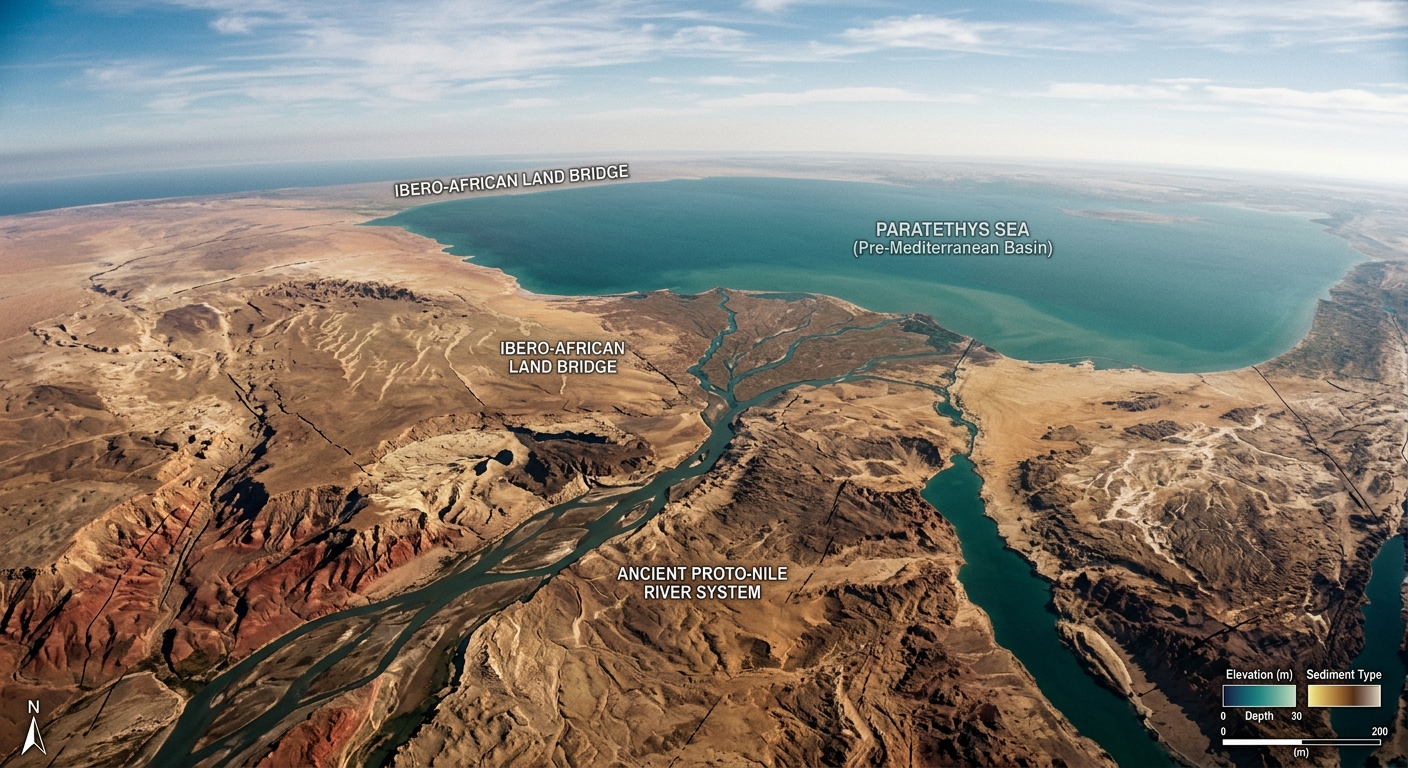
The mighty Nile River, flowing majestically through eleven countries for over 4,000 miles, holds secrets that stretch back millions of years. While most people know it as the world’s longest river system emptying into the Mediterranean Sea, few realize that for most of its existence, the Nile followed a completely different path and poured its waters into an entirely different body of water.
What scientists have discovered about the Nile’s ancient history challenges everything we thought we knew about one of humanity’s most important waterways. The story involves vanished seas, dramatic geological upheavals, and a river system that once looked nothing like the Nile we know today.
When the Mediterranean Was Just a Memory
To understand the Nile’s dramatic transformation, we need to travel back in time to the Miocene epoch, roughly 6 million years ago. During this period, the Earth looked vastly different from today. The Mediterranean Sea, which now serves as the Nile’s final destination, was in the process of drying up completely during an event geologists call the Messinian Salinity Crisis.
Between 5.96 and 5.33 million years ago, tectonic movements caused the Strait of Gibraltar to close, cutting off the Mediterranean from the Atlantic Ocean. Without this vital connection, the enclosed sea began to evaporate under the intense heat of the African and European sun. Within a relatively short geological timeframe, what we now know as the Mediterranean transformed into a series of hypersaline lakes and vast salt flats, some lying more than a mile below current sea level.
But where did the ancient Nile flow during this dramatic period? The answer lies in an entirely different direction: westward across the African continent.
The Lost River: Following Ancient Waters
Before the Mediterranean’s disappearance, the ancestral Nile system followed a radically different course. Instead of flowing northward through Egypt as it does today, geological evidence suggests that the ancient river system flowed westward across what is now the Sahara Desert, eventually emptying into the Atlantic Ocean somewhere along the coast of West Africa.
This westward-flowing river system was part of a much larger network that drained vast portions of northeastern Africa. Satellite imagery and geological surveys have revealed traces of these ancient river channels, now buried beneath thousands of years of sand and sediment. These paleochannels tell the story of a time when the Sahara was not the arid wasteland we know today, but a landscape crisscrossed by flowing rivers and dotted with lakes.
Evidence Written in Stone
The proof of this ancient river system comes from multiple sources that read like a geological detective story:
- Sediment Analysis: Core samples from the Atlantic Ocean floor off the West African coast contain sediments that match the geological signature of rocks from the Ethiopian Highlands, suggesting that ancient waters carried this material westward across the continent.
- Satellite Archaeology: Advanced radar and satellite imaging has revealed buried river channels beneath the Sahara, showing clear evidence of westward-flowing water systems.
- Geological Formations: Rock formations in the Western Desert of Egypt show evidence of ancient water flow patterns that align with a westward drainage system.
- Mineral Deposits: Certain mineral deposits found in West Africa can be traced back to source rocks in the Nile’s current headwaters, indicating an ancient connection.
The Great Reversal: How the Nile Changed Course
The dramatic shift in the Nile’s course wasn’t a sudden event but rather a gradual process driven by massive geological forces. As the Mediterranean dried up during the Messinian Salinity Crisis, it created what geologists call a “base level drop” of extraordinary proportions. Imagine a bathtub suddenly having its drain opened, but on a scale involving an entire sea.
This dramatic lowering of the Mediterranean created a powerful headward erosion process. Rivers and streams that had previously flowed into the shrinking sea began cutting deeper and deeper channels as they sought to reach the ever-lowering water level. These erosional forces worked their way upstream, gradually capturing and redirecting water flow from the westward-flowing river systems.
When the Mediterranean began to refill approximately 5.3 million years ago (as the Gibraltar strait reopened), the newly established northward drainage pattern was already entrenched. The Nile had effectively “switched teams,” abandoning its ancient westward journey in favor of the shorter, steeper route to what would become the Mediterranean Sea.
What This Means for Our Understanding of Ancient Africa
This revelation about the Nile’s ancient course has profound implications for our understanding of African geography, climate, and even human evolution. The westward-flowing river system would have created a vastly different landscape across North Africa, supporting ecosystems and migration patterns that we’re only beginning to understand.
The ancient river system likely supported lush vegetation and diverse wildlife across what is now the Sahara Desert. Archaeological evidence suggests that early human ancestors may have followed these ancient waterways as they spread across the African continent, making the lost river system a potential highway for human migration and cultural development.
Climate Connections
The switch in the Nile’s course also had significant effects on regional and global climate patterns. The loss of the westward drainage system contributed to the gradual aridification of the Sahara, while the establishment of the modern Nile created the fertile corridor that would eventually support one of humanity’s greatest civilizations in Egypt.
Modern Discoveries and Future Research
Today’s scientists continue to uncover new evidence about the Nile’s ancient past using increasingly sophisticated techniques. Ground-penetrating radar, satellite spectroscopy, and advanced computer modeling are revealing details about this lost river system that were unimaginable just decades ago.
Recent studies have even suggested that remnants of the ancient westward-flowing system may still exist as underground aquifers beneath the Sahara. These hidden water reserves could potentially be tapped for future water needs, making the ancient Nile not just a geological curiosity but a potential lifeline for modern Africa.
The story of the Nile’s dramatic course change reminds us that even the most permanent-seeming features of our planet are subject to constant change. The river that nurtured ancient Egyptian civilization and continues to support millions of people today once followed an entirely different path across a continent that looked nothing like the Africa we know. It’s a humbling reminder of the dynamic forces that continue to shape our world, often in ways we’re only beginning to understand.



yo this is such a good question though because it actually reminds me of how unihemispheric sleep works in fish – like some species can literally rest one brain hemisphere at a time to stay alert for predators, and im wondering if parasite pressure and predation risk during major geographic shifts like this wouldve actually selected for different rest behaviors too? like did those fish populations develop different vigilance patterns when they were isolated? the whole thing makes me realize we know so little about how animal biology responds to continental scale changes over time and its wild to think about
Log in or register to replyok this is cool and all but now im imagining what parasites were doing during that whole geographic upheaval and like… did the fish in that western-flowing nile have completely different parasite communities than the mediterranean ones? because imagine the host switching that couldve happened when the water routes changed, thats literally evolution on fast forward. parasites are so underrated in these stories, everyone talks about the geology but nobodys thinking about how the microfilariae and trematodes were just having the wildest time adapting to new host populations lol
Log in or register to replyI love how you’re thinking about the cascading ecological disruptions here, because this is exactly what keeps me up at night about rapid Arctic changes too. When you have dramatic environmental shifts like the Mediterranean drying or ice habitat vanishing, the parasite-host dynamics get absolutely chaotic and we honestly know so little about those invisible consequences. The fish communities would’ve been under insane selection pressure, and yeah, you’re right that parasites usually get ignored but they’re literally the connective tissue of ecosystems. Makes me wonder if studying those ancient parasite populations could tell us something useful about predicting which modern species will adapt fastest versus crash when their environments shift.
Log in or register to reply