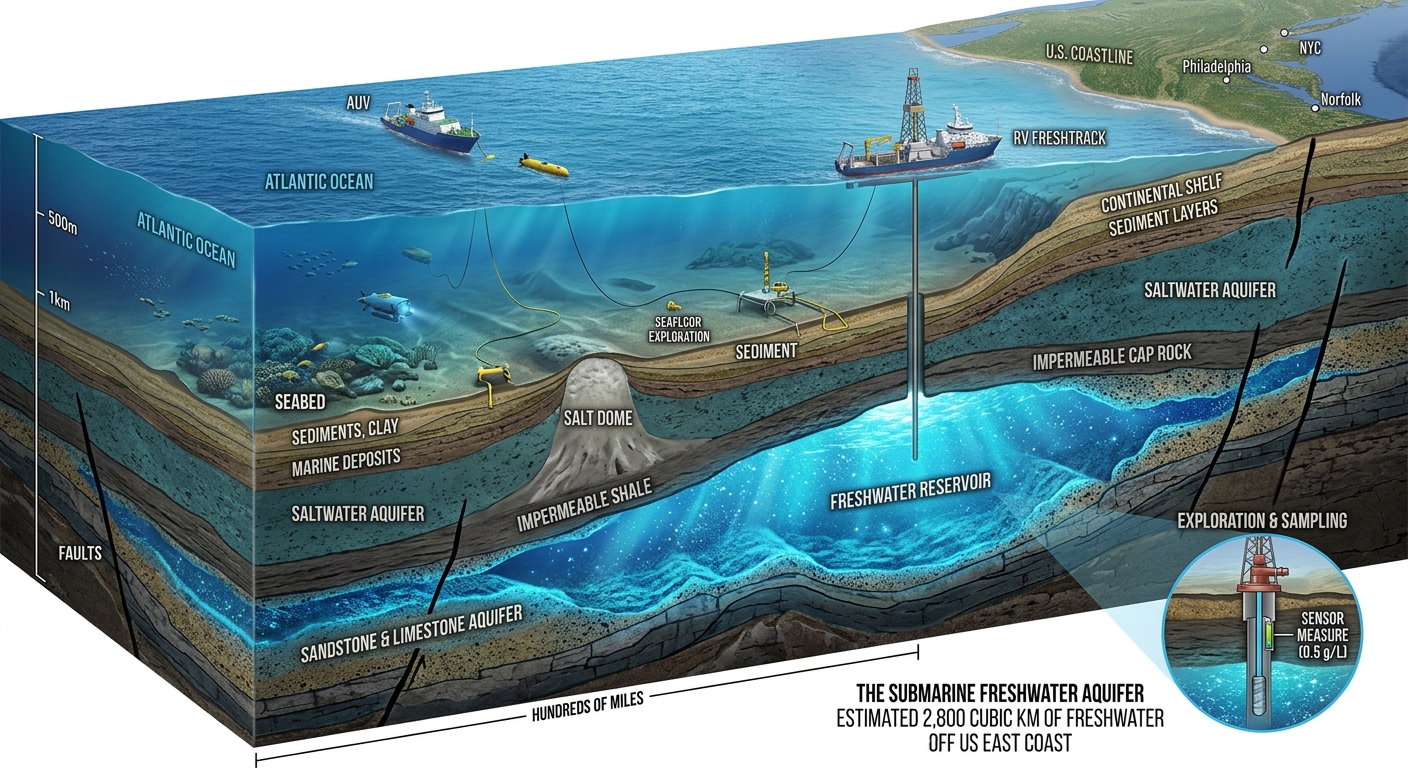
Deep beneath the churning waters of the Atlantic Ocean, off the northeastern coast of the United States, lies one of the most extraordinary discoveries of the 21st century: a massive freshwater aquifer that dwarfs most surface water bodies. This underground oceanic reservoir contains enough fresh water to fill Lake Superior twice over, fundamentally challenging our understanding of Earth’s hidden water systems.
The Discovery That Shocked Scientists
In 2019, researchers from Columbia University’s Lamont-Doherty Earth Observatory published findings that sent shockwaves through the scientific community. Using advanced electromagnetic imaging techniques, they had uncovered something unprecedented: a continuous band of low-salinity groundwater stretching from at least Massachusetts to New Jersey, extending up to 75 miles offshore.
This wasn’t just a small pocket of fresh water. The aquifer spans approximately 50,000 square miles and contains an estimated 670 cubic miles of fresh water. To put this in perspective, this single underground reservoir holds more water than all the Great Lakes combined, sitting quietly beneath one of the world’s most studied ocean regions.
How Does Fresh Water Survive Under Salt Water?
The existence of fresh water beneath the ocean might seem impossible at first glance. After all, wouldn’t saltwater simply contaminate any freshwater deposits? The answer lies in the fascinating physics of density and geological barriers.
Fresh water is less dense than salt water, causing it to naturally “float” above denser saline layers. This phenomenon creates what scientists call a “freshwater lens,” where the lighter fresh water maintains its position above the heavier saltwater, much like oil floating on water. Additionally, layers of impermeable clay and sediment act as natural barriers, preventing the mixing of these different water masses over geological timescales.
The Role of Ancient Geology
The story of this underwater aquifer begins hundreds of thousands of years ago during the last ice age. As massive glaciers advanced and retreated across North America, they carved out river valleys and deposited enormous amounts of sediment. When sea levels were much lower than today, fresh water from melting glaciers and ancient river systems seeped into the exposed continental shelf.
As the ice age ended and sea levels rose, the ocean gradually covered these freshwater deposits. Rather than immediately mixing with the saltwater above, the fresh water became trapped in the porous rock and sediment layers beneath the seafloor, preserved like a time capsule from a different era.
Revolutionary Detection Methods
Discovering this hidden aquifer required cutting-edge technology that would have been impossible just decades ago. The research team employed controlled-source electromagnetic (CSEM) imaging, a technique that measures how electromagnetic waves travel through different materials beneath the ocean floor.
The process involved towing specialized equipment behind research vessels, sending electromagnetic pulses into the seafloor and measuring the returning signals. Fresh water and salt water conduct electricity differently, creating distinct electromagnetic signatures that allowed scientists to map the extent and boundaries of the freshwater deposits with remarkable precision.
Implications for Future Water Security
The discovery of this massive freshwater reservoir comes at a time when water scarcity is becoming an increasingly urgent global concern. With growing populations and changing climate patterns putting unprecedented stress on traditional freshwater sources, offshore aquifers like this one could represent a crucial backup resource.
Potential Benefits and Challenges
Extracting fresh water from beneath the ocean floor presents both opportunities and obstacles:
- Massive Volume: The sheer quantity of water available could supply coastal regions for decades or centuries
- Strategic Location: The aquifer sits directly offshore from some of the most densely populated areas of the United States
- Natural Filtration: The water has been naturally filtered through rock and sediment for millennia
- Technical Challenges: Extracting water from depths of up to 1,200 feet below the seafloor would require significant technological innovation
- Environmental Concerns: Any extraction process must carefully avoid contaminating the aquifer with saltwater
A Global Phenomenon
Perhaps most intriguingly, this Atlantic discovery isn’t unique. Scientists now believe that similar offshore freshwater reserves likely exist along continental margins worldwide. Preliminary research has identified potential aquifers off the coasts of Australia, China, North Africa, and South Africa.
These findings suggest that Earth’s freshwater reserves may be far more extensive than previously imagined, hidden in places we never thought to look. Conservative estimates propose that offshore aquifers globally could contain millions of cubic kilometers of fresh water.
The Future of Hidden Water
As research continues, scientists are working to better understand the formation, extent, and accessibility of these underwater freshwater reserves. Advanced computer modeling and improved electromagnetic imaging techniques are revealing new details about how these aquifers maintain their integrity over geological time scales.
The Atlantic freshwater lens represents more than just a scientific curiosity. It’s a reminder that our planet still holds profound secrets, even in regions we consider well-explored. As we face mounting challenges related to freshwater availability, these hidden oceanic reservoirs might prove to be among Earth’s most valuable undiscovered resources.
The next time you gaze out at the seemingly uniform surface of the ocean, remember that beneath those waves lies a complex world of hidden freshwater rivers, trapped in time and waiting to reshape our understanding of Earth’s most precious resource.


This is wild, but now I’m wondering how something like this might affect animal migration patterns, especially for marine mammals that rely on specific water chemistry and salinity gradients for navigation. Like, if these freshwater plumes are seeping up through the ocean floor and creating localized density differences, could whales or sea turtles be using them as chemical waypoints during their migrations? I’ve read so much about how animals navigate by magnetism and sun angles, but the hydrochemical stuff feels criminally understudied. Has anyone tracked whether migratory species show behavioral shifts near these aquifer zones?
Log in or register to replyThis is honestly giving me chills, like we’re discovering entire worlds hidden in plain sight on our own planet. If we can find oceans *under* oceans here, I genuinely cannot fathom what might be locked beneath the ice on Europa or Enceladus, waiting for us to finally get there. The fact that life thrived in Earth’s deepest, darkest places makes me even more hopeful that somewhere out there, something is quietly existing in conditions we once thought were impossible. We’re only just beginning to understand our own world.
Log in or register to replyok but this is actually making me think about how many cryptid sightings coudl be explained by weird water conditions like this? like if theres freshwater plumes mixing with salt water it might create optical distortions or strange behavior in fish that people misinterpret as sea monsters lol. the kraken vs giant squid thing keeps coming up for me but honestly these kinds of hidden geological features could totally explain why ppl see strange stuff in the ocean – its literally not what they think it is down there
Log in or register to reply