
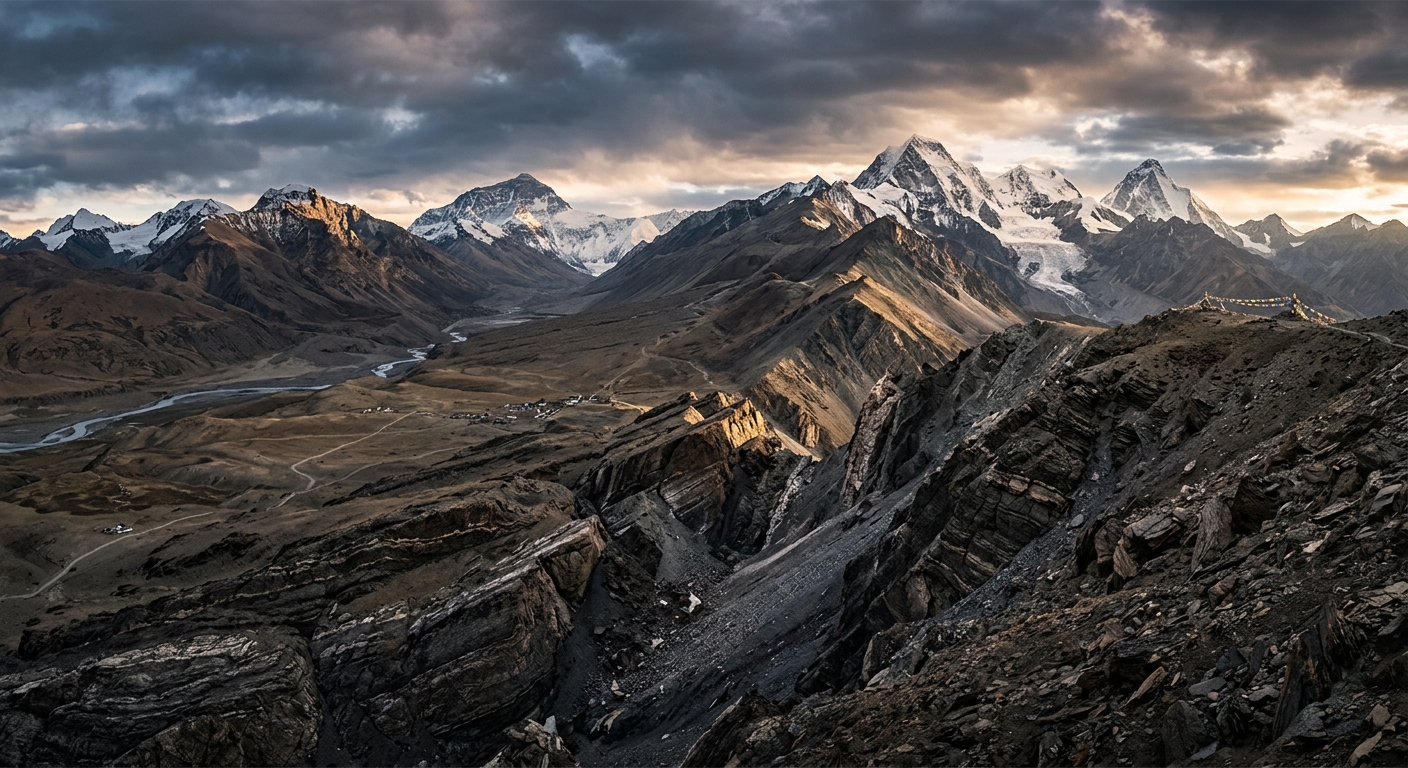
Deep beneath the towering peaks of Mount Everest and across the vast expanse of the Tibetan Plateau, an extraordinary geological dance has been unfolding for millions of years. What most people don’t realize is that these two iconic features of our planet are literally growing together, rising skyward at nearly identical rates in one of Earth’s most spectacular displays of tectonic power.
The Incredible Numbers Behind Earth’s Greatest Growth Spurt
Mount Everest, standing at 29,032 feet above sea level, captures headlines every time scientists measure its height. But what’s truly mind-blowing is that this colossal mountain is still growing at a rate of approximately 4 millimeters per year. Even more fascinating? The entire Tibetan Plateau, spanning an area roughly four times the size of Texas, is rising at virtually the same rate.
This synchronized growth represents one of the most dramatic ongoing geological processes on our planet. To put this in perspective, in a single human lifetime of 80 years, both Everest and the plateau will have risen by more than a foot. Over the course of a millennium, they’ll gain an additional 13 feet in elevation.
The Titanic Collision That Started It All
The story behind this remarkable phenomenon begins approximately 50 million years ago with one of the most significant geological events in Earth’s history: the collision between the Indian and Eurasian tectonic plates. This wasn’t a gentle meeting, but rather a catastrophic crash that fundamentally reshaped the geography of Asia.
The Indian plate, moving northward at a rate that was geologically lightning-fast, slammed into the Eurasian plate with tremendous force. Unlike oceanic plates that typically slide beneath continental ones, both plates involved in this collision were continental, meaning neither could easily subduct beneath the other. The result? The land had nowhere to go but up.
Understanding the Mechanics of Mountain Building
This collision created what geologists call a “zone of convergent compression,” where the immense pressure from the ongoing collision continues to push rock formations skyward. The process involves several fascinating mechanisms:
- Crustal thickening: As the plates continue to converge, the Earth’s crust becomes progressively thicker, much like how a rug bunches up when pushed against a wall
- Isostatic rebound: The thickened crust actually “floats” higher on the underlying mantle, similar to how a heavily loaded ship sits lower in water than an empty one
- Continued tectonic pressure: The Indian plate continues its northward journey at about 2 inches per year, maintaining the upward pressure
Why the Rates Are Nearly Identical
The fact that Mount Everest and the Tibetan Plateau are rising at almost exactly the same rate isn’t a coincidence but rather a testament to the unified nature of this geological system. Both features are products of the same tectonic forces and are essentially part of one massive, elevated region.
The Tibetan Plateau, often called “the Roof of the World,” has an average elevation of over 14,000 feet, making it the highest and largest plateau on Earth. Mount Everest, along with the entire Himalayan range, represents the southern edge of this elevated region where the compression and uplift are most intense.
The Ripple Effects Across Asia
The ongoing collision and uplift have consequences that extend far beyond the immediate region. The rising Tibetan Plateau has fundamentally altered Asia’s climate patterns, created major river systems, and continues to influence weather across the continent. The plateau acts as a massive heat source in summer and a cold reservoir in winter, driving monsoon patterns that affect billions of people.
Measuring Mountain Growth in Real Time
Modern technology has revolutionized our ability to measure these incremental changes with unprecedented precision. GPS stations, satellite interferometry, and other advanced surveying techniques allow scientists to track millimeter-scale movements across the region.
These measurements have revealed that the uplift isn’t uniform across the entire plateau. Some areas rise faster than others, creating a complex pattern of growth that helps scientists understand the underlying geological processes. The data also shows that while the average rate is about 4 millimeters per year, this can vary significantly based on local geological conditions.
The Future of the World’s Tallest Mountain
Will Mount Everest continue growing forever? The answer lies in the ongoing collision between the Indian and Eurasian plates. As long as the Indian plate continues its northward journey, the Himalayan region will keep rising. However, this process operates on geological timescales that dwarf human history.
Scientists estimate that the collision and uplift will continue for millions of years to come, though the rates may eventually slow as the plates’ relative motion decreases. Even then, erosion will begin to play a more significant role in shaping these mountains, potentially limiting their ultimate height.
A Living, Breathing Planet
The synchronized rise of Mount Everest and the Tibetan Plateau serves as a powerful reminder that our planet is far from static. Beneath our feet, massive forces are constantly at work, reshaping continents and building mountains on timescales that stretch across millions of years.
This ongoing geological drama, playing out at a rate of just 4 millimeters per year, represents one of the most spectacular examples of Earth’s dynamic nature. Every day, as we go about our lives, the roof of the world continues its inexorable rise toward the sky, growing taller with each passing moment in a process that began long before humans existed and will continue long after we’re gone.






This is wild, but it makes me think about how the Tibetan Plateau’s elevation creates these rain shadow effects that fundamentally shape ecosystems across entire continents. I wonder if that steady 4mm/year uplift actually plays into the climate dynamics that protect or threaten the remaining forests in places like the eastern Himalayan foothills and into Southeast Asia, where you see that crazy mosaic of biodiversity. The geological timescale is stunning, but I’m curious if researchers are tracking how rapid climate shifts interact with this slow tectonic process, especially since those montane forests are already under pressure from deforestation.
Log in or register to replyThis is such a cool way to think about how geology shapes life on Earth, honestly. It makes me wonder if primatologists studying high altitude primate populations, like the golden snub-nosed monkeys in the Himalayan regions, factor in these long term geological shifts when looking at habitat changes. Jane Goodall’s work taught us how crucial it is to see animals in their full environmental context, and these massive tectonic processes kind of remind us that ecosystems are constantly reshaping themselves in ways we can barely perceive year to year.
Log in or register to replySuper interesting point about the rain shadow effects, Trevor. You’re definitely onto something with how that elevation shapes regional climate, though I’d add that the uplift rate itself is almost too gradual to directly influence year to year weather patterns. What’s really fascinating from an ecology perspective is how that long term elevation change drives the evolution of fire regimes in the surrounding grasslands and shrublands, especially places like the eastern Tibetan plateau where grassland fires are crucial for maintaining those ecosystems. The uplift also influences precipitation patterns over centuries and millennia, which definitely affects fuel moisture and fire behavior in ways we’re still trying to fully understand.
Log in or register to reply