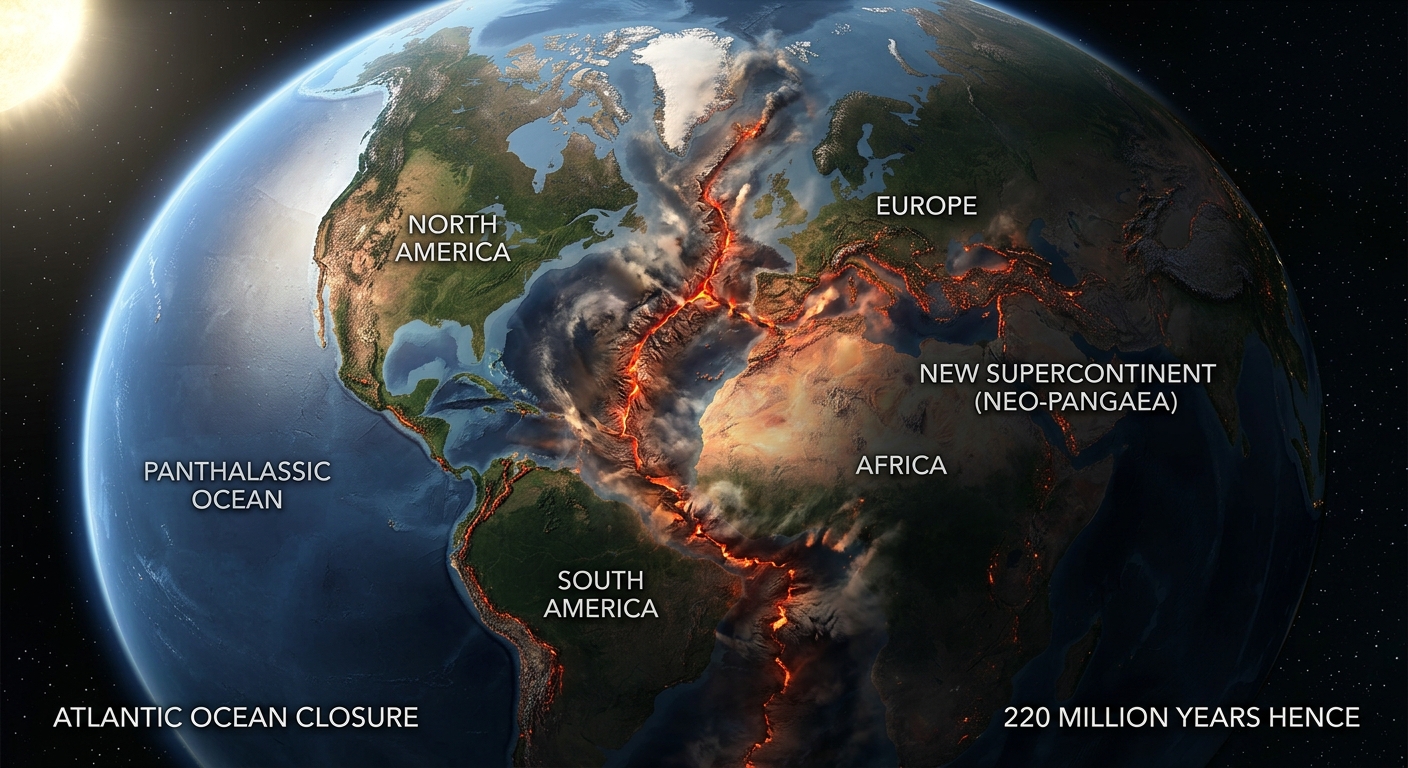
Imagine standing on the shores of the Atlantic Ocean, watching waves crash against the coastline, completely unaware that you’re witnessing one of Earth’s greatest disappearing acts. While the Atlantic appears eternal and unchanging to our human perception, this massive body of water is actually living on borrowed time. In approximately 220 million years, the Atlantic Ocean will cease to exist, swallowed by the relentless march of continental drift.
The Shocking Reality of Ocean Death
The Atlantic Ocean, which currently separates Europe and Africa from the Americas, is slowly but steadily shrinking. This isn’t science fiction or distant speculation, it’s geological fact backed by decades of scientific research and measurement. Every year, the Atlantic becomes incrementally smaller as the Pacific Ocean grows larger, part of a planetary-scale transformation that will fundamentally reshape our world’s geography.
Scientists have discovered that the Atlantic Ocean is closing at a rate of about 2-3 centimeters per year. While this might seem negligibly slow, over geological timescales, this steady contraction will eventually bring the continents crashing back together in a spectacular collision that will create the next supercontinent.
The Science Behind Ocean Disappearance
To understand how an entire ocean can vanish, we need to dive into the fascinating world of plate tectonics. The Earth’s surface consists of massive tectonic plates that float on the semi-molten mantle beneath. These plates are in constant motion, driven by convection currents deep within our planet.
Subduction: The Ocean Killer
The primary mechanism behind the Atlantic’s eventual demise is a process called subduction. Along certain boundaries where oceanic plates meet continental plates, the denser oceanic plate gets forced beneath the lighter continental plate, diving deep into the Earth’s mantle where it melts and recycles.
Currently, subduction zones exist along the western edges of the Atlantic, particularly in the Caribbean region. These zones act like massive conveyor belts, continuously consuming oceanic crust and pulling the continents closer together. As more oceanic floor disappears into these subduction zones, the Atlantic basin gradually shrinks.
The Pacific’s Opposite Story
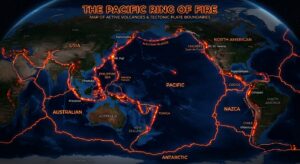
While the Atlantic shrinks, the Pacific Ocean is expanding. This occurs because of active seafloor spreading along mid-ocean ridges, where new oceanic crust forms as magma rises from the mantle. The East Pacific Rise and other spreading centers continuously create new ocean floor, pushing the Pacific’s boundaries outward even as subduction zones around the Pacific Ring of Fire consume older crust.
Geological Evidence and Measurements
Scientists use several sophisticated methods to track the Atlantic’s gradual closure:
- GPS Technology: Precise satellite measurements can detect the millimeter-scale movements of continents, confirming the Atlantic’s gradual narrowing
- Paleomagnetic Analysis: Studying magnetic signatures in ancient rocks reveals past positions of continents and ocean basins
- Seismic Monitoring: Earthquake patterns and deep Earth imaging help scientists understand plate movements and subduction processes
- Ocean Floor Dating: Age analysis of oceanic crust reveals spreading and consumption patterns over millions of years
The Future Supercontinent: Pangaea Proxima
When the Atlantic finally closes in 200-250 million years, the result will be the formation of a new supercontinent that scientists have dubbed “Pangaea Proxima” or “Amasia.” This massive landmass will bring together the Americas, Europe, Africa, and Asia into a single, enormous continent surrounded by a vast super-ocean.
What Will Earth Look Like?
The formation of Pangaea Proxima will create:
- Massive mountain ranges where the continents collide, potentially dwarfing the current Himalayas
- Dramatically altered climate patterns due to the changed distribution of land and water
- New desert regions in the continental interior, far from oceanic moisture sources
- Completely different weather systems and ocean currents
The Cyclical Nature of Supercontinents
The Atlantic’s closure represents part of a larger geological cycle called the Wilson Cycle, named after Canadian geophysicist John Tuzo Wilson. This cycle describes how oceans open and close over hundreds of millions of years as supercontinents form, break apart, and reform.
Earth has experienced several supercontinents throughout its history, including the famous Pangaea that existed around 300 million years ago. The Atlantic Ocean itself formed when Pangaea began breaking apart roughly 200 million years ago, and now we’re witnessing the early stages of its eventual closure.
Implications for Life on Earth
The closure of the Atlantic Ocean will have profound implications for life on Earth, though these changes will occur over timescales so vast that evolution will have countless opportunities to adapt. The formation of Pangaea Proxima will likely trigger:
- Mass extinction events due to climate disruption and habitat loss
- New evolutionary pressures and opportunities as species adapt to changed environments
- Altered ocean chemistry and circulation patterns affecting marine ecosystems
- Potential ice ages or extreme warming periods depending on the new continental configuration
The Mind-Bending Scale of Deep Time
Perhaps the most fascinating aspect of the Atlantic’s eventual disappearance is how it challenges our perception of permanence. The ocean that has shaped human civilization, exploration, and trade for millennia is actually a temporary feature in Earth’s long history. This perspective offers a humbling reminder of the dynamic nature of our planet and the incredible timescales over which geological processes operate.
While 220 million years seems incomprehensibly long from a human perspective, it represents just a small fraction of Earth’s 4.6-billion-year history. In this context, even our seemingly permanent oceans are merely brief phases in our planet’s ongoing geological evolution.
The next time you gaze across the Atlantic’s vast expanse, remember that you’re witnessing not just an ocean, but a closing chapter in Earth’s geological story. This massive body of water, which seems so permanent and eternal, is actually participating in one of the most spectacular vanishing acts our planet has to offer.
honestly dave’s point about the deep sea ecosystems hits different when you think about light pollution doing similar damage on shorter timescales, like how bioluminescent organisms depend on darkness we’re actively stealing from them right now. 220 million years feels abstract until you realize we’re reshaping ocean chemistry and migration patterns for nocturnal fish and squid species in real time, and unlike continental drift we could actually do something about it if we cared to look at what’s happening in the dark.
Log in or register to replyOh wow, this really puts things in perspective! I’ve spent countless nights with my telescope wondering about the timescales of planetary change, and 220 million years is such a wild timeframe to wrap your head around. It makes you realize how dynamic our planet really is, kind of like how we now know exoplanets are constantly evolving too. I wonder what kind of life will exist in Pangaea Proxima’s climate, and whether any organisms today might have descendants adapted to that totally different world. The fact that we can actually measure this disappearance now feels like such a privilege.
Log in or register to replyhonestly the thing that gets me is thinking about what happens to all the deep sea ecosystems during that process, like the hydrothermal vents and chemosynthetic communities at 2500+ meters down that we’ve barely even catalogued yet. by the time the atlantic actually closes we’ll have lost entire worlds of creatures we never even knew existed tbh, and thats almost more sobering than the geology itself. the ocean floor subduction happening right now is literally erasing evidence of life forms we might discover next year.
Log in or register to reply