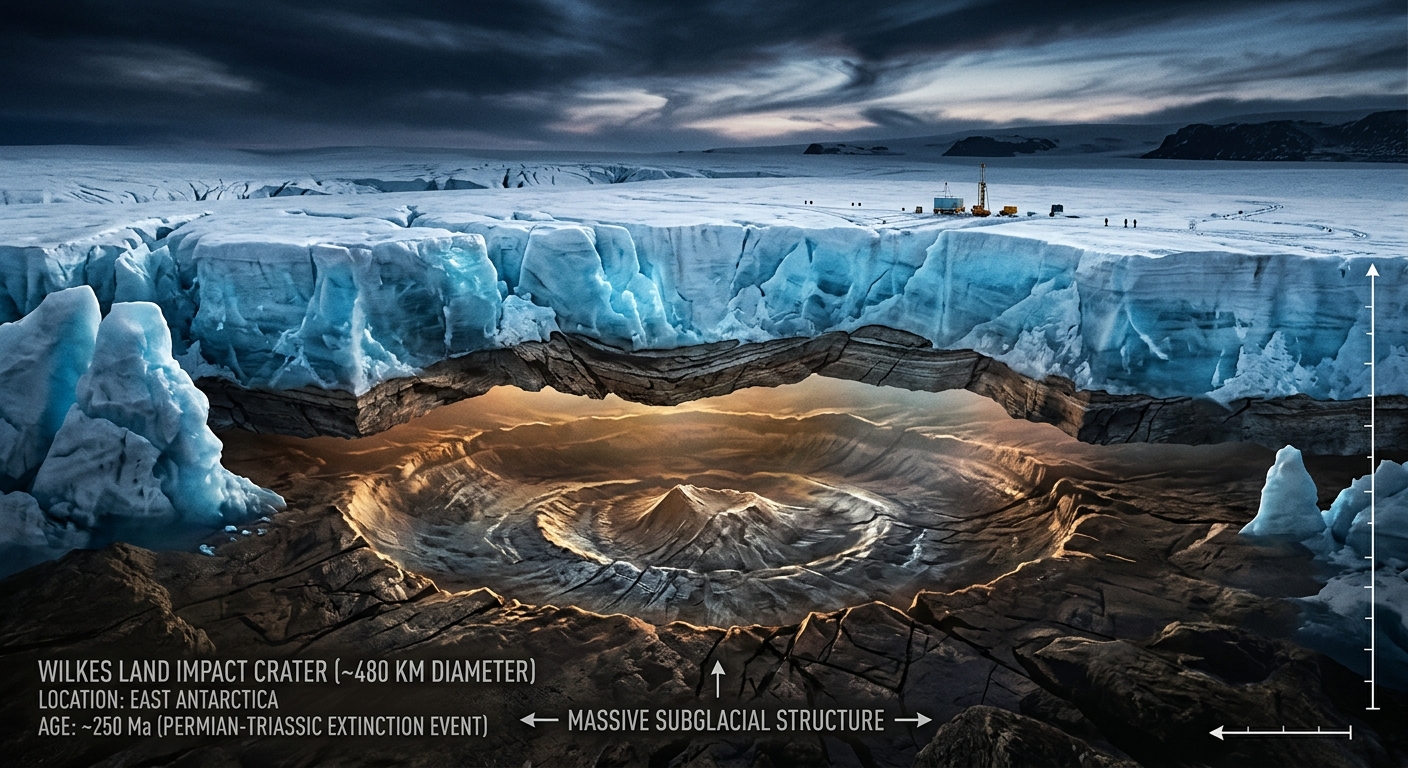
Deep beneath the ice sheets of Antarctica lies what could be the smoking gun behind the most catastrophic event in Earth’s history. The Wilkes Land Crater, a massive circular depression hidden under two miles of ice, may hold the key to understanding how 96% of all marine life and 70% of terrestrial species vanished in what scientists call the Great Dying.
Discovery of the Antarctic Monster
In 2006, scientists using gravity measurements and satellite data made a startling discovery. Buried beneath the Wilkes Land region of East Antarctica, they found evidence of a colossal impact crater stretching over 300 miles (480 kilometers) across. To put this in perspective, this crater dwarfs the famous Chicxulub crater in Mexico, which is linked to the dinosaur extinction, by more than twice its size.
The discovery wasn’t made through traditional excavation methods. Instead, researchers used gravitational anomalies detected by NASA’s GRACE satellites. These variations in Earth’s gravitational field revealed a massive circular depression beneath the ice, suggesting a structure formed by an enormous impact event.
The Permian Extinction: Earth’s Worst Nightmare
Approximately 252 million years ago, Earth experienced its most severe extinction event. The Permian-Triassic extinction, also known as the Great Dying, was so devastating that it nearly ended complex life on our planet entirely. The statistics are mind-boggling:
- 96% of marine species went extinct
- 70% of terrestrial vertebrate species disappeared
- 83% of insect species vanished
- It took nearly 10 million years for biodiversity to recover
For comparison, the extinction that killed the dinosaurs 66 million years ago eliminated only about 75% of species. The Permian extinction was in a league of its own, prompting scientists to search for equally extraordinary causes.
The Perfect Storm: How an Antarctic Impact Could Trigger Global Catastrophe
If the Wilkes Land Crater is indeed from the Permian period, the impact would have been devastating beyond imagination. Scientists estimate that the asteroid or comet responsible would have been between 30 to 50 kilometers in diameter, roughly the size of a small city, traveling at speeds of 20 to 70 kilometers per second.
Immediate Effects of the Impact
The initial impact would have released energy equivalent to billions of nuclear weapons. The immediate effects would have included:
- Massive earthquakes registering magnitude 12 or higher on the Richter scale
- Tsunamis hundreds of meters high sweeping across the globe
- A fireball that would have incinerated everything within thousands of kilometers
- Shock waves that circled the Earth multiple times
The Siberian Traps Connection
One of the most intriguing aspects of this theory involves the Siberian Traps, massive volcanic formations in Russia that were actively erupting during the Permian extinction. Some scientists propose that the Wilkes Land impact may have triggered or intensified these volcanic eruptions through seismic waves traveling through the Earth’s core.
The Siberian Traps released enormous quantities of lava, ash, and toxic gases over hundreds of thousands of years. The combination of impact effects and massive volcanism would have created a perfect storm of destruction, fundamentally altering Earth’s atmosphere and climate.
Evidence Supporting the Impact Theory
Several lines of evidence support the idea that a massive impact contributed to the Permian extinction:
Shocked Minerals
Scientists have found shocked quartz and other minerals in rock layers from the Permian period. These minerals only form under the extreme pressures created by meteorite impacts or nuclear explosions.
Fullerenes with Extraterrestrial Gases
Researchers have discovered fullerenes (soccer ball-shaped carbon molecules) containing noble gases with isotopic ratios that match those found in meteorites, not Earth rocks. These were found in rocks dating to the Permian extinction period.
Iridium Anomalies
Elevated levels of iridium, a metal rare on Earth but common in asteroids, have been detected in some Permian-Triassic boundary rocks, though not as consistently as in the dinosaur extinction layer.
The Controversy: Not Everyone’s Convinced
Despite compelling evidence, the Wilkes Land impact theory remains hotly debated among scientists. Critics point out several challenges:
- Dating the crater precisely is difficult due to the ice cover
- Some studies suggest the crater might be much older than the Permian extinction
- The evidence for impact-related materials is less consistent than for other extinction events
- Volcanic activity alone might explain the extinction without requiring an impact
The debate reflects the complexity of studying events that occurred hundreds of millions of years ago, especially when key evidence lies buried under miles of Antarctic ice.
Modern Implications: Understanding Our Planet’s Violent Past
Whether or not the Wilkes Land Crater caused the Permian extinction, its existence reminds us of Earth’s violent cosmic history. Our planet has been struck by massive objects throughout its 4.6-billion-year existence, and these impacts have profoundly shaped the evolution of life.
Understanding these ancient catastrophes helps scientists better assess modern risks from near-Earth asteroids and comets. It also provides crucial insights into how life recovers from extreme disasters, knowledge that becomes increasingly relevant as we face current environmental challenges.
The Antarctic Time Capsule
Antarctica’s ice sheets preserve an incredible record of Earth’s history, and the Wilkes Land region may hold secrets that could revolutionize our understanding of mass extinctions. Future research missions using advanced drilling techniques and geophysical surveys may finally provide definitive answers about this mysterious crater’s age and origin.
As technology advances and our ability to study remote, ice-covered regions improves, we may soon solve one of paleontology’s greatest mysteries. The story of the Wilkes Land Crater serves as a powerful reminder that our planet’s history is filled with dramatic events that challenge our understanding of life’s resilience and fragility.

This is fascinating from a resilience standpoint – I’m immediately thinking about how surviving species had to completely rewire their stress response systems after that kind of planetary shock. Makes me wonder if we could study the physiological adaptations those survivors developed (think extremophiles, deep sea organisms that made it through) and reverse-engineer some of those survival mechanisms for our own systems? A 300-mile crater event is basically nature’s ultimate stress test, and the organisms that came out of it on the other side basically wrote the playbook for adaptation.
Log in or register to replyI’m fascinated by this angle on extinction mechanics, especially thinking about the cascading collapse of reef systems, but I have to say the parallel to what we’re watching happen right now with corals keeps me up at night – we’re talking about losing 96% of marine life in one catastrophic event versus losing our reefs in real time over decades, and the difference is that we actually know what’s causing this one and could theoretically stop it. Bryan’s point about stress response systems is really interesting though, because I’ve seen corals pushed to their absolute limits on dives and some populations are showing surprising resilience traits, so understanding what made species adaptable 252 million years ago might genuinely help us identify which reef
Log in or register to replyoh this is such a cool angle Bryan, I love thinking about survival strategies across deep time! though I gotta say, some of the most fascinating post-extinction adaptations show up in the insects that made it through – like, the surviving insect lineages basically rewired their entire life cycles and metabolisms to handle the new atmosphere and temperature swings, and you can still see echoes of that stress response in modern insect physiology today. I actually macro photographed a longhorn beetle last month whose antennae sensory structures are wildly sensitive to barometric pressure changes, and our entomologist friend was talking about how that trait might trace back to those Permian survivors needing to detect environmental chaos. the insects
Log in or register to reply