While we’ve mapped every corner of land on Earth, over 80% of our ocean floor remains as mysterious as an alien planet. What we’ve discovered so far has shattered every assumption about where the most dramatic landscapes on Earth actually exist. Forget the Himalayas, the Grand Canyon, or the Ring of Fire. The real geological superstars lie hidden beneath miles of seawater, creating an underwater world so vast and varied that it makes terrestrial landscapes look like gentle rolling hills.
The Underwater Mountain Ranges That Put the Himalayas to Shame
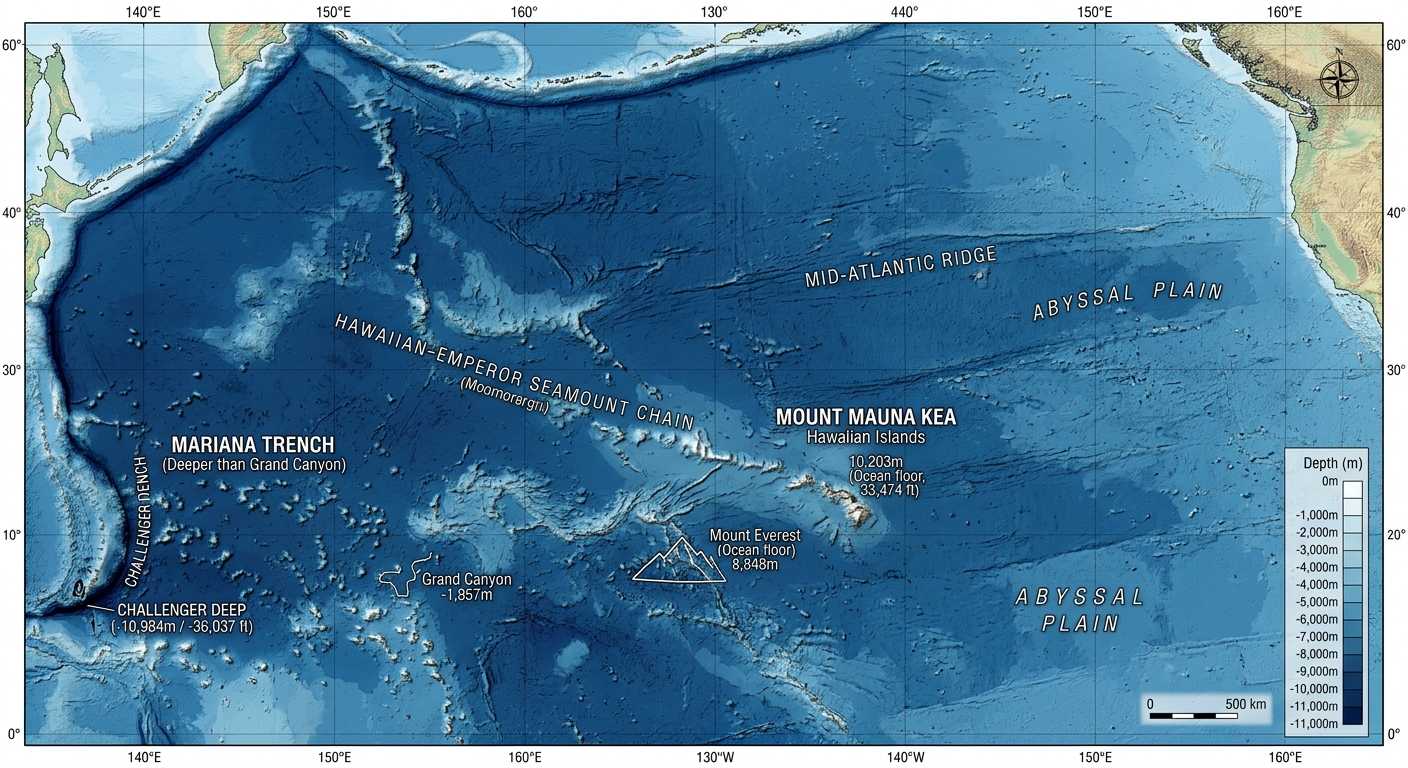
The Mid-Atlantic Ridge alone stretches over 10,000 miles, snaking through the Atlantic Ocean like a massive underwater spine. This single mountain range is longer than the Andes, Rockies, and Himalayas combined. But it’s not just about length. The Mid-Ocean Ridge system, which wraps around the globe like the seam on a baseball, covers an area larger than all the continents put together.
These aren’t just underwater hills either. Many seamounts rise from the abyssal plains to heights that would rival Mount Everest if they were on land. The Mauna Kea volcano in Hawaii, when measured from its base on the ocean floor, stands over 33,000 feet tall, making it technically taller than Everest. And there are thousands of similar underwater mountains we’ve barely begun to explore.
Why Ocean Floor Topography Is So Extreme
The ocean floor’s dramatic landscape exists because of fundamental differences in how geological processes work underwater versus on land. On the surface, wind, rain, and ice constantly wear down mountains and fill in valleys. This weathering and erosion act like a cosmic landscaper, smoothing out the Earth’s rougher edges over millions of years.
Underwater, these erosive forces are virtually absent. Without wind and rain, and with water actually protecting geological formations from many weathering processes, underwater mountains and canyons can maintain their dramatic profiles for tens of millions of years longer than their land-based counterparts.
Volcanic Activity: The Ocean Floor’s Explosive Secret
While we know about famous volcanoes like Mount Vesuvius and Mount Fuji, the majority of Earth’s volcanic activity actually happens on the ocean floor. Scientists estimate that over 75% of all volcanic activity on our planet occurs underwater, hidden from human view.
The mid-ocean ridges are essentially massive underwater volcanic mountain ranges that are constantly growing. These ridges produce new oceanic crust at a rate of several centimeters per year through continuous volcanic activity. This means that right now, as you read this, the ocean floor is literally expanding through underwater eruptions happening 24 hours a day, 365 days a year.
Hydrothermal Vents: Underwater Volcanic Oases
Perhaps the most fascinating volcanic features on the ocean floor are hydrothermal vents. These underwater geysers spew superheated water rich in minerals, creating chimney-like structures that can grow to several stories tall. The water emerging from these vents can reach temperatures of over 700 degrees Fahrenheit, hot enough to melt lead.
Around these vents, entire ecosystems thrive in complete darkness, thousands of feet below the surface. Giant tube worms, ghostly white crabs, and bacteria that feed on chemicals rather than sunlight create alien-like communities that challenge our understanding of where life can exist.
Canyons That Make the Grand Canyon Look Like a Creek Bed
The Monterey Canyon off the coast of California plunges deeper and cuts wider than the Grand Canyon. At its deepest point, it reaches down over 12,000 feet below sea level. But Monterey Canyon is just one of thousands of submarine canyons that carve through the continental shelves around the world.
These underwater canyons form through different processes than their land-based cousins. Instead of rivers slowly carving through rock over millions of years, submarine canyons are often carved by massive underwater landslides, turbidity currents that move like underwater avalanches, and the gradual slumping of sediment-laden slopes.
The Mariana Trench: Earth’s Deepest Frontier
The deepest part of our planet isn’t on top of the highest mountain looking up at space, it’s at the bottom of the Mariana Trench looking up at over 36,000 feet of water. This crescent-shaped trench in the Pacific Ocean is so deep that if Mount Everest were placed at its bottom, the peak would still be over a mile underwater.
The pressure at the bottom of the Mariana Trench is over 1,000 times greater than at sea level, equivalent to having 50 jumbo jets pressing down on every square meter. Yet even in this extreme environment, life finds a way. Scientists have discovered organisms thriving in these crushing depths, proving that life on Earth is far more resilient and adaptable than we ever imagined.
Mapping the Unknown: Why We Know More About Mars Than Our Ocean Floor
The irony of our situation is striking. We have detailed maps of Mars, comprehensive images of the moon’s surface, and precise measurements of distant planets, yet we’ve mapped less than 20% of our own ocean floor in high resolution. The combination of crushing pressure, total darkness, and vast distances makes exploring the deep ocean more challenging than exploring space.
Every deep-sea expedition reveals new mountains, previously unknown volcanoes, and undiscovered canyons. In 2020 alone, scientists discovered over 30 new species and mapped several underwater mountain ranges that were completely unknown to science.
The Future of Deep-Sea Exploration
As technology advances, we’re beginning to unlock the secrets of this underwater realm. Autonomous underwater vehicles, advanced sonar mapping, and deep-sea submersibles are revealing a world of geological wonders that rivals any science fiction landscape.
Each new discovery reminds us that our planet still holds incredible secrets. The ocean floor represents the largest unexplored frontier on Earth, containing more mountains, volcanoes, and canyons than all the continents combined. These hidden landscapes shape our planet’s geology, influence our climate, and harbor forms of life that expand our understanding of biology itself.
The next time you look out at the ocean’s surface, remember that beneath those waves lies a world of geological drama that makes terrestrial landscapes look positively tame by comparison.


this is wild because it really puts into perspective how much of earth we basically dont know about yet, like theres probably entire ecosystems down there we havent even catalogued. i wonder if anyone has tried mapping these with the same kind of community science approach that works so well for surface observations – crowd sourced sonar data or something. the ocean floor is basically the last true frontier and it bugs me that we know more about the moon sometimes
Log in or register to replyI’ve been tracking seasonal shifts in our local watershed for years now, and this really resonates with me, Priya. We obsess over cataloging surface-level details while the deep currents and underwater geology that literally drive so much of our climate and ecology remain mysterious. It makes me think about how true conservation has to start with seeing what’s actually there, even if “there” is thousands of meters down. Ben, they are mapping some of these with sonar tech, but you’re right that the actual biological surveys lag so far behind.
Log in or register to replyomg this is exactly why i find myself thinking about how much we still dont understand about earths systems, like we can name every cultivar of monstera but we barely know whats happening in the mariana trench?? its kind of humbling honestly. makes me wonder if some of the deep sea organisms down there have communication or chemical signaling systems as complex as what we’re discovering with mycorrhizal networks in soil – the ocean floor could be a totally different dimension of intelligence that we just havent figured out how to detect yet
Log in or register to reply