
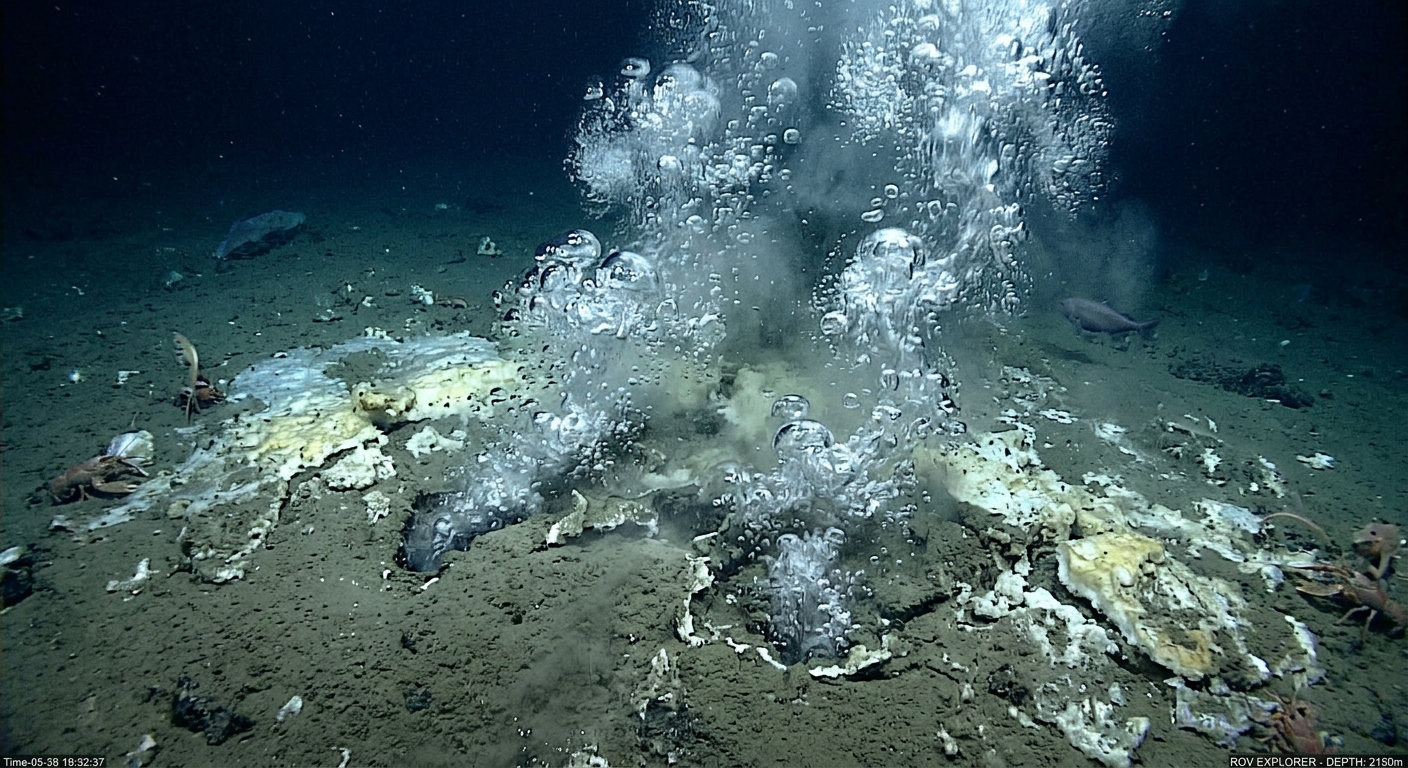
Deep beneath the ocean’s surface, a vast frozen reservoir contains enough methane to fundamentally alter our planet’s climate system. These crystalline structures, known as methane hydrates, represent one of the most significant yet least understood threats to global climate stability. Scientists estimate that seafloor methane hydrates contain more carbon than all known fossil fuel reserves combined, making them a potential climate change accelerator of unprecedented scale.
What Are Methane Hydrates?
Methane hydrates, often called “fire ice,” are cage-like crystalline structures formed when methane gas becomes trapped within frozen water molecules under specific conditions of high pressure and low temperature. These remarkable formations occur naturally in ocean sediments and permafrost regions, where the extreme environment creates the perfect conditions for their formation and stability.
The appearance of methane hydrates is deceptively simple. They look like ordinary ice, yet they contain a potent greenhouse gas that is 25 times more effective at trapping heat than carbon dioxide over a 100-year period. When brought to the surface, these ice-like structures can literally be set on fire, burning with a clean blue flame as the trapped methane escapes and ignites.
The Ocean’s Hidden Methane Reserves
The seafloor hosts the vast majority of Earth’s methane hydrate deposits. These formations are primarily found along continental margins, where organic matter accumulates and decomposes in oxygen-poor environments. The process begins when bacteria break down organic material, producing methane that becomes trapped in ice-like structures under the immense pressure of deep ocean water.
Global Distribution and Scale
Current estimates suggest that oceanic methane hydrate deposits contain between 1,000 to 5,000 gigatons of carbon. To put this in perspective, the entire atmosphere currently contains approximately 850 gigatons of carbon. The largest known deposits exist in:
- The continental slopes of the Atlantic and Pacific Oceans
- The Gulf of Mexico
- The seas surrounding Japan and South Korea
- The Arctic Ocean margins
- The Mediterranean Sea floor
These deposits formed over millions of years through the continuous accumulation and decomposition of marine organic matter, creating vast underwater reserves that dwarf conventional natural gas deposits.
The Climate Change Connection
The relationship between methane hydrates and climate change creates a potentially catastrophic feedback loop. As ocean temperatures rise due to global warming, the stability of these frozen methane deposits becomes compromised. The process is insidious because it’s largely invisible, occurring thousands of feet below the ocean surface.
Temperature Sensitivity
Methane hydrates are stable within a narrow temperature range. Even a warming of just a few degrees Celsius in deep ocean waters can destabilize vast deposits, causing them to break down and release their trapped methane. This process is irreversible once it begins, as the released methane contributes to further atmospheric warming, which in turn destabilizes more hydrate deposits.
Recent studies have detected methane plumes rising from the seafloor in various locations worldwide, suggesting that this process may already be underway. Underwater monitoring stations have recorded increasing methane concentrations in areas previously considered stable, indicating that warming ocean temperatures are beginning to affect these deposits.
The Clathrate Gun Hypothesis
Scientists have proposed the “clathrate gun hypothesis” to describe a scenario where rapid warming triggers massive methane hydrate decomposition, leading to runaway climate change. This hypothesis suggests that once a critical threshold is reached, the release of methane could accelerate global warming far beyond current projections.
Historical Precedents
Geological evidence indicates that methane hydrate releases may have contributed to past climate catastrophes. The Paleocene-Eocene Thermal Maximum, which occurred 55 million years ago, saw global temperatures rise by 5-8 degrees Celsius in just a few thousand years. Some researchers believe that massive methane hydrate releases played a crucial role in this ancient warming event.
More recently, methane hydrate destabilization has been linked to warming events during the last ice age, demonstrating that these systems can respond relatively quickly to temperature changes on geological timescales.
Current Research and Monitoring
Scientists worldwide are racing to understand methane hydrate behavior and monitor existing deposits for signs of instability. Advanced underwater research vessels equipped with sophisticated sensors regularly survey known hydrate fields, measuring temperature changes, methane concentrations, and seafloor stability.
Technological Challenges
Studying methane hydrates presents unique technical challenges. The extreme depths, high pressures, and remote locations make direct observation difficult and expensive. Researchers must rely on:
- Seismic surveys to map hydrate distributions
- Deep-sea drilling to collect samples
- Underwater autonomous vehicles for continuous monitoring
- Computer modeling to predict future behavior
Implications for Climate Policy
The potential for methane hydrate releases adds urgency to climate change mitigation efforts. Current climate models may underestimate future warming if they don’t fully account for potential methane hydrate feedback effects. This uncertainty has significant implications for climate policy and international agreements.
The discovery of methane hydrate instability also highlights the importance of ocean temperature monitoring and deep-sea research funding. Understanding these systems could be crucial for predicting and potentially mitigating future climate impacts.
The Race Against Time
As global temperatures continue to rise, the stability of seafloor methane hydrates becomes increasingly precarious. While scientists debate the exact timeline and mechanisms involved, the potential consequences demand immediate attention. The challenge lies in developing monitoring systems, improving climate models, and implementing mitigation strategies before critical thresholds are crossed.
The methane hydrates sleeping beneath our oceans represent one of Earth’s most significant climate wildcards. Understanding and monitoring these frozen time bombs may be essential for preventing runaway climate change and protecting our planet’s future habitability.
yeah philip’s right about the timescales thing, the PETM is such a great example because even with that massive warming event the feedback loops took thousands of years to really play out, not overnight doomsday scenarios. that said the methane hydrate releases are still a real concern we need to monitor seriously, just maybe with a bit less apocalyptic framing? sorry im always that person lol but the science is dramatic enough without the extra doom and it actually helps people take it more seriously when we get the details right
Log in or register to replyThis is genuinely terrifying climate science, but I have to say it’s a relief to see mainstream attention on something other than vampire bats for once (seriously, they’re like 0.3% of bat species and people won’t let it go). The methane clathrate threat is real and deserves the urgency you’re describing, though I’d love to see similar energy directed at how bat populations collapsing from white-nose syndrome actually impacts our ability to control insect populations that further stress ecosystems dealing with warming oceans. Bats eat millions of tons of insects annually, and we’re losing them to a fungus that’s entirely preventable with better cave management and research funding, so there’s this
Log in or register to replyThe methane hydrate feedback loop is definitely worth taking seriously, though it’s worth noting the actual release timescales are probably slower than “apocalypse” suggests, since these systems have responded to dramatic warming before (like during the Paleocene-Eocene Thermal Maximum around 56 mya) without completely spiraling into runaway. That said, yeah, we’re moving ocean temps way faster than geological processes usually work, so the real concern is whether we’re outpacing the system’s ability to buffer itself. Also Brenda, I feel you on the vampire bat thing, though fun fact: they’re actually weirdly specialized metabolically in ways that make them fascinating even outside the “spooky
Log in or register to reply