
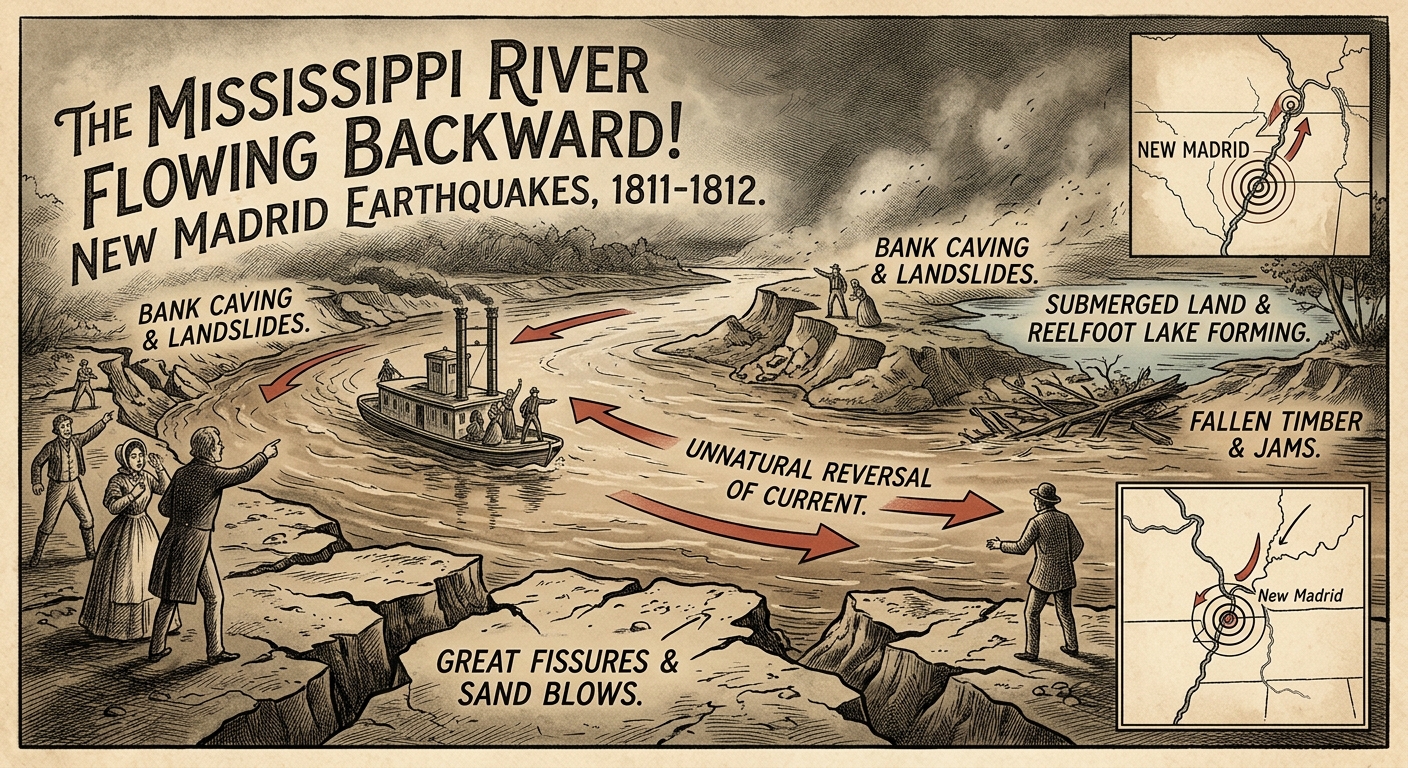
Imagine standing on the banks of the Mississippi River and watching in horror as the mighty waterway suddenly stops flowing, churns violently, and then begins rushing backward. This isn’t the plot of a disaster movie or a fever dream. This actually happened for three terrifying days in December 1811, when one of the most powerful earthquakes in American history literally reversed the flow of North America’s greatest river.
The New Madrid Earthquake Series: Nature’s Ultimate Power Display
The winter of 1811-1812 brought a series of earthquakes so violent they reshaped the American landscape. The epicenter lay near New Madrid, Missouri, in what geologists now call the New Madrid Seismic Zone. Between December 16, 1811, and February 7, 1812, at least three massive earthquakes, each estimated between magnitude 7.0 and 8.0, rocked the central United States.
But it was the first quake, striking at 2:15 AM on December 16, 1811, that performed the seemingly impossible feat of making the Mississippi River flow backward. The earthquake was so powerful that it awakened people as far away as New York City and rang church bells in Boston, over 1,000 miles from the epicenter.
How Do You Make a River Flow Backward?
The mechanics behind this incredible phenomenon involve forces so massive they beggar imagination. When the earthquake struck, it didn’t just shake the ground, it fundamentally altered the topography of the Mississippi River valley. Here’s what happened:
Massive Land Displacement
The earthquake caused enormous sections of riverbed to suddenly drop, creating instant deep basins, while other areas were thrust upward, forming temporary dams. These dramatic elevation changes disrupted the river’s natural gradient, which normally ensures water flows from north to south toward the Gulf of Mexico.
Liquefaction and River Channel Chaos
The intense seismic activity caused a process called liquefaction, where water-saturated soil temporarily behaves like liquid. This phenomenon caused riverbanks to collapse, islands to disappear entirely, and new ones to emerge from nowhere. Massive landslides dumped millions of tons of debris into the river, creating natural dams that further disrupted normal flow patterns.
The Reelfoot Lake Formation
One of the most dramatic changes occurred when a large section of land suddenly sank 15-20 feet below its original level. This created Reelfoot Lake in Tennessee, an 8-mile-long body of water that formed almost instantly. The creation of this lake, along with other topographical changes, contributed to the river’s confused flow patterns.
Eyewitness Accounts: Terror on the River
The few people living in the sparsely populated region left haunting accounts of the disaster. Eliza Bryan, a resident of New Madrid, described the scene:
“The Mississippi first seemed to recede from its banks, and its waters gathering up like a mountain, leaving for a moment many boats on bare sand, in which time the poor sailors made their escape from them. It then suddenly rolled forward again with great velocity, taking with it all that opposed its course.”
Boat crews reported the most terrifying experiences. Many described their vessels being swept upstream by the reversing current, while others told of being stranded on suddenly exposed riverbed before massive waves crashed over them. Some boats were carried inland by the churning waters, ending up hundreds of yards from the river’s new course.
The Science Behind the Impossible
Modern seismologists have studied this event extensively to understand how such extreme geological forces could overcome the Mississippi’s massive flow. The river normally carries about 600,000 cubic feet of water per second past New Madrid. Reversing this flow required forces equivalent to several nuclear weapons.
Seismic Waves and Water Displacement
The earthquake generated powerful seismic waves that traveled through the Earth’s crust faster than the river water could react. These waves created a domino effect of land movements that essentially “pulled the rug out” from under the flowing river. The water, temporarily having nowhere to go in its normal direction, was forced to flow backward until new channels and gradients established themselves.
Temporary Dam Formation
Geologists believe that temporary dams formed from landslides and upthrust land masses created a backup effect. Picture a massive beaver dam suddenly appearing across the Mississippi: the backed-up water would have nowhere to go except backward, creating the reverse flow that terrified witnesses described.
Long-term Consequences and Changes
The earthquake’s effects on the Mississippi River weren’t limited to those three days of reverse flow. The seismic activity permanently altered the river’s course in several locations, created new tributaries, and eliminated others. Several river islands disappeared forever, while new ones emerged from the changed riverbed.
The disaster also marked one of the first major tests of the federal government’s disaster response capabilities. Land records were destroyed, property boundaries became meaningless when the land itself had moved, and the federal government eventually passed special legislation to help affected landowners.
Could It Happen Again?
The New Madrid Seismic Zone remains active today, though major earthquakes are relatively rare. Scientists estimate there’s a 7-10% chance of a repeat performance in the next 50 years. However, the consequences would be far more catastrophic now, given the millions of people living in the region and the extensive infrastructure that depends on the Mississippi River.
Modern earthquake monitoring and early warning systems would provide some advance notice, but the fundamental physics remain unchanged. A sufficiently powerful earthquake in the right location could still, theoretically, make the Mississippi flow backward again.
Nature’s Ultimate Reminder
The 1811 New Madrid earthquake serves as a humbling reminder of the incredible forces constantly at work beneath our feet. In just three days, it demonstrated that even something as fundamental and seemingly permanent as a river’s flow direction can be altered by the planet’s immense geological power.
The next time you see the Mississippi River flowing peacefully toward the Gulf of Mexico, remember those three extraordinary days in December 1811 when nature rewrote the rules and made America’s mightiest river run backward. It stands as one of the most bizarre and fascinating examples of our planet’s ability to surprise us with displays of power that defy our everyday understanding of how the world works.




This is such a fascinating historical event! I’m curious though, not to derail from the earthquake itself, but I wonder how something like this affected the aquatic mammals in the Mississippi at that time, especially the river dolphins and whatever marine life depended on that specific current direction. It’s a good reminder that we often overlook how interconnected everything in these ecosystems really is, kind of like how humpbacks navigate by sensing Earth’s magnetic fields, cetaceans in general have these intricate relationships with their environments that we’re still learning about.
Log in or register to replyYou’re totally right that we overlook these ecosystem connections, and the 1811 reversal probably devastated migratory fish runs and displaced the remaining pallid sturgeon and paddlefish that relied on those currents, though honestly the bigger concern for me is how modern dams like those on the Upper Mississippi now permanently disrupt what that earthquake only did for three days. The magnetic navigation angle is interesting too, but I’d add that what really gets me fired up is how we’ve systematized the destruction of dynamic river systems instead of letting them do their natural thing like that earthquake forced temporarily, you know?
Log in or register to replyoh wow ive read about the 1811 new madrid quake but never knew the mississippi actually reversed, thats absolutely wild and makes me wonder how many bird populations got displaced during that time, especially since so many species depend on those specific river corridors during migration. id love to see if theres any historical records about what happened to the warblers and shorebirds that year cause that kind of geological disruption would have totally thrown off their navigation.
Log in or register to reply