
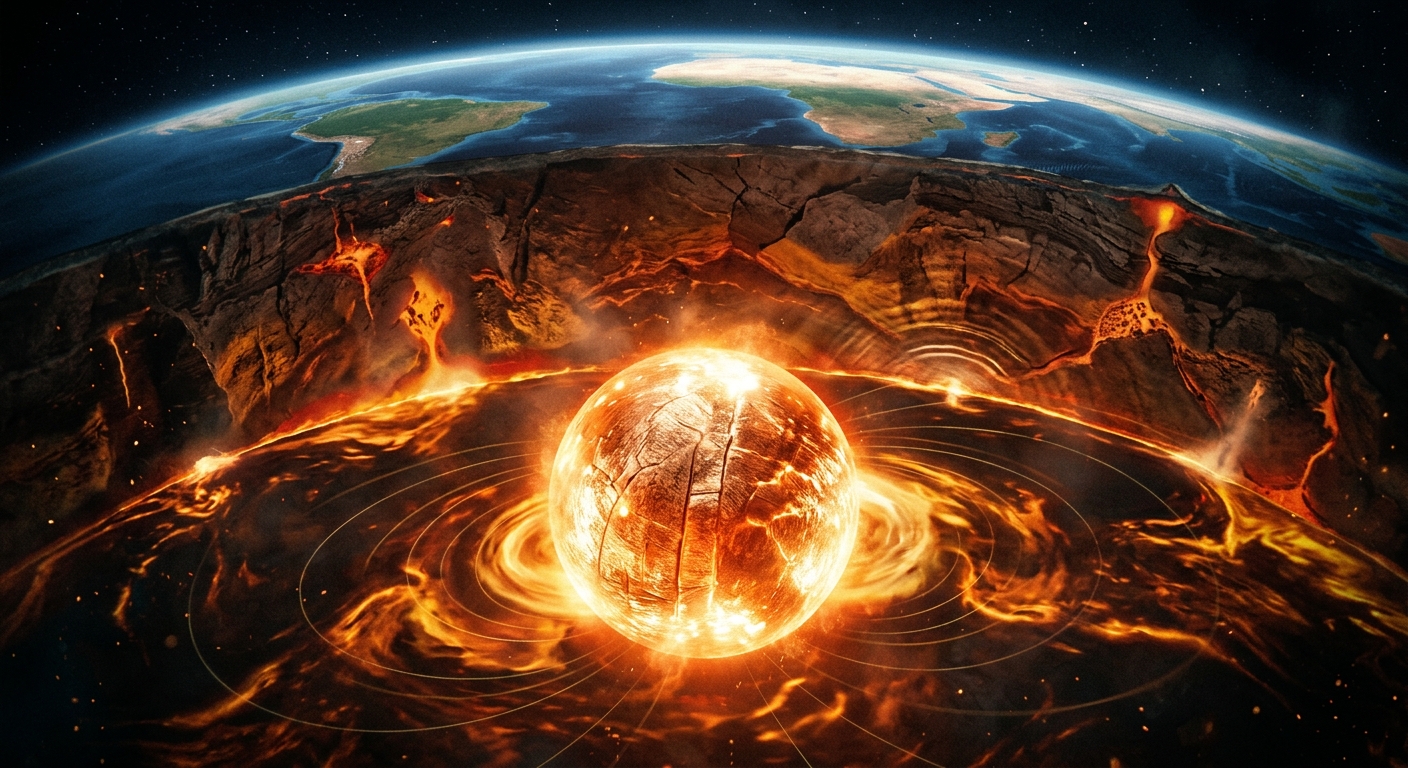
Deep beneath your feet, over 3,000 miles below the surface, lies one of Earth’s most mind-boggling secrets. While you’re going about your daily life, assuming the entire planet rotates as one solid unit, the truth is far stranger. Our planet’s innermost core, a solid ball of iron and nickel roughly the size of the Moon, marches to the beat of its own drum, spinning at a completely different speed than the rest of Earth.
This discovery has revolutionized our understanding of planetary mechanics and continues to baffle scientists worldwide. How is it possible for the center of our planet to rotate independently? What forces drive this cosmic dance? And what does this mean for life on the surface?
The Incredible Journey to Discovery
For most of human history, we had no idea what lay at Earth’s center. Ancient civilizations imagined everything from underworld realms to vast caverns filled with fire. It wasn’t until the 20th century that seismologists began using earthquake waves to peer into our planet’s depths, like using sound to map the inside of a locked room.
The breakthrough came in 1996 when geophysicist Xiaodong Song and his colleagues at Columbia University made an astonishing observation. By analyzing seismic waves from earthquakes that had traveled through the inner core over several decades, they noticed something extraordinary: the waves were arriving at detection stations slightly earlier than expected based on previous measurements.
This could only mean one thing – the inner core was moving. Not just vibrating or shifting, but actually rotating faster than the rest of the planet. The scientific community was stunned. How could a ball of solid metal, suspended in liquid iron thousands of miles below the surface, spin independently?
The Mechanics of a Spinning Core
To understand this phenomenon, imagine a ball bearing floating in honey, with magnetic forces acting upon it. Earth’s inner core exists in a similar situation, surrounded by the liquid outer core and influenced by powerful electromagnetic forces.
The Three-Layer System
Earth’s core isn’t just one uniform mass. It consists of two distinct layers:
- The Outer Core: A churning ocean of liquid iron and nickel, roughly 1,400 miles thick, with temperatures reaching 8,000°F
- The Inner Core: A solid ball of iron-nickel alloy, about 760 miles in radius, under such immense pressure that it remains solid despite being hotter than the Sun’s surface
The boundary between these layers acts like a frictionless bearing, allowing the inner core to rotate independently while the liquid outer core flows around it.
The Driving Forces
Several forces work together to create this differential rotation:
- Electromagnetic coupling: The flowing liquid iron in the outer core generates Earth’s magnetic field through a process called the geodynamo. This same process creates electromagnetic forces that can speed up or slow down the inner core’s rotation
- Gravitational forces: Slight variations in the Earth’s gravitational field, caused by surface features and the Moon’s pull, can influence the inner core’s motion
- Thermal convection: Heat flow from the inner core boundary drives convection in the outer core, creating additional torques
The Rate of Rotation: A Moving Target
Initially, scientists believed the inner core rotated about 0.3 to 0.5 degrees per year faster than the surface. This means it completes one full extra rotation relative to the surface roughly every 720 to 1,200 years. However, recent studies have revealed that this rate isn’t constant.
In 2022, researchers from Peking University published findings suggesting that the inner core’s rotation has been slowing down since around 2009. Even more remarkably, some evidence points to periods when the inner core may have briefly rotated slower than the surface, or even paused its differential rotation entirely.
This variability suggests that the forces controlling the inner core’s motion are far more complex and dynamic than previously thought. The inner core appears to undergo decades-long cycles of speeding up and slowing down, like a cosmic pendulum swinging back and forth through geological time.
Implications for Earth’s Magnetic Field
The inner core’s independent rotation has profound implications for Earth’s magnetic field, which shields us from harmful solar radiation and cosmic rays. The interaction between the solid inner core and the liquid outer core helps maintain the geodynamo process that generates our magnetic field.
Changes in the inner core’s rotation rate could potentially influence:
- The strength of Earth’s magnetic field
- The location of magnetic north and south poles
- The frequency of magnetic field reversals
- The formation of magnetic anomalies
Some scientists theorize that variations in inner core rotation might contribute to the gradual weakening of Earth’s magnetic field observed over the past few centuries, though this connection remains highly debated.
Effects on Day Length and Earth’s Surface
While the inner core’s differential rotation might seem too distant to affect surface life, some researchers suggest it could have subtle influences on our planet’s rotation rate. Extremely precise atomic clocks have detected tiny variations in the length of Earth’s day, sometimes changing by milliseconds over years or decades.
These variations could be partially attributed to:
- Exchange of angular momentum between the inner core and the rest of the planet
- Changes in Earth’s moment of inertia as the inner core’s rotation varies
- Coupling effects between the core and the mantle
The Ongoing Mystery
Despite decades of research, the inner core’s rotation remains one of Earth’s most enigmatic phenomena. Every new study seems to reveal additional layers of complexity, challenging our understanding of deep Earth dynamics.
Current research focuses on:
- Improving seismic imaging techniques to better track inner core motion
- Understanding the coupling mechanisms between different layers of the core
- Modeling the long-term evolution of inner core rotation
- Investigating potential connections to surface phenomena and climate patterns
As we continue to peer deeper into our planet’s heart with increasingly sophisticated tools, one thing becomes clear: Earth is far more dynamic and complex than we ever imagined. The next time you feel the solid ground beneath your feet, remember that you’re standing on a planet within a planet, where a Moon-sized ball of iron spins to its own mysterious rhythm, thousands of miles below, helping to maintain the magnetic shield that makes life on Earth possible.
This spinning core serves as a humbling reminder that even our home planet still holds secrets waiting to be unlocked, continuing to surprise us with its hidden wonders and complex inner workings.



okay but this is actually kind of like how ophiocordyceps fungi manipulate ant behavior – like theres this whole hidden system operating independently that most people never even think about, and its controlling fundamental things about our planet the same way the fungus controls the ant’s movement toward optimal spore dispersal conditions. the core doing its own thing down there while we walk around on the surface is genuinely just as wild as zombie ants, parasites and planetary mechanics both reminding us that nature operates on scales and systems way weirder than we give it credit for
Log in or register to replyThis is exactly the kind of exhibit I wish every natural history museum had a whole wing dedicated to, because you’re both touching on something crucial: once people understand there’s a *system* underneath everything they take for granted, suddenly they want to know more about all the systems. I’ve had more conversations start with “wait, the core spins differently?” than with almost any other science fact, and it’s because it hits that sweet spot of being totally weird but also totally real and affecting you right now.
Log in or register to replyhonestly this is the kind of thing that gets me as emotional as watching a dumbo octopus drift through the midnight zone, like theres literally an entire spinning world happening 3000 miles down that we barely understand and people are out here saying we know more about mars lol. the way our planets literally has its own internal rhythm separate from us… ngl that feels way more alien then anything in outer space tbh.
Log in or register to reply