
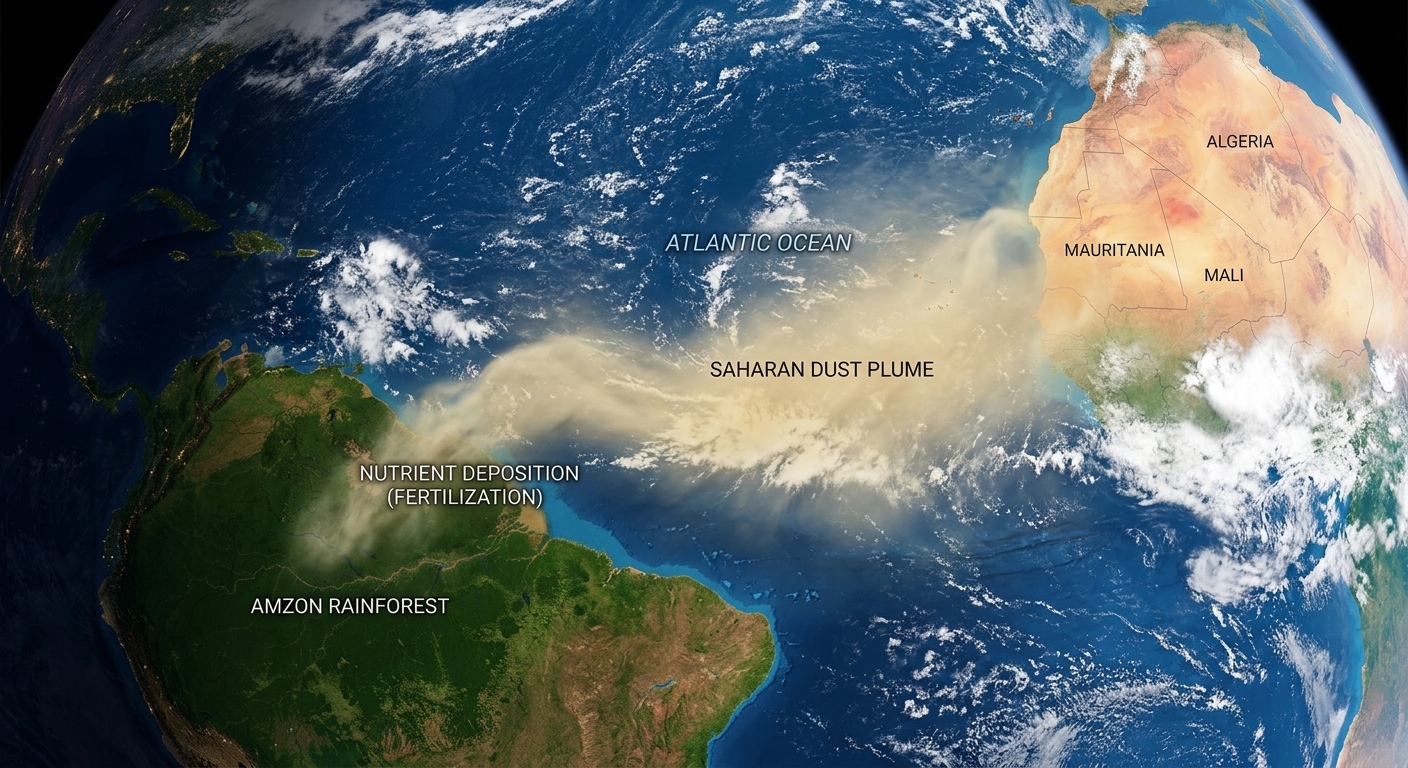
Imagine a river in the sky, carrying precious cargo across an entire ocean. While you can’t see it with the naked eye, one of Earth’s most spectacular natural phenomena unfolds above our heads every year: the Sahara Desert literally feeds the Amazon rainforest through an atmospheric highway that spans two continents.
The Great Dust Migration
Every year, approximately 22,000 tons of dust particles lift off from the Sahara Desert and begin an extraordinary 4,000-mile journey across the Atlantic Ocean. By the time this aerial caravan reaches South America, it delivers roughly 22 million tons of mineral-rich sediment to the Amazon basin. But here’s where the story gets truly mind-bending: much of this dust originates from a single location.
The Bodélé Depression in Chad, a dried-up lakebed smaller than the state of West Virginia, contributes nearly half of all the dust that eventually nourishes the world’s largest rainforest. This ancient lake basin, once part of the massive Lake Mega-Chad, now serves as Earth’s most prolific dust factory.
Nature’s Fertilizer Delivery System
What makes this transcontinental dust delivery so crucial for the Amazon? The answer lies in chemistry. Saharan dust is loaded with phosphorus, a vital nutrient that the Amazon desperately needs but lacks in its own soil.
The Phosphorus Problem
Amazon soils are notoriously nutrient-poor, particularly in phosphorus. Heavy tropical rains constantly wash away essential minerals, creating a paradox: how does the world’s most biodiverse rainforest thrive in such nutrient-depleted conditions? The answer blows in from Africa every year.
Scientists estimate that Saharan dust delivers about 22,000 tons of phosphorus annually to the Amazon basin. To put this in perspective, that’s roughly equivalent to the amount of phosphorus lost each year through rainfall and flooding. Nature has created a perfectly balanced system where Africa’s loss becomes South America’s gain.
The Journey Across the Atlantic
The voyage of Saharan dust reads like an epic adventure novel. It begins when powerful trade winds, particularly during the dry season from December to April, lift billions of microscopic particles from the desert floor. These dust clouds can tower up to 20,000 feet into the atmosphere, creating massive plumes visible from space.
Riding the Trade Winds
Once airborne, the dust catches a ride on the African Easterly Jet, a river of fast-moving air that flows west across the Atlantic. This atmospheric conveyor belt carries the dust at speeds of up to 35 miles per hour, completing the transatlantic journey in just five to seven days.
The scale of these dust storms is breathtaking. Satellite images reveal dust plumes stretching over 2,000 miles long and 1,000 miles wide. Some are so massive they can be seen from the International Space Station, appearing like vast brown brushstrokes painted across the blue Atlantic.
More Than Just Plant Food
While phosphorus gets most of the attention, Saharan dust delivers a complete mineral buffet to the Amazon:
- Iron: Essential for chlorophyll production and photosynthesis
- Calcium: Crucial for plant cell wall development
- Magnesium: A key component of chlorophyll molecules
- Potassium: Vital for plant water regulation and disease resistance
- Silicon: Helps plants resist pests and diseases
This mineral delivery service doesn’t just feed plants directly. The dust also nourishes soil microorganisms, which in turn support the complex web of life that makes the Amazon possible.
A Delicate Balance
Recent research has revealed that this dust highway operates on a surprisingly precise schedule. Too little dust, and the Amazon suffers from nutrient deficiency. Too much, and the excess particles can actually harm plant growth and affect local weather patterns.
Climate Change Concerns
Scientists are closely monitoring how climate change might disrupt this ancient system. Shifting wind patterns, changing precipitation in the Sahara, and alterations to storm intensity could all impact the amount and timing of dust delivery to the Amazon.
Some studies suggest that prolonged droughts in the Sahara could increase dust production, while others indicate that changing atmospheric circulation patterns might redirect dust plumes away from South America entirely.
The Invisible Connection
This remarkable relationship between the Sahara and Amazon demonstrates one of nature’s most elegant solutions to a logistical nightmare. How do you transport 22 million tons of fertilizer across an ocean without trucks, ships, or planes? You let the atmosphere do the work.
The next time you see a stunning sunset enhanced by atmospheric dust, or notice a slightly hazy sky, you might be witnessing part of this incredible intercontinental nutrient exchange. It’s a reminder that our planet operates as one interconnected system, where events in Africa directly influence the health of rainforests in South America.
This sky bridge between continents has been operating for thousands of years, long before humans understood its importance. It’s a testament to Earth’s remarkable ability to maintain balance through systems so vast and complex that we’re only beginning to understand them fully.

ok but like can we just talk about how absolutely bonkers it is that life finds a way to thrive in both of these extreme environments – the Sahara is basically a desert hellscape and yet somehow microorganisms are out there thriving in that dust cloud, and then those same nutrients end up feeding one of the most biodiverse places on earth? i keep thinking about tardigrades and how they can literally survive in space and extreme radiation and it makes you wonder if theres some kind of microscopic hitchhikers getting carried on that dust too, just casually crossing an ocean in a dormant state waiting to land somewhere with water again, like the whole thing is this insane evolutionary chess move that nature has been
Log in or register to replyThis is fascinating stuff, though I’m curious how climate change and increased desertification are affecting the consistency of this nutrient delivery – I’ve been monitoring phosphorus levels in rivers and noticing some wild fluctuations that make me wonder if we’re seeing disruptions in these long-distance ecological connections. The Amazon’s dependency on this distant source is kind of like how dam construction upstream destroys spawning habitats downstream, you know? These ecosystems are so intricately linked that we don’t always see the full cascade of impacts until something breaks.
Log in or register to replyYou’re touching on something that genuinely fires me up, Toby, because the museum’s desert exhibit completely undersells this! The Sahara isn’t dead at all, it’s actually this incredibly active biological system, and what makes the dust transport so wild is that those microorganisms and mineral particles are literally essential to ecosystems thousands of miles away that people think are self-contained. It’s this humbling reminder that there’s no such thing as a standalone ecosystem, and once you really *see* that interconnection, you can’t unsee how fragile everything is.
Log in or register to reply