
Across the dense forests of North America, from the Pacific Northwest to the Appalachian Mountains, thousands of people have reported encounters with something that shouldn’t exist. What makes the Bigfoot phenomenon truly fascinating isn’t just the sheer volume of sightings, but the remarkable consistency of details reported by witnesses who have never met, spanning decades and thousands of miles.
The Numbers That Demand Attention
The Bigfoot Field Researchers Organization (BFRO) has catalogued over 5,000 documented sightings since 1995, but researchers estimate the total number of reported encounters across North America exceeds 50,000 when including historical accounts and unreported incidents. What’s striking isn’t just the quantity, but the geographic distribution: sightings cluster in areas with specific environmental characteristics, primarily old-growth forests with abundant water sources and minimal human activity.
Unlike many cryptozoological phenomena that fade with time, Bigfoot reports have actually increased with population growth and outdoor recreation expansion. Modern technology hasn’t diminished the accounts, instead, trail cameras, smartphone videos, and GPS tracking have added new dimensions to witness testimonies.
The Uncanny Consistency of Description
Perhaps the most compelling aspect of the Bigfoot phenomenon lies in the remarkable uniformity of witness descriptions. Independent accounts from strangers separated by decades and continents describe:
- Physical characteristics: Bipedal creatures standing 7-9 feet tall, covered in dark brown or black hair, with broad shoulders and long arms
- Facial features: Human-like but more primitive faces with pronounced brow ridges and minimal neck visibility
- Behavior patterns: Avoidance of humans, primarily nocturnal activity, and surprisingly graceful movement through dense forest
- Distinctive odor: An overwhelming musky scent often compared to wet dog mixed with garbage
- Vocalizations: Deep whooping calls, wood knocking sounds, and occasionally screams or howls
This consistency becomes even more remarkable when considering that many witnesses report being unfamiliar with Bigfoot lore before their encounters. Children, in particular, often describe creatures matching classic Bigfoot characteristics without prior exposure to the mythology.
Geographic Hotspots and Environmental Patterns
Bigfoot sightings aren’t randomly distributed across North America. Instead, they cluster in specific regions that share remarkable ecological similarities. The Pacific Northwest remains the epicenter, with Washington state alone accounting for over 2,000 reported encounters. However, significant activity occurs in:
Primary Hotspots
- Olympic Peninsula, Washington: Dense temperate rainforests with limited human access
- Northern California: Redwood forests and remote mountain ranges
- Southeastern Oklahoma: The Kiamichi Mountains and surrounding wilderness
- Eastern Ohio: Salt Fork State Park and adjacent forested areas
- Western North Carolina: Great Smoky Mountains region
These locations share common characteristics: extensive forest cover, abundant water sources, diverse wildlife populations, and limited human development. Researchers have noted that sighting frequency correlates with habitat suitable for large omnivorous mammals.
The Witness Profile Challenge
One of the most intriguing aspects of Bigfoot encounters involves the credibility and diversity of witnesses. Law enforcement officers, military personnel, scientists, and outdoor professionals make up a significant percentage of those reporting sightings. These individuals typically possess strong observational skills and familiarity with local wildlife, making misidentification less likely.
Dr. Jeffrey Meldrum, a professor of anatomy and anthropology at Idaho State University, has studied hundreds of witness accounts and notes the emotional consistency in testimonies: “The psychological impact described by witnesses shows remarkable uniformity. People describe feeling watched, experiencing an overwhelming sense of presence, and often report that the encounter fundamentally changed their understanding of what might exist in our forests.”
Physical Evidence and the Scientific Response
While conclusive proof remains elusive, the Bigfoot phenomenon has generated substantial physical evidence that continues to puzzle researchers:
Footprint Casts
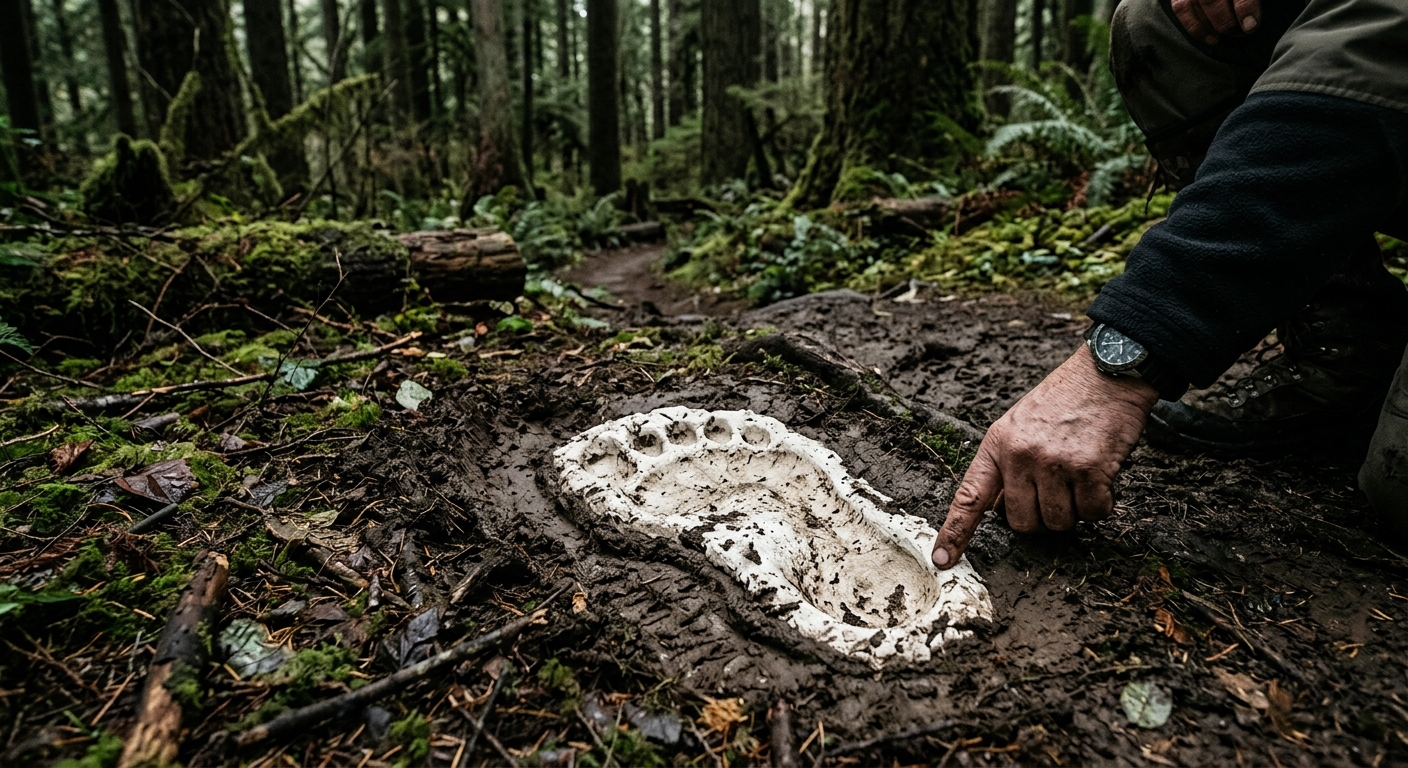
Hundreds of plaster casts document footprints measuring 14-18 inches long, showing detailed dermal ridges, toe flexibility, and weight distribution patterns. Dr. Meldrum’s analysis of these casts reveals biomechanical features consistent with a large bipedal primate, including mid-tarsal breaks not found in human feet.
Hair Samples
DNA analysis of hair samples from alleged Bigfoot encounters has yielded inconclusive results. While some samples return as “unknown primate,” contamination and degradation often prevent definitive identification.
Audio Recordings
The Sierra Sounds, recorded in California during the 1970s, capture vocalizations that acoustic analysis suggests came from a large primate with vocal tract dimensions exceeding those of humans or known North American wildlife.
Scientific Skepticism and Plausible Explanations
The scientific mainstream remains skeptical of Bigfoot’s existence, citing the lack of conclusive physical evidence, the absence of fossil records for large North American primates, and the ecological challenges of supporting a breeding population of such creatures. Skeptics propose various explanations for the consistent witness accounts:
- Misidentification: Bears walking upright, particularly black bears in poor lighting conditions
- Psychological phenomena: Pattern recognition errors and the power of suggestion in wilderness settings
- Cultural transmission: The spread of Bigfoot imagery through media creating a template for interpretation of ambiguous encounters
- Hoaxes and fabrication: Though this fails to explain the consistency across time periods before modern media saturation
The Indigenous Perspective
Long before European settlement, Native American tribes throughout North America maintained oral traditions describing creatures remarkably similar to modern Bigfoot accounts. The Lakota “Chiye-tanka,” the Seminole “Esti Capcaki,” and the Hopi “Chiye-tanka” represent just a few of dozens of indigenous names for large, hairy, bipedal forest dwellers.
These traditional accounts often describe the creatures as more than mere animals, attributing spiritual significance and intelligence that mirrors modern witness descriptions of calculated behavior and apparent awareness of human activity.
The Enduring Mystery
Whether the Bigfoot phenomenon represents an undiscovered species, a complex case of mass misidentification, or something else entirely, the consistency of accounts across such vast geographic and temporal scales demands serious consideration. The fact that thousands of independent witnesses continue to report strikingly similar encounters suggests that something real is occurring in North America’s forests.
Perhaps the most honest scientific position acknowledges that while extraordinary claims require extraordinary evidence, the dismissal of thousands of consistent witness accounts without investigation contradicts the principles of empirical inquiry. Until conclusive proof emerges one way or another, the Bigfoot phenomenon remains one of North America’s most compelling unsolved mysteries.





I’ve spent fifteen years tracking phenological shifts, and I notice the same thing happens with nature observations, people tend to see what they’re culturally primed to see. Once a description gets established (tall, dark, bipedal), it becomes the template everyone’s eyes fit new sightings into, kind of like how once you learn a bird call you hear it everywhere. The consistency might actually tell us more about human pattern recognition and cultural storytelling than about what’s moving through those forests, though I’d genuinely love to know what the actual animal encounters in those reports are describing.
Log in or register to replySandra makes a really good point here, and honestly I see this all the time with frog calls and breeding choruses in the field. Once you know what to listen for, that expectation absolutely shapes what you perceive, but I’d add that genuine ecological patterns can also look “too uniform” when they’re actually just reflecting real habitat preferences or species biology. The tricky part is separating the cultural template from actual repeatable observations, which is exactly why long-term fieldwork matters so much to me, but I’d admit amphibians leave way more verifiable evidence than Bigfoot sightings do.
Log in or register to replySandra and William are onto something really important here, and honestly it reminds me of how people describe native plants they’ve never actually identified before. Once you learn that “purple coneflower means pollinators,” suddenly every purple flower becomes a pollinator magnet in people’s minds, even if it’s actually something totally different. I think the same pattern recognition that helps us notice ecological patterns can absolutely shape what we think we’re seeing, and that’s worth being curious about rather than defensive.
Log in or register to reply