Deep in the Pacific Ocean, on one of the most remote inhabited islands on Earth, lies a mystery that has stumped linguists, archaeologists, and codebreakers for over 150 years. The rongorongo script of Easter Island represents one of the few undeciphered writing systems in the world, a collection of intricate symbols carved into wooden tablets that may hold the key to understanding a lost civilization.
A Writing System Lost in Time
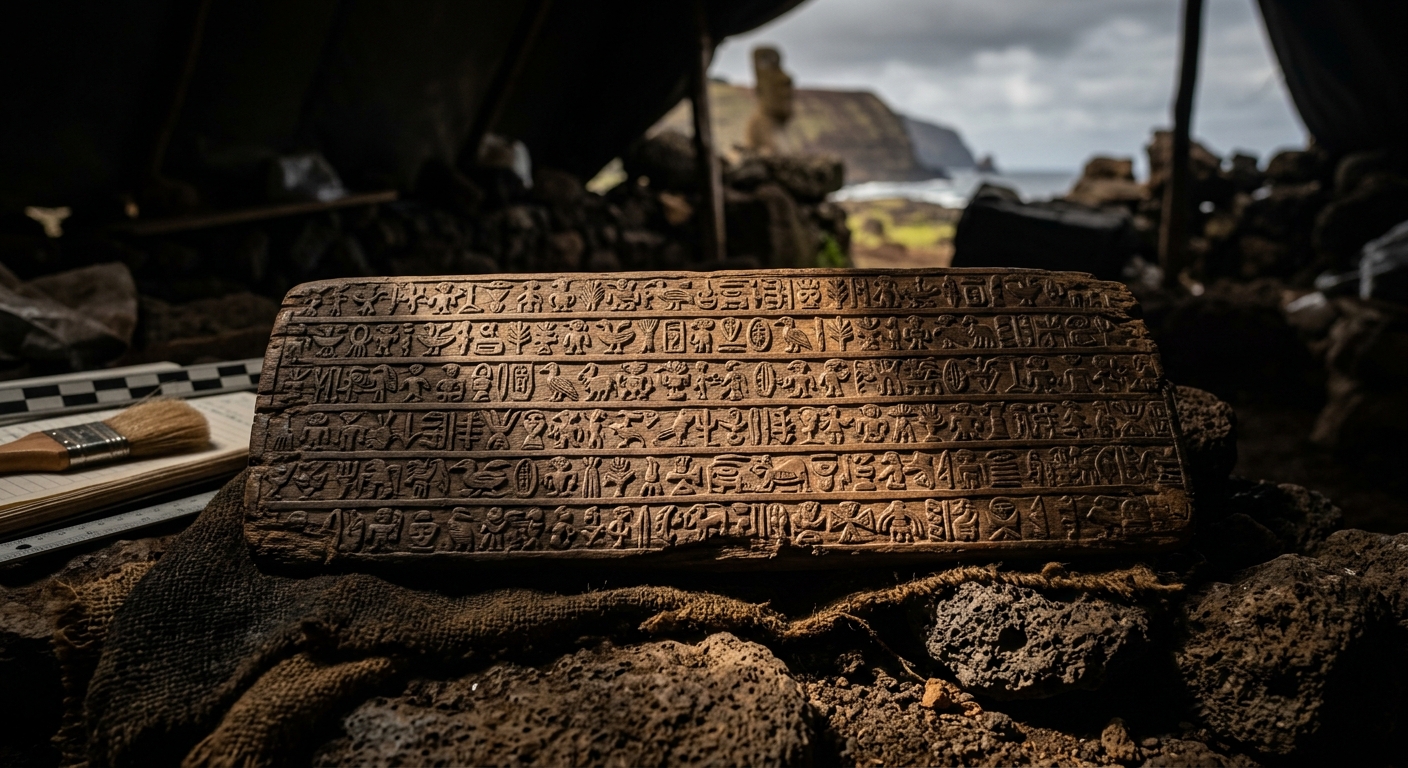
Easter Island, known to its inhabitants as Rapa Nui, is famous worldwide for its towering stone statues called moai. But these silent sentinels aren’t the only enigma this isolated island holds. Hidden in museums and private collections around the world are 26 surviving wooden artifacts covered in hundreds of mysterious glyphs that form the rongorongo script.
The word “rongorongo” means “to recite” or “to chant” in the Rapanui language, suggesting these tablets were meant to be read aloud, possibly as sacred texts or historical records. Each symbol is meticulously carved, featuring a bizarre menagerie of human figures, birds, fish, plants, and geometric shapes that seem to dance across the wood in neat rows.
The Discovery That Started a Century of Confusion
The Western world first learned of rongorongo in 1864 when French missionary Eugène Eyraud mentioned seeing wooden tablets covered in hieroglyphic characters in the homes of Easter Island natives. By the time serious scholarly interest developed, however, it was almost too late. The island’s population had been devastated by slave raids and disease, dropping from an estimated 15,000 people to just 111 survivors by 1877.
Most tragically, the knowledge of how to read rongorongo died with the island’s learned men. When researchers finally arrived to study the script seriously, they found a people who remembered that the tablets were important but could no longer decipher their meaning. It was as if an entire library of knowledge had been locked away, with the key forever lost.
The Race Against Time
In the 1880s, desperate researchers brought surviving tablets to the few remaining islanders who might remember something about the script. The results were frustrating and contradictory. Different informants gave completely different “readings” of the same passages, leading scholars to suspect that either the script was purely decorative, or the informants were making up interpretations rather than actually reading the text.
What Makes Rongorongo So Difficult to Crack?
Several factors combine to make rongorongo one of the world’s most challenging undeciphered scripts:
- Limited corpus: With only 26 surviving artifacts containing roughly 14,000 individual glyphs, researchers have far less material to work with compared to other ancient scripts
- No bilingual texts: Unlike the Rosetta Stone that helped crack Egyptian hieroglyphs, no rongorongo text exists alongside a translation in a known language
- Uncertain direction: The script appears to be written in “reverse boustrophedon,” meaning alternating lines are read in opposite directions, with every other line also inverted upside down
- Unknown language structure: Even if the symbols could be identified, researchers don’t know if they represent words, syllables, or individual sounds
Modern Attempts at Decipherment
Despite these challenges, dedicated researchers continue their attempts to unlock rongorongo’s secrets. Computer analysis has revealed that the script does show statistical patterns consistent with true writing systems rather than random decoration. The symbols appear in predictable sequences, suggesting grammatical rules and meaningful content.
Breakthrough or False Dawn?
In the 1950s, German ethnologist Thomas Barthel made what seemed like a major breakthrough, identifying what he believed were lunar calendar sequences within the script. His work suggested that at least some rongorongo texts dealt with astronomical observations and ritual calendars. However, his interpretations remain controversial, with many scholars arguing that he was reading patterns into the data that weren’t actually there.
More recently, researchers have used advanced computer modeling to analyze the frequency and distribution of symbols, comparing them to known writing systems. These studies suggest that rongorongo likely represents a true script rather than mere artistic decoration, but the actual content remains as mysterious as ever.
What Secrets Might the Tablets Hold?
If rongorongo is ever deciphered, what might we learn? The tablets could contain invaluable information about Easter Island’s history, including:
- The island’s settlement and early history
- Religious beliefs and creation myths
- Genealogies of important families and chiefs
- Astronomical knowledge and calendar systems
- Information about the island’s ecological collapse
- Details about the construction and meaning of the famous moai statues
The Broader Mystery
Rongorongo represents more than just an undeciphered script; it’s a symbol of how much human knowledge has been lost to time. Easter Island’s isolated location in the Pacific meant that its unique writing system developed independently from other world cultures, making it a precious example of human ingenuity and creativity.
The fact that we can travel to space, sequence genomes, and communicate instantly across the globe, yet remain baffled by wooden tablets carved by Pacific islanders centuries ago, serves as a humbling reminder of the gaps in our knowledge and the fragility of human cultural achievements.
Will We Ever Crack the Code?
Hope for deciphering rongorongo isn’t entirely lost. New technologies, including artificial intelligence and machine learning algorithms designed for pattern recognition, offer fresh approaches to this ancient puzzle. Additionally, ongoing archaeological work on Easter Island occasionally uncovers new artifacts that might provide additional context.
Some researchers remain optimistic that breakthrough discoveries in related Polynesian cultures, or new analytical techniques, might finally provide the key to understanding these mysterious tablets. Until then, rongorongo stands as one of our planet’s most intriguing unsolved mysteries, a reminder that even in our interconnected world, some secrets from the past continue to guard their silence.
The rongorongo script of Easter Island remains humanity’s most enigmatic writing system, holding its secrets as tightly as the moai statues hold their eternal watch over the Pacific. Whether these carved symbols will ever reveal their meaning remains one of archaeology’s greatest unanswered questions.





This is such a good point about looking at the ocean side of the story, Patricia. I’ve dived around Easter Island and the marine ecosystem there is… honestly fragile in ways that make you wonder what it was like when those settlements were thriving. The rongorongo tablets are fascinating, but yeah, understanding what happened to their fish stocks and coastal resources might tell us more about the civilization’s actual decline than cracking the script ever could. Really hope more researchers start connecting those dots!
Log in or register to replyI love the mystery angle here, but can we talk about how the *actual* mystery of Easter Island might be in the ocean around it? The collapse of that civilization is tied way more to what happened with their marine ecosystem and plankton productivity than any hidden code, honestly. Those tiny organisms that form the base of the food chain literally drove whether the island could sustain its population, and we’re still learning how climate shifts affected diatom blooms and fish availability back then. The rongorongo tablets are cool and all, but I’d argue the real undeciphered story is written in microfossils in ocean sediment cores.
Log in or register to replyPatricia’s point about the marine ecosystem is really interesting – I’d be curious to see more studies connecting offshore productivity shifts to the timing of settlement and resource stress on the island. The rongorongo script mystery definitely captures attention, but you’re right that the ecological narrative (deforestation, population dynamics, climate fluctuations between 1200-1600s) probably tells us more about what actually happened there than deciphering tablets would. Both stories matter though, and sometimes the dramatic “uncracked code” angle helps draw people into learning about the environmental context.
Log in or register to reply