
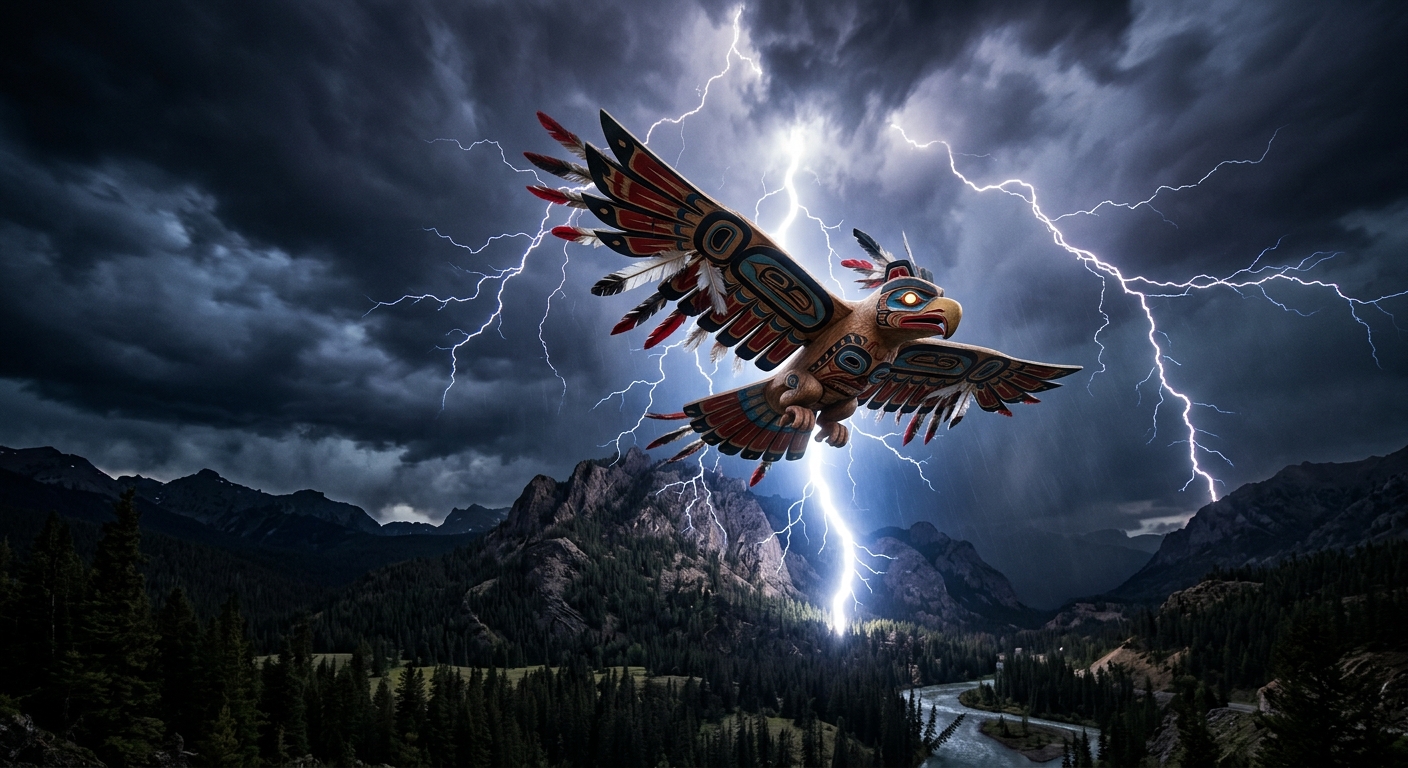
Long before meteorology became a science, Native American tribes across North America described powerful supernatural beings that controlled thunder and lightning. These “Thunder Beings” weren’t just mythical creatures born from imagination, they were surprisingly accurate descriptions of atmospheric phenomena that modern science has only recently begun to fully understand.
The Thunder Beings: More Than Mythology
Across dozens of Native American cultures, from the Lakota Sioux to the Cherokee, from the Ojibwe to the Pueblo peoples, stories of Thunder Beings appear with remarkable consistency. These entities were described as massive bird-like creatures whose wings created thunder, whose eyes flashed lightning, and whose breath brought the life-giving rains.
The Lakota called them “Wakinyan,” meaning “sacred flying ones.” The Ojibwe knew them as “Animkii,” the thunderbirds. Despite geographical separation and distinct languages, these cultures described Thunder Beings with strikingly similar characteristics that align almost perfectly with modern meteorological understanding of severe thunderstorms.
Ancient Descriptions Match Modern Storm Structure
When atmospheric scientists study severe thunderstorms today, they identify specific structural components that Native American descriptions captured with uncanny accuracy:
The Anvil Head: Wings of the Thunder Being
Native traditions consistently described Thunder Beings as having massive, spreading wings that stretched across the sky. Modern meteorology recognizes this as the anvil cloud formation, where the top of a thunderstorm spreads out horizontally when it hits the tropopause, creating the distinctive anvil or wing-like shape visible from great distances.
Lakota elder Black Elk described the Thunder Beings as having wings “so wide they darkened half the sky.” This matches exactly what observers see when a supercell thunderstorm’s anvil cloud extends 50-100 miles from the storm’s core.
Electromagnetic Phenomena: Eyes That Flash Fire
Thunder Beings were universally described as having eyes that flashed with brilliant light. This perfectly describes the cloud-to-ground and intracloud lightning that characterizes severe thunderstorms. Some traditions even specified that the beings had multiple eyes, which corresponds to the multiple lightning channels that branch through storm systems.
The Cherokee spoke of Thunder Beings whose “eyes opened and closed rapidly,” matching the rapid-fire lightning strikes that occur during peak storm intensity. Modern lightning detection networks confirm that severe storms can produce hundreds of lightning strikes per minute.
Sound Generation: The Wings That Roar
Every Thunder Being tradition emphasized the tremendous sound these creatures made. The Ojibwe described the beating of Animkii’s wings as creating rolling thunder that could be heard from great distances. This precisely describes how thunder propagates: the initial crack from nearby lightning followed by the rolling rumble as sound waves reflect off terrain and atmospheric layers.
Behavioral Patterns: Ancient Wisdom Meets Modern Forecasting
Native American Thunder Being lore didn’t just describe storm structure; it accurately predicted storm behavior patterns that meteorologists now track with sophisticated radar and satellite technology.
Seasonal Movement Patterns
Many tribes described Thunder Beings as migrating seasonally, arriving in spring and departing in fall. This matches exactly with the seasonal pattern of severe weather across North America, where atmospheric conditions conducive to thunderstorm development follow predictable seasonal cycles.
The Plains tribes particularly emphasized that Thunder Beings came from the west, bringing both destruction and life-giving rain. Modern weather patterns confirm that most severe weather systems across the Great Plains move from west to east, following jet stream patterns.
Terrain Preferences
Traditional stories often mentioned that Thunder Beings preferred certain landscapes: high places, areas where different terrain types met, and river valleys. Modern meteorology recognizes these as zones where topography enhances thunderstorm development through orographic lifting, convergence zones, and temperature differentials.
The Science Behind the Accuracy
How did pre-scientific cultures develop such accurate descriptions of complex atmospheric phenomena? The answer lies in thousands of years of careful observation and oral tradition preservation.
Native American societies were deeply connected to natural cycles, with survival depending on accurate weather prediction. Skilled observers watched storm patterns across generations, noting correlations between atmospheric conditions, seasonal changes, and storm behavior. This empirical knowledge was encoded in memorable stories that preserved essential information across centuries.
Collective Observational Wisdom
Unlike modern meteorology, which relies on instrumental data, traditional weather knowledge represented the collective observations of entire communities across vast time periods. While individual storms might vary, the consistent patterns emerged clearly to observers who watched the sky daily for survival.
Archaeological evidence suggests some Native American sites were specifically positioned to observe weather patterns, with petroglyphs and ceremonial structures aligned to track seasonal changes and storm approach routes.
Modern Validation of Ancient Knowledge
Recent advances in atmospheric science continue to validate traditional Thunder Being descriptions. Doppler radar reveals the internal structure of thunderstorms in ways that match traditional stories: the rotating updrafts described as the Thunder Being’s breathing, the downdrafts portrayed as its descent to earth, and the mesocyclone circulation depicted as the creature’s spiraling flight patterns.
Even more remarkably, modern storm chasers and meteorologists often use language that echoes traditional descriptions. They speak of storms “breathing,” having “eyes” (the calm center of rotating storms), and displaying “behavior” as they track across landscapes.
Lessons for Modern Science
The accuracy of Thunder Being lore offers important lessons for contemporary science. Traditional ecological knowledge systems often contain empirical observations that complement modern instrumental data. As climate change alters weather patterns globally, traditional knowledge from indigenous cultures worldwide may provide crucial insights into long-term atmospheric cycles that instrumental records cannot capture.
The Thunder Beings of Native American tradition weren’t just mythological constructs; they were sophisticated encoding systems for complex meteorological knowledge. In their stories of sky beings with flashing eyes and thundering wings, indigenous cultures preserved accurate descriptions of atmospheric phenomena that modern science has spent centuries learning to understand.






this is really cool to think about, though i’d be curious how much of this is pattern matching vs actual predictive accuracy? like, every culture with thunderstorms probably noticed they come with rain and loud sounds and stuff, but im wondering if the specific meteorological details actually match up or if thats more of a retrofitting thing. either way, the observation part is legit impressive – those folks were definitely doing science, just expressing it differently than we do now. have you looked into what eBird or similar platforms show about how indigenous land management practices actually shaped animal/weather patterns over time?
Log in or register to replyyeah ben and philip are onto something here – like, noticing patterns in nature is genuinely valuable and it’s cool that multiple cultures independently observed storm behavior, but thats kinda different from “accurately predicting modern science”? convergent observation is real (think how octopuses and vertebrates both evolved camera eyes without sharing that ancestor), but the jump to “encoded thousands of years of accurate meteorology” feels like pattern matching to me. im not saying indigenous knowledge isnt worth taking seriously, but conflating observation with scientific accuracy actually undersells how impressive careful empirical study and instruments actually are?
Log in or register to replyBen’s got a good point here – there’s a real difference between “noticing thunderstorms have pattern X” and “encoding meteorological accuracy,” and honestly most of this stuff falls into the first category. I’m not trying to diminish the value of thousands of years of observation, but we should be careful about retrofitting modern science onto mythology, you know? It’s like when people claim ancient cultures “knew” about DNA because they used spirals in art – the pattern matching feels satisfying but doesn’t really mean the same thing.
Log in or register to reply