
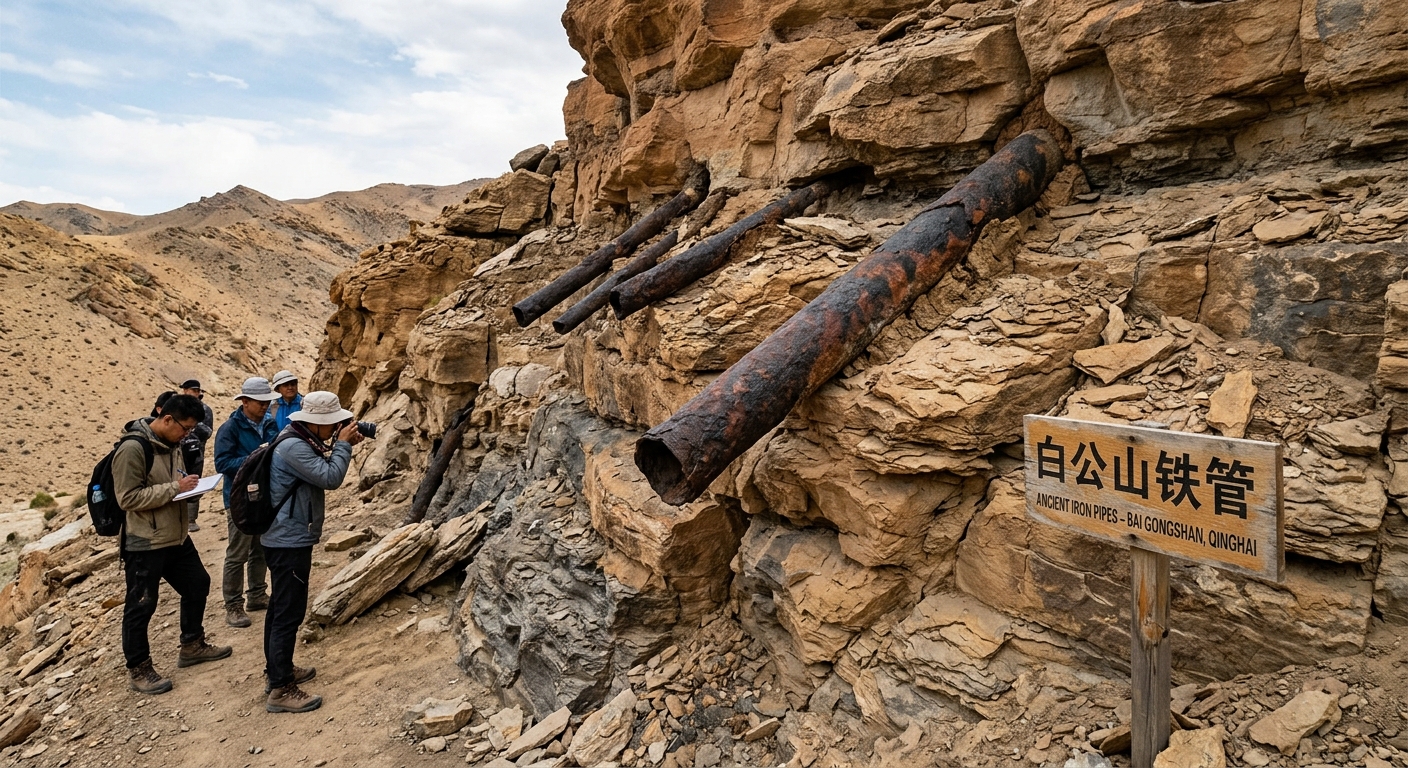
Deep in the remote wilderness of China’s Qinghai Province, nestled within the desolate landscape of the Qaidam Basin, lies one of archaeology’s most perplexing mysteries. The Baigong Pipes, a collection of metallic tubular structures embedded in rock formations, have challenged our understanding of ancient civilizations and human technological development for decades.
These enigmatic metal pipes, discovered near Mount Baigong and Qinghai Lake, appear to be far older than any known advanced human civilization. What makes them truly extraordinary is not just their age, but their sophisticated construction and the fact that no one can adequately explain how they came to exist.
The Discovery That Changed Everything
The Baigong Pipes were first brought to widespread attention in the early 2000s, though local residents had known about these strange formations for generations. Located approximately 40 kilometers southwest of the city of Delingha, the pipes are found in three primary locations: two embedded within Mount Baigong itself, and a third group scattered along the shores of nearby Qinghai Lake.
The most impressive specimens are found within pyramidal rock formations on Mount Baigong. These aren’t crude, primitive constructions. The pipes display remarkable uniformity in their circular cross-sections and appear to have been deliberately installed. Some extend deep into the mountain, while others seem to connect different sections of the rock formation in ways that suggest purposeful engineering.
Mysterious Specifications That Defy Explanation
What sets the Baigong Pipes apart from other archaeological anomalies is their technical sophistication. The pipes range in diameter from toothpick-thin specimens to massive tubes over 16 inches across. Many show evidence of having been precision-manufactured rather than naturally formed.
Physical Characteristics
- Uniform circular cross-sections throughout their length
- Sizes ranging from 0.08 inches to 16 inches in diameter
- Some pipes extend horizontally into Mount Baigong for unknown distances
- Others run vertically through rock layers
- Many show signs of deliberate placement and orientation
The pipes near Qinghai Lake present their own mysteries. These specimens appear to connect the lakeshore with deeper underwater locations, suggesting they may have once been part of a larger system. Some researchers have speculated they could have served as conduits for water, though their true purpose remains unknown.
The Age Problem: 150,000 Years Too Early
Perhaps the most mind-boggling aspect of the Baigong Pipes is their estimated age. Scientific analysis suggests these structures are approximately 150,000 years old. To put this in perspective, the oldest known advanced human civilizations emerged around 10,000 to 12,000 years ago. The construction of sophisticated metal pipes predating known metallurgy by over 140,000 years presents a significant challenge to conventional archaeological timelines.
Carbon dating and geological analysis of the surrounding rock formations support this ancient timeline. The pipes appear to have been in place long before the rock layers that now surround them were fully formed, suggesting they were installed and subsequently became embedded through natural geological processes over millennia.
Composition Analysis: Not Quite What You’d Expect
Chemical analysis of the Baigong Pipes has revealed another layer of mystery. While they appear metallic, their composition includes materials not typically found in conventional metallurgy. The pipes contain iron oxide, silicon dioxide, and calcium oxide, along with trace amounts of other elements that don’t match known natural mineral formations in the area.
Unusual Chemical Properties
- High iron content suggesting deliberate smelting
- Silicon dioxide levels inconsistent with natural rock formation
- Presence of materials not native to the local geology
- Corrosion patterns that suggest extreme age
- Structural integrity that has survived 150,000 years of environmental exposure
Theories and Explanations: From Plausible to Extraordinary
Scientists and researchers have proposed various theories to explain the Baigong Pipes, ranging from conventional geological explanations to more extraordinary possibilities.
Natural Formation Theory
Some geologists suggest the pipes could be fossilized tree roots or other organic material that has mineralized over time. However, this explanation struggles to account for the uniform circular cross-sections and the presence of clearly artificial materials in their composition.
Ancient Technology Theory
A more controversial explanation proposes that an unknown ancient civilization possessed advanced metallurgical capabilities far earlier than previously thought. This theory would require a complete revision of our understanding of human technological development and raises questions about what happened to this advanced society.
Extraterrestrial Hypothesis
Some researchers have suggested the pipes could be remnants of ancient extraterrestrial activity, though this explanation lacks concrete supporting evidence and remains highly speculative.
The Ongoing Investigation
Research into the Baigong Pipes continues, with scientists employing increasingly sophisticated analytical techniques to unlock their secrets. Ground-penetrating radar has revealed that the pipe network may be far more extensive than initially believed, potentially forming a complex underground system.
Recent investigations have focused on understanding how the pipes were manufactured and installed. The precision of their construction suggests advanced engineering knowledge, yet no associated artifacts or evidence of the civilization that created them has been found.
What the Baigong Pipes Mean for History
Regardless of their ultimate explanation, the Baigong Pipes represent a significant challenge to our understanding of ancient history and human technological development. They remind us that our planet still holds mysteries that don’t fit neatly into established scientific paradigms.
Whether they prove to be evidence of an unknown ancient civilization, an unusual geological phenomenon, or something else entirely, the Baigong Pipes continue to fascinate researchers and challenge our assumptions about the past. They stand as a testament to the fact that Earth still has secrets waiting to be uncovered, mysteries that could fundamentally change how we understand our world and our place in it.
As investigation techniques improve and new technologies become available, perhaps we’ll finally solve the puzzle of these ancient metal pipes. Until then, they remain one of archaeology’s most intriguing unsolved mysteries, buried in the remote Chinese desert, waiting to reveal their secrets.






Great catch, Pete! I’m always amazed how easily extraordinary claims can spread before the mundane explanation catches up. This is actually a perfect example of something I see a lot in my world too, honestly – people want mysteries to be real so badly that confirmation bias takes over. The same pattern happens with spider “facts” that circulate online (like the “we swallow spiders in our sleep” myth), where the compelling story wins out over actual evidence every time. Appreciate you doing the legwork to set the record straight!
Log in or register to replyThis is a pretty famous hoax that’s been thoroughly debunked, but I appreciate the mystery angle! The pipes are actually modern drilling equipment left behind from oil/mineral exploration in the 1950s-60s, and the “dating” to 150,000 years came from misinterpreting geological surveys of the surrounding rock layers. If you’re interested in actual ancient chemistry and materials science though, the history of how early humans figured out smelting and alloy metallurgy is genuinely wild – totally worth looking into!
Log in or register to replyhonestly this reminds me of something i’ve noticed on night surveys, where you spot something strange in the dark and your mind fills in blanks before your eyes adjust. the desert at night does something similar to perception, i think, and those remote areas get so little foot traffic that modern debris can look impossibly old in the right light. thanks for the grounding context here!
Log in or register to reply