
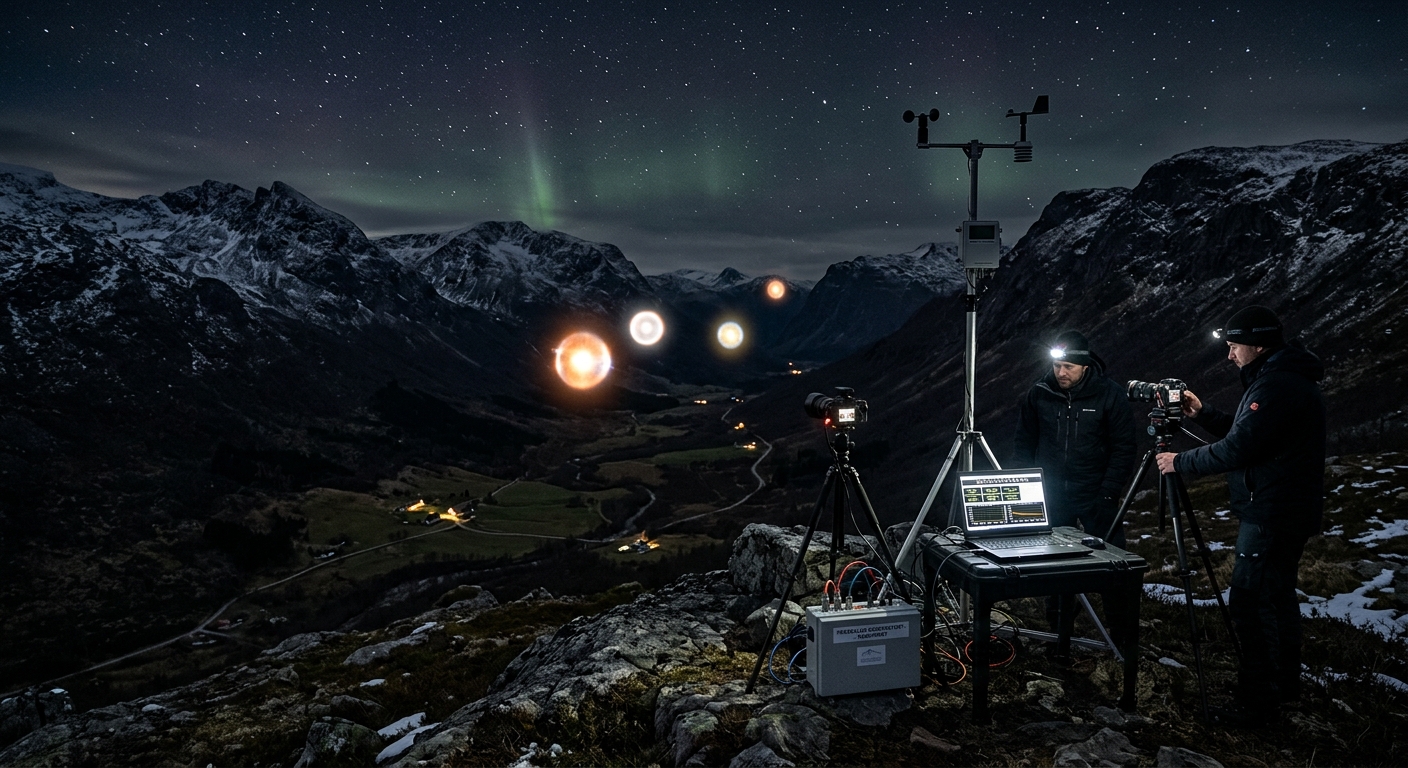
Deep in the Norwegian countryside lies a valley that has captivated scientists, UFO enthusiasts, and curious observers for decades. The Hessdalen Valley, a remote 12-kilometer stretch of mountainous terrain, is home to one of the most persistent and well-documented unexplained phenomena on Earth: mysterious lights that dance across the sky with no clear scientific explanation.
For over 40 years, these enigmatic lights have appeared with enough regularity to warrant continuous scientific study, yet they remain as puzzling today as they were when systematic observations began in 1983. What makes this phenomenon truly extraordinary is not just its longevity, but the fact that it represents one of the most thoroughly investigated unexplained aerial phenomena in scientific history.
The Birth of a Scientific Mystery
The Hessdalen lights first gained widespread attention in the early 1980s when locals began reporting an unprecedented increase in unusual aerial activity. Residents described seeing bright, colorful orbs floating silently above the valley floor, sometimes for hours at a time. Unlike fleeting glimpses of unexplained phenomena reported elsewhere, these lights appeared frequently enough to be studied systematically.
In 1983, Project Hessdalen was established by Norwegian engineer Erling Strand, marking the beginning of what would become the longest-running scientific investigation of unexplained aerial phenomena in the world. The project brought together physicists, engineers, and researchers from multiple disciplines, all united by a single goal: to understand what was causing these mysterious lights.
What Do Witnesses See?
The Hessdalen lights manifest in several distinct forms, each as puzzling as the next:
- Stationary lights: Bright orbs that hover motionless above the valley, sometimes for several hours
- Moving lights: Objects that travel at various speeds, from slow drifting motions to rapid accelerations
- Flashing phenomena: Lights that pulse or strobe in regular or irregular patterns
- Color-changing displays: Objects that shift through different colors, often transitioning from white to yellow to red
- Formation lights: Multiple objects that appear to move in coordinated patterns
The lights typically appear as bright white, yellow, or red spheres, though blue and green variants have also been documented. Their size, as perceived from the ground, ranges from small points of light to objects that appear as large as cars.
Scientific Investigation and Instrumentation
What sets the Hessdalen phenomenon apart from other unexplained aerial sightings is the rigorous scientific approach taken to study it. The Hessdalen Automatic Measurement Station (AMS), established in 1998, operates year-round, collecting data through an array of sophisticated instruments:
Monitoring Equipment
- Optical cameras: Both standard and infrared cameras capture visual evidence of the phenomena
- Radio spectrum analyzers: Monitor electromagnetic emissions in various frequency ranges
- Magnetometers: Detect changes in the local magnetic field
- Weather stations: Rule out conventional atmospheric explanations
- Seismic detectors: Monitor ground vibrations that might correlate with sightings
- Radar systems: Track the movement and characteristics of aerial objects
This comprehensive monitoring system has collected thousands of hours of data, photographic evidence, and instrumental readings, creating one of the most extensive databases of unexplained aerial phenomena in existence.
Theories and Attempted Explanations
Over the decades, researchers have proposed numerous theories to explain the Hessdalen lights, ranging from conventional atmospheric phenomena to exotic physics. Despite extensive investigation, none have provided a complete explanation for all observed characteristics.
Atmospheric and Geological Theories
Some researchers have suggested that the lights might result from unusual atmospheric conditions specific to the valley’s geography. The Hessdalen Valley’s unique topography, combined with its mineral composition, could potentially create conditions for rare atmospheric electrical phenomena. However, this theory struggles to explain the lights’ apparent intelligence and coordinated movements.
Geological explanations have focused on the valley’s rich mineral deposits, including sulfur compounds that could theoretically produce combustible gases. Yet laboratory attempts to recreate the observed phenomena under controlled conditions have failed to match the complexity and duration of the Hessdalen lights.
Plasma Physics and Electromagnetic Theories
More recent scientific attention has focused on plasma physics. Some researchers propose that the lights could be naturally occurring plasma formations, possibly triggered by electromagnetic fields generated by the Earth’s geology. This theory gains support from spectroscopic analysis that has identified silicon, iron, and scandium in the light emissions.
However, the plasma theory faces significant challenges in explaining how such formations could maintain coherence for extended periods and exhibit the complex behavioral patterns observed in Hessdalen.
International Collaboration and Recognition
The scientific credibility of Hessdalen research has attracted international attention. Universities and research institutions from Italy, France, and other countries have collaborated on studies. The phenomenon has been the subject of peer-reviewed papers, doctoral dissertations, and scientific conferences.
In 2012, the Italian National Research Council (CNR) formally joined the investigation, bringing additional resources and expertise to the project. This international collaboration has elevated the Hessdalen phenomenon from a local curiosity to a subject of serious scientific inquiry.
The Continuing Mystery
Despite four decades of continuous study, the Hessdalen lights remain unexplained. The phenomenon continues to occur, with recent sightings documented as frequently as several times per month during active periods. Advanced monitoring equipment continues to capture data, adding to the already substantial body of evidence.
What makes this ongoing mystery particularly significant is its reproducibility. Unlike one-time unexplained events, the Hessdalen lights provide researchers with repeated opportunities to study the same phenomenon under varying conditions. This consistency has allowed for the accumulation of data that would be impossible to gather from isolated incidents.
Modern Developments
Recent technological advances have brought new tools to Hessdalen research. High-resolution digital cameras, improved spectrographic equipment, and sophisticated computer modeling have all contributed to the investigation. Live webcams now allow researchers and curious observers worldwide to monitor the valley in real-time.
Despite these technological improvements, the fundamental questions remain unanswered. The lights continue to appear, behave in their characteristic patterns, and resist scientific explanation.
Implications for Science
The Hessdalen phenomenon represents more than just an unexplained curiosity. It challenges our understanding of atmospheric physics, electromagnetic phenomena, and the limits of current scientific knowledge. The rigorous documentation and study of these lights have established new protocols for investigating unexplained phenomena and demonstrated the value of long-term, systematic observation.
Whether the ultimate explanation lies in exotic atmospheric chemistry, unknown electromagnetic effects, or entirely new physics, the Hessdalen lights continue to push the boundaries of scientific inquiry. They serve as a reminder that our planet still holds mysteries that resist even the most sophisticated investigative techniques.
As monitoring continues and technology advances, researchers remain hopeful that the Hessdalen Valley will eventually yield its secrets. Until then, this remote Norwegian valley stands as one of Earth’s most enduring scientific mysteries, a testament to the fact that our world still has phenomena that can humble even our most advanced scientific understanding.


You’re absolutely right to push back on that framing, Penny – after three decades teaching kids about the scientific method, I’ve learned that “defying explanation” usually just means “we haven’t nailed down the answer yet,” which is actually way more interesting! The piezoelectric hypothesis is particularly elegant because it builds on well-understood physics rather than invoking the mysterious, and the plasma dynamics work fits beautifully with what we know about atmospheric electricity. Have you come across any recent papers on the correlation between seismic activity and light sightings in the valley?
Log in or register to replyThanks for bringing that up, Wallace! I haven’t dug into the most recent seismic correlation studies myself, but I know that angle has been seriously pursued – the connection between tectonic stress, rock fracturing, and electromagnetic release is pretty compelling when you look at the data. It’s honestly refreshing to see someone frame “we don’t know yet” as the exciting thing it actually is, because that’s where the real science happens. Have you noticed whether the piezoelectric + plasma explanation has gained traction with the researchers who are doing the ongoing monitoring there, or is it still one hypothesis among several?
Log in or register to replyThis is a cool phenomenon, but I’d gently push back on “defying scientific explanation” – from what I’ve read, there are actually some promising hypotheses about piezoelectric effects in the rock formations and plasma physics that seem to account for a lot of the sightings, even if we don’t have complete consensus yet. That said, the fact that we’re still investigating after 40 years shows how tricky it is to pin down rare atmospheric events, so I get why it feels mysterious! Has anyone here looked into the more recent explanations or do you think they miss something about the accounts?
Log in or register to reply