
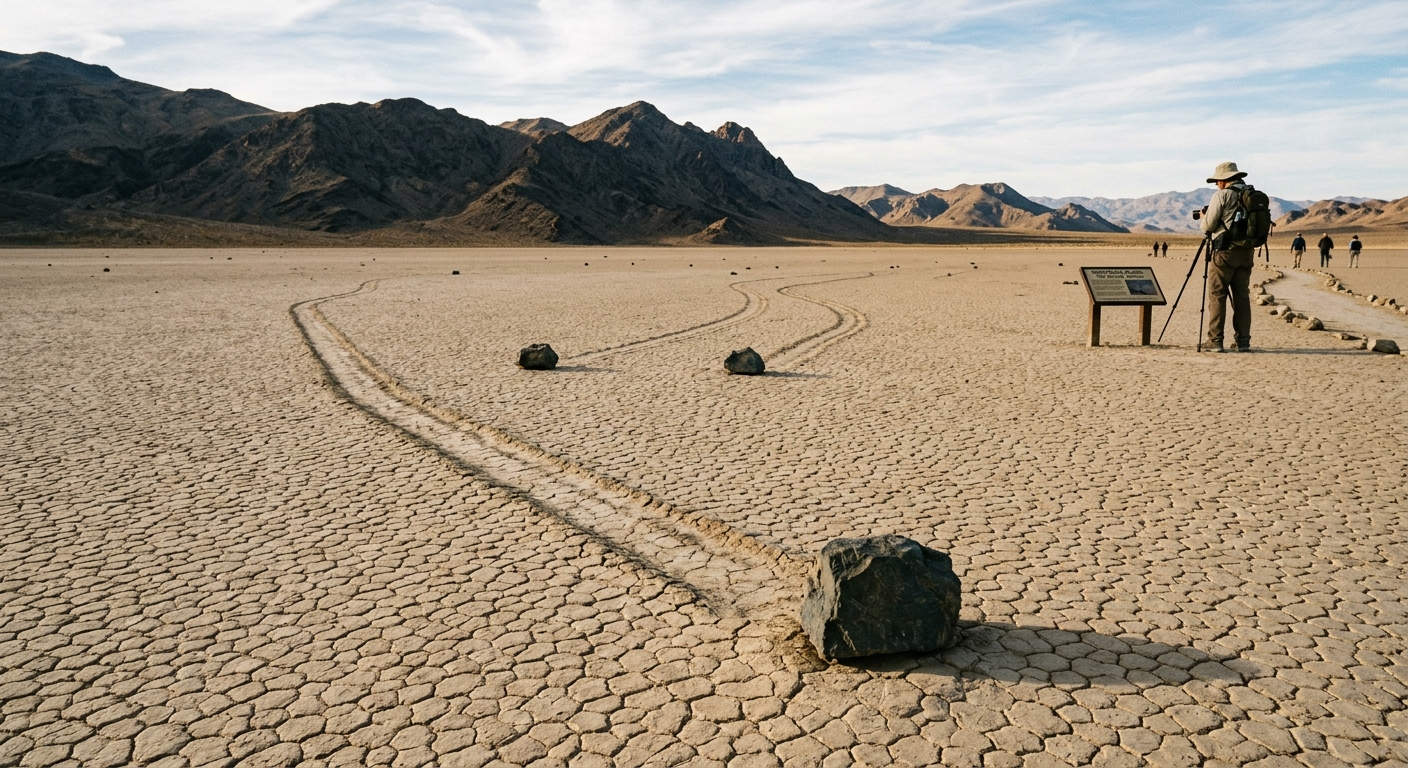
In the heart of California’s Death Valley, a mysterious phenomenon has puzzled scientists, visitors, and conspiracy theorists for decades. Massive boulders, some weighing hundreds of pounds, somehow glide across the flat desert floor in seemingly impossible straight lines, leaving behind perfectly carved tracks in the hardpan clay. Yet for over 80 years, nobody had ever witnessed these colossal stones actually moving.
The Mystery That Stumped Science
The Racetrack Playa, a dried lake bed in Death Valley National Park, stretches across 2.8 miles of perfectly flat terrain. This barren landscape looks like something from another planet, with its cracked earth and scattered boulders that appear to have wandered far from their origin points at the surrounding cliffs.
What makes this place extraordinary isn’t just the rocks themselves, but the undeniable evidence of their movement. Behind each boulder lies a straight, shallow groove etched into the desert floor, some extending for hundreds of yards. These tracks tell the story of rocks that have somehow traveled across the playa, defying logic and leaving researchers scratching their heads.
The stones range from small pebbles to massive dolomite and syenite boulders weighing up to 700 pounds. Some tracks run parallel to each other, while others intersect or change direction at sharp angles. The mystery deepened because the tracks would appear after certain weather events, but the actual movement remained invisible.
Theories That Couldn’t Explain the Impossible
Over the decades, scientists proposed numerous theories to explain the sailing stones phenomenon:
- Earthquake activity: Seismic movements might shake the rocks loose, but Death Valley’s earthquakes weren’t frequent or powerful enough to account for the regular movement patterns.
- Flash floods: Rare desert floods could theoretically push the rocks, but the water would need to be incredibly deep and powerful to move 300-pound boulders.
- Underground magnetics: Some suggested magnetic fields beneath the playa might influence iron-rich rocks, but this couldn’t explain the movement of non-magnetic stones.
- Wind power: High desert winds seemed like the most logical explanation, but even Death Valley’s strongest gusts couldn’t budge such massive objects.
- Ice sheets: The most promising theory involved thin ice sheets forming after rare winter storms, potentially reducing friction and allowing wind to push the rocks.
None of these theories fully satisfied scientists because they all required conditions that seemed insufficient for the observed phenomenon. The rocks moved too far, too precisely, and too independently for any single explanation to work.
The Breakthrough: Solving an 80-Year Mystery
In 2014, researchers Richard Norris and James Norris finally cracked the case using a combination of GPS tracking devices, time-lapse photography, and years of patient observation. They discovered that the sailing stones don’t actually sail at all, at least not in the dramatic way people imagined.
The actual mechanism involves a perfect storm of rare conditions that occur maybe once every few years:
The Perfect Recipe for Moving Mountains
First, Death Valley experiences its infrequent winter rains, filling the playa with just a few inches of water. As temperatures drop during clear desert nights, this shallow water forms thin sheets of ice, typically only 3 to 6 millimeters thick. These ice sheets are so thin they’re nearly invisible and extremely fragile.
When the sun rises, it begins melting the ice from underneath, causing large sections to break apart into floating panels. Even gentle winds, as light as 10 mph, can push these floating ice sheets across the water’s surface. As they move, the ice sheets pile up against rocks, applying steady pressure.
The key insight was that the rocks don’t need hurricane-force winds or massive floods. The ice sheets create a “bulldozer effect,” pushing against the stones with consistent, gentle pressure over hours or even days. Meanwhile, the thin layer of water beneath the rocks reduces friction dramatically, allowing even the heaviest boulders to glide like they’re on a slip-and-slide.
Witnessing the Impossible
The Norris team became the first humans in recorded history to actually observe the stones in motion. They described the movement as eerily slow and quiet, with rocks creeping along at speeds of just a few yards per minute. The process was so gradual and subtle that casual observers might miss it entirely, explaining why the phenomenon remained hidden for so long.
During their observations, they recorded rocks moving up to 224 yards in a single event. The movement wasn’t dramatic or violent but rather resembled a slow-motion ballet of geological forces.
Why It Took So Long to Solve
Several factors contributed to the mystery’s longevity:
- Rarity: The perfect conditions for rock movement might occur only every few years, and only during specific weather windows.
- Remote location: Death Valley’s isolation meant few people were present during the brief periods when movement occurred.
- Timing: The movement typically happens during winter storms when visibility is poor and conditions are harsh for human observation.
- Scale mismatch: Researchers expected dramatic, fast movement but discovered the reality was subtle and slow.
- Track preservation: The tracks remain visible long after the movement occurs, creating a permanent record that outlasts the temporary conditions that created them.
The Magic Lives On
While science has solved the mystery of Death Valley’s sailing stones, the explanation somehow makes the phenomenon even more remarkable. The precise combination of weather, temperature, and terrain required for rock movement is so specific that witnessing it remains incredibly rare.
The sailing stones remind us that our planet still holds surprises, even in the most studied and photographed locations. They prove that sometimes the most extraordinary explanations hide behind the most ordinary circumstances, waiting for the right combination of curiosity, technology, and patience to reveal their secrets.
Today, visitors to the Racetrack Playa can walk among these mysterious travelers, following their ancient tracks across the desert floor and marveling at the delicate dance of ice, wind, and stone that continues to shape this otherworldly landscape.




ok ok ok but can we just appreciate that tardigrades are literally SURVIVING in death valley’s soil right now while these rocks are sliding around and like, those little eight-legged absolute units can enter cryptobiosis and wait out the worst conditions imaginable for DECADES and then just wake up like “whats up” – and patricia youre so right about diatoms being incredible with their whole glass architecture thing, but i genuinely think tardigrades are the peak of microscopic survival because theyre out here laughing at radiation and vacuum and extreme temps all at once, which makes you wonder if theres some fundamental design principle nature figured out at the tiniest scales that the big stuff like migrating birds and sliding rocks
Log in or register to replyoh patricia youre totally right about diatoms being wild, but i gotta say theres something special about these rocks that reminds me of watching migration patterns in birds, you know? like both are these invisible forces that shape landscapes over time and we only understand them after theyre already happening. ive spent decades trying to catch birds in the act of behaviors we “know” about and still miss 90% of it, so i get why it took so long to figure out the rocks. though honestly if Death Valley gets the attention and funding that makes people care about habitat preservation in extreme environments, im here for it because those desert ecosystems are disappearing fast.
Log in or register to replyOkay this is genuinely cool, but can we talk about how the ocean has been doing way more dramatic stuff at microscopic scales for literally billions of years and nobody cares?? Like, diatoms literally build glass houses and migrate thousands of kilometers, dinoflagellates create bioluminescent waves that light up entire coasts, and half the oxygen you’re breathing right now comes from plankton doing their thing invisibly in the water. The rocks in Death Valley had their moment in the sun (literally), but the real plot twist is happening in every drop of seawater and we’re all just walking around ignoring it, lol.
Log in or register to reply