High above your head, moving faster than most cars on the highway, flows an invisible river that determines whether you’ll need an umbrella tomorrow or if your city will face a devastating drought next summer. This aerial superhighway, known as the jet stream, is one of Earth’s most powerful and least understood weather-making machines. But here’s the unsettling part: scientists are discovering that this atmospheric giant is becoming increasingly unstable, and the consequences are reshaping weather patterns across the entire planet.
What Exactly Is This Invisible Sky River?
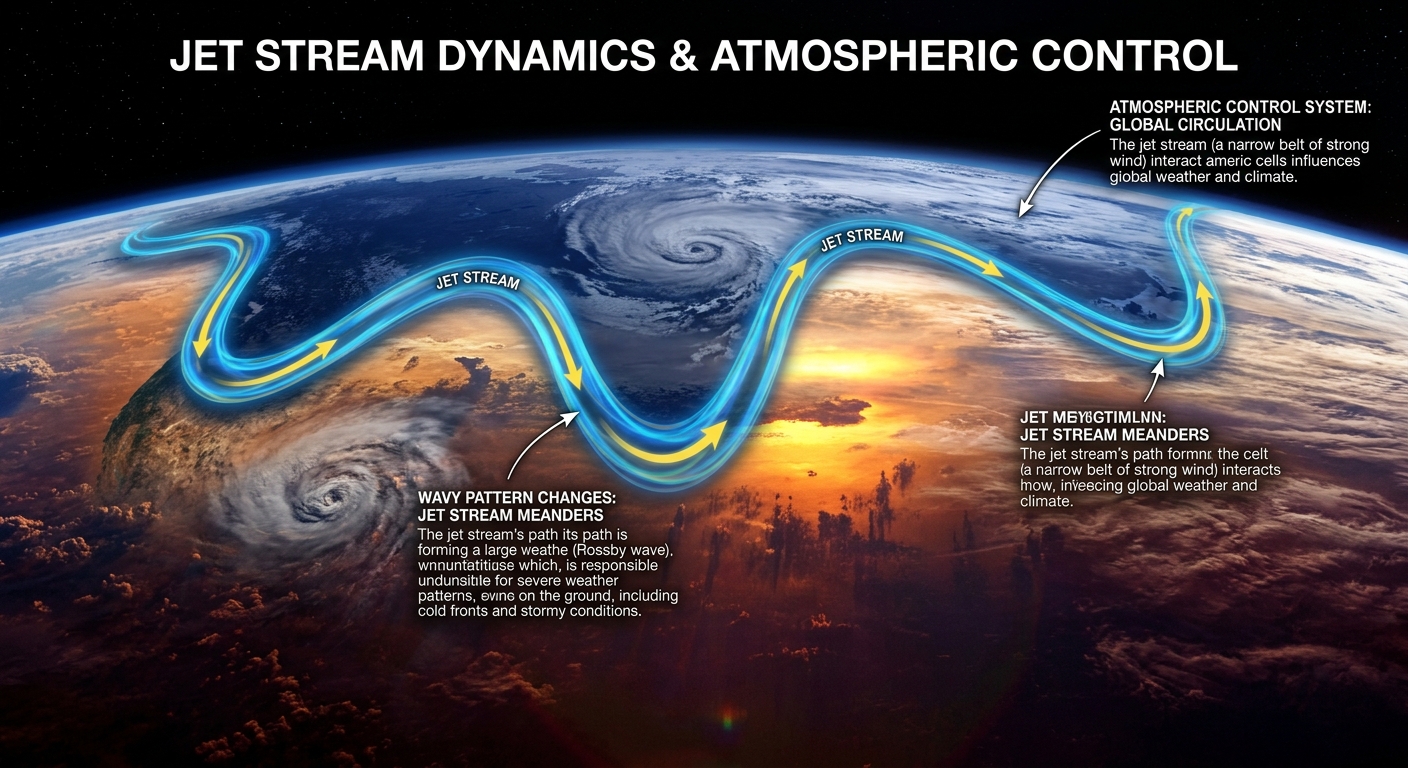
The jet stream isn’t just moving air, it’s a concentrated band of winds racing through the upper atmosphere at speeds that can reach 275 miles per hour. Picture a ribbon of air roughly 200 to 300 miles wide, flowing at altitudes between 20,000 and 50,000 feet above sea level. There are actually four major jet streams encircling our planet, but the two that most dramatically affect weather are the polar jet streams in each hemisphere.
These atmospheric rivers form due to the temperature contrast between different air masses. Cold polar air and warm tropical air don’t mix easily, so they create a boundary. The Earth’s rotation then accelerates the air along this boundary, creating the fast-moving currents we call jet streams. It’s like nature’s own high-speed conveyor belt, constantly moving weather systems from west to east across continents.
The Weather-Making Machine You Never Knew Existed
Every major weather event on Earth has the jet stream’s fingerprints on it. This atmospheric powerhouse acts as a steering wheel for storm systems, guiding hurricanes, directing winter blizzards, and determining where high and low pressure systems will park themselves. When meteorologists track a hurricane’s path or predict where a winter storm will hit, they’re essentially following the jet stream’s movements.
The jet stream creates weather through several mechanisms:
- Storm Steering: Weather systems get caught in the jet stream’s flow like leaves in a river current
- Temperature Transport: It moves cold air southward and warm air northward, creating the temperature contrasts that fuel storms
- Pressure System Formation: The jet stream’s curves and dips create areas of divergence and convergence that form high and low pressure systems
- Precipitation Patterns: Where the jet stream positions itself determines which regions receive rain or snow and which experience drought
The Rossby Wave Phenomenon
One of the most fascinating aspects of jet stream behavior involves massive undulations called Rossby waves. Named after meteorologist Carl-Gustaf Rossby, these are enormous meanders in the jet stream that can stretch across entire continents. When these waves become amplified, they can lock weather patterns in place for weeks or even months, leading to extended periods of drought, flooding, or extreme temperatures.
Climate Change Is Breaking the System
Here’s where the story takes a concerning turn. Scientists have discovered that our changing climate is fundamentally altering how the jet stream behaves, and the results are already visible in increasingly erratic weather patterns worldwide.
The primary driver of this change is Arctic warming. The Arctic is heating up nearly twice as fast as the rest of the planet, a phenomenon called Arctic amplification. This rapid warming is reducing the temperature difference between the poles and the equator, which is like removing fuel from the jet stream’s engine.
The Wobbling River
As the temperature contrast weakens, the jet stream becomes less stable and more prone to dramatic meandering. Instead of flowing in a relatively straight line from west to east, it increasingly develops large loops and waves that can persist for extended periods. These persistent patterns are responsible for some of the most extreme weather events of recent decades.
When the jet stream develops a large northward loop, it can pump unusually warm air far into polar regions. Conversely, when it dips far southward, it can drag Arctic air deep into temperate zones, causing sudden temperature drops and unusual snowstorms in places that rarely see snow.
Real-World Consequences We’re Already Seeing
The jet stream’s increasing instability isn’t just a theoretical concern for future generations. It’s driving extreme weather events happening right now:
- Polar Vortex Events: When the polar jet stream weakens dramatically, the polar vortex can split or shift, sending frigid Arctic air plunging into North America and Europe
- Heat Domes: Persistent high-pressure ridges in the jet stream can trap hot air over regions for weeks, creating deadly heat waves
- Atmospheric Rivers: Changes in jet stream patterns can intensify moisture transport, leading to extreme precipitation events
- Drought Persistence: When high-pressure systems get locked in place by jet stream patterns, they can block storm systems for months
The 2021 Texas Freeze: A Case Study
The February 2021 Texas winter storm provides a perfect example of jet stream disruption in action. A sudden warming event in the Arctic weakened the polar vortex, causing the jet stream to develop a massive southward dip. This pattern change allowed Arctic air to plunge deep into Texas, bringing temperatures that the state’s infrastructure was never designed to handle.
Predicting the Unpredictable Future
Scientists are working frantically to understand how the jet stream will continue to change as global temperatures rise. Climate models suggest we can expect continued weakening of the jet stream, leading to more frequent blocking patterns and persistent weather extremes.
However, predicting exactly how these changes will manifest remains one of the greatest challenges in climate science. The jet stream is influenced by countless factors, from sea ice extent to ocean temperatures to snow cover patterns, making it incredibly complex to model accurately.
The Butterfly Effect on a Global Scale
Perhaps the most mind-blowing aspect of the jet stream is how small changes in this invisible sky river can trigger massive consequences worldwide. A slight shift in the jet stream’s position can mean the difference between a bountiful harvest and crop failure, between a mild winter and a deadly freeze, between normal rainfall and catastrophic flooding.
As our planet continues to warm, understanding and monitoring the jet stream becomes increasingly critical for everything from agriculture planning to disaster preparedness. This invisible force high above our heads will continue to shape human civilization in ways we’re only beginning to comprehend.
The next time you step outside and feel the wind on your face, remember that you’re experiencing just a tiny fraction of the massive atmospheric machinery operating miles above your head, steering the weather that shapes our world.



I mean, Patricia’s got a point about giving proper respect to ocean currents, but honestly I think both deserve the hype here. As someone who keeps reptiles, I’m pretty invested in stable climate systems since my ball python Copernicus depends on precise humidity and temperature ranges, and I’ve had to adapt his enclosure setup multiple times over the years as conditions shift. The atmospheric rivers and ocean currents are basically working together as this massive interconnected system, so singling one out as more important feels like missing the bigger picture of how fragile these balances really are.
Log in or register to replyokay but can we talk about the *actual* invisible rivers that deserve this hype – the ocean currents that drive weather AND produce half the oxygen you’re breathing right now?? like, atmospheric rivers are wild, don’t get me wrong, but phytoplankton are literally the lungs of the planet and nobody’s out here writing about how climate change is disrupting their productivity, which has cascading effects on everything from nutrient cycling to fish populations. it’s wild how we obsess over weather patterns but sleep on the microscopic organisms that make Earth’s whole respiratory system work honestly
Log in or register to replyyo this is such a cool rabbit hole – atmospheric rivers really are wild but patricia’s right that ocean currents kinda get slept on, theyre like the circulatory system of the whole planet. hank i feel you on the climate stability thing, thats actually why i started tracking weather patterns on inaturalist, helps me see how local conditions shift and connect to the bigger picture. if you guys havent checked out actual satellite imagery of these systems moving you should, its genuinely mind blowing and way more accessible than it used to be.
Log in or register to reply