
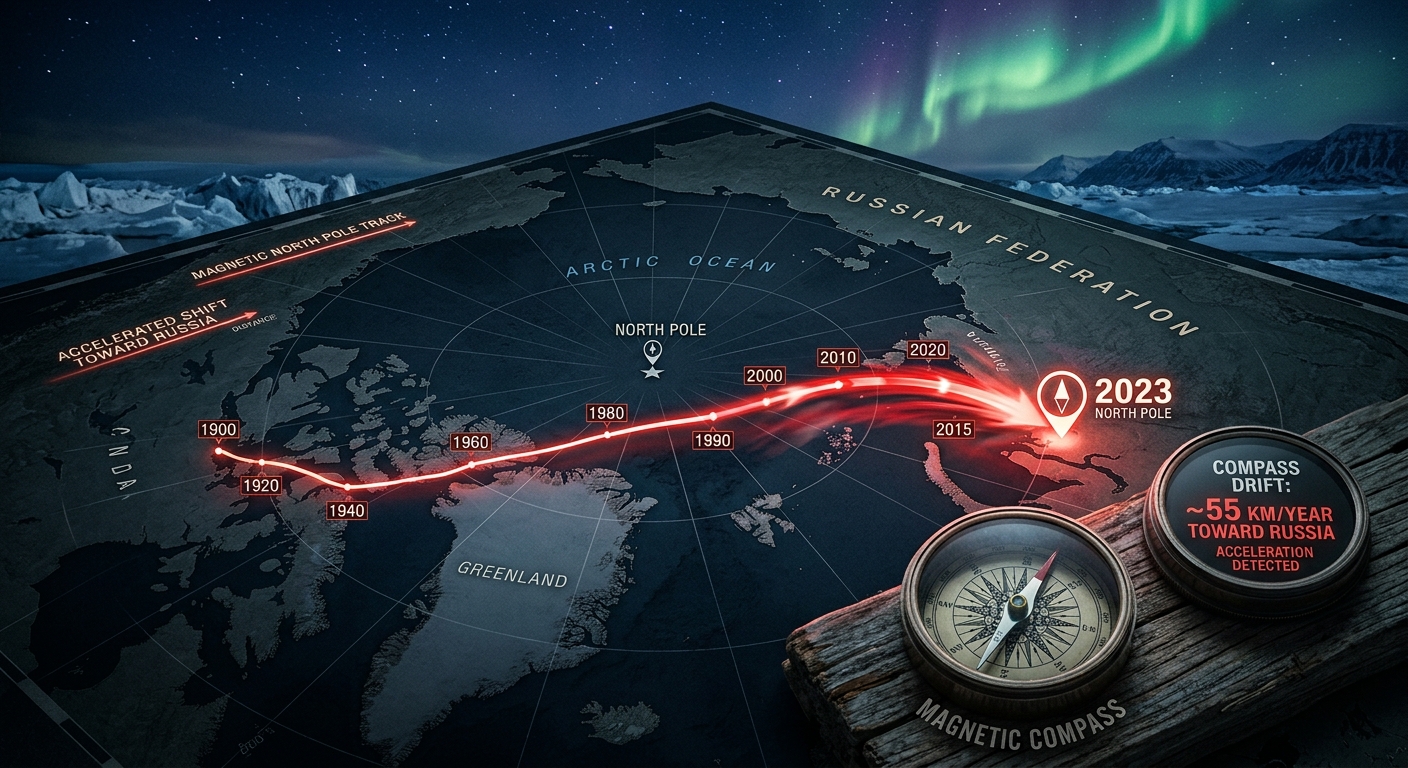
Imagine if your compass suddenly started pointing in a completely different direction, or if GPS systems worldwide began giving increasingly inaccurate readings. This scenario isn’t science fiction: it’s happening right now as Earth’s magnetic North Pole embarks on an unprecedented journey across the Arctic at speeds that have scientists scrambling to understand and adapt.
The Great Magnetic Migration
For centuries, navigators have relied on Earth’s magnetic North Pole as a fixed reference point. But this invisible landmark is anything but stationary. Currently racing across the Arctic Ocean from Canada toward Siberia at approximately 55 kilometers per year, the magnetic North Pole is moving faster than a migrating whale and shows no signs of slowing down.
To put this speed into perspective, the magnetic pole is moving at roughly 150 meters per day. That’s faster than most people walk, and it represents a dramatic acceleration from the leisurely 15 kilometers per year it maintained throughout most of the 20th century. This fourfold increase in speed has transformed what was once a predictable drift into a magnetic sprint that’s rewriting our understanding of Earth’s inner workings.
The Invisible Force Field That Protects Us
Before diving deeper into this magnetic mystery, it’s crucial to understand what creates Earth’s magnetic field. Deep beneath our feet, approximately 3,000 kilometers down, lies a churning ocean of molten iron and nickel known as the outer core. This liquid metal layer, heated to temperatures exceeding 4,000 degrees Celsius, flows in complex patterns driven by Earth’s rotation and convection currents.
As this electrically conductive fluid moves, it generates electric currents, which in turn create magnetic fields. This process, known as the geodynamo effect, produces Earth’s magnetic field that extends far into space, forming our planet’s protective magnetosphere. This invisible shield deflects harmful solar radiation and cosmic particles that would otherwise strip away our atmosphere and make life as we know it impossible.
Where True North and Magnetic North Diverge
It’s important to distinguish between the geographic North Pole and the magnetic North Pole. The geographic North Pole is the fixed point where Earth’s rotational axis meets the surface, located at 90 degrees north latitude. The magnetic North Pole, however, is where Earth’s magnetic field lines converge and point straight down into the planet. These two poles have never coincided, and the distance between them is constantly changing.
A History of Wandering
The magnetic North Pole’s restless nature isn’t entirely new. Since British explorer James Clark Ross first located it in 1831 on Canada’s Boothia Peninsula, the pole has been gradually shifting. For over a century, it meandered slowly across the Canadian Arctic archipelago, moving in somewhat predictable patterns that allowed scientists to track and forecast its position with reasonable accuracy.
However, something changed dramatically in the 1990s. The pole’s movement began accelerating, and by the early 2000s, it had crossed into international waters, continuing its relentless march toward Siberia. This acceleration caught the scientific community off guard and forced researchers to fundamentally reconsider their models of Earth’s magnetic behavior.
The Deep Earth Connection
The magnetic pole’s current sprint appears to be linked to dramatic changes occurring deep within Earth’s core. Scientists believe that shifts in the flow patterns of molten iron in the outer core are responsible for this acceleration. These changes affect the strength and direction of magnetic field generation, ultimately influencing where the magnetic poles are located on Earth’s surface.
Recent research has identified two large regions of rapidly flowing molten iron beneath Canada and Siberia. These “magnetic blobs” appear to be in a kind of tug-of-war, with the Siberian blob currently winning. As the Canadian blob weakens and the Siberian one strengthens, the magnetic North Pole is being pulled toward Russia at an ever-increasing pace.
Technology Under Pressure
This magnetic migration has far-reaching implications for modern technology and navigation systems. The World Magnetic Model, which serves as the foundation for GPS systems, smartphone compasses, and military navigation equipment, must be updated every five years to account for the changing magnetic field. However, the pole’s acceleration has been so dramatic that emergency updates have become necessary.
In 2019, scientists had to release an unprecedented early update to the World Magnetic Model because the magnetic North Pole had moved so far from predicted positions that navigation errors were becoming significant. Without these updates, GPS systems could experience errors of several kilometers, potentially causing serious problems for aviation, shipping, and military operations.
Could This Lead to a Magnetic Reversal?
Perhaps the most intriguing question surrounding the magnetic pole’s behavior is whether it signals an impending magnetic reversal. Throughout Earth’s history, the magnetic field has completely flipped approximately every 200,000 to 300,000 years, with the magnetic North and South poles switching places. The last reversal occurred about 780,000 years ago, meaning we’re statistically overdue for another flip.
During a magnetic reversal, Earth’s magnetic field weakens significantly before reorganizing in the opposite direction. This process can take anywhere from a few thousand to several thousand years to complete. While reversals are natural phenomena that life on Earth has survived many times before, a weakened magnetic field during the transition period could pose challenges for modern technology and potentially increase radiation exposure for astronauts and airline passengers.
The Race to Understand
Scientists worldwide are working to unravel the mysteries of Earth’s changing magnetic field. Satellite missions like the European Space Agency’s Swarm constellation continuously monitor magnetic field variations from space, while ground-based observatories track changes at Earth’s surface. Computer models attempt to simulate the complex dynamics of the outer core, though the extreme conditions and vast scales involved make accurate predictions challenging.
Recent advances in supercomputing and data analysis are beginning to reveal new insights into the geodynamo process. Researchers have discovered that magnetic pole movements may be influenced by factors ranging from the moon’s gravitational pull to changes in Earth’s rotation speed. These findings suggest that our planet’s magnetic behavior is even more complex and interconnected than previously thought.
Adapting to a Moving Target
As the magnetic North Pole continues its journey toward Siberia, scientists, engineers, and policymakers must adapt to this new reality of rapid magnetic change. Navigation systems are being redesigned to accommodate more frequent updates, while researchers develop new techniques for monitoring and predicting magnetic field variations.
The story of our wandering magnetic pole serves as a powerful reminder that Earth is a dynamic, ever-changing planet. Beneath our feet, forces beyond our direct control continue to shape the invisible fields that protect and guide us. As we stand on the surface of this restless world, we can only watch in wonder as our magnetic compass points toward an increasingly uncertain northern destination, racing across the Arctic at speeds that would make even the most seasoned traveler dizzy.




honestly this is wild but now im curious how this could affect animal migration patterns since so many creatures rely on magnetic fields to navigate, like birds and sea turtles during their long journeys. do scientists think wildlife could adapt fast enough or would we see like, mass disorientation events during migration seasons? its making me think about how the wildebeest migration in the mara might be impacted if the magnetic field keeps shifting, those herds are already dealing with so much climate variability
Log in or register to replyOh great question! So bats actually navigate using echolocation primarily, but YES they absolutely use magnetoreception too, especially for long-distance migration, and honestly the magnetic pole shift is something we’re watching closely in the bat conservation community. The good news is that bats seem way more adaptable than we initially thought – they adjust their routes surprisingly fast when things change – but it’s definitely another stressor on top of white-nose syndrome and habitat loss that we’re trying to monitor. Birds and sea turtles probably have it tougher tbh since they rely more heavily on that magnetic cue than bats do.
Log in or register to replyThis is such a fascinating angle that doesn’t get nearly enough attention! I’ve seen how sensitive rainforest creatures are to environmental shifts during my time in Borneo and the Congo, and honestly the thought of disrupting migration pathways for birds, sea turtles, and countless insect species that navigate by magnetic cues is pretty sobering. The canopy already faces enough pressure from deforestation without adding geomagnetic chaos to the mix, so I really hope we’re funding the research to understand how quickly species can adapt to these shifts. Has anyone here read recent studies on whether certain populations are already showing behavioral changes?
Log in or register to reply