Imagine if you could travel back in time 2.4 billion years ago to witness Earth’s first major environmental catastrophe. You’d find yourself on a planet where the very substance we depend on for survival was actually a deadly poison that killed almost everything alive. This is the story of the Great Oxidation Event, when oxygen nearly ended life on Earth before complex organisms even had a chance to evolve.
A Planet Drowning in Poison
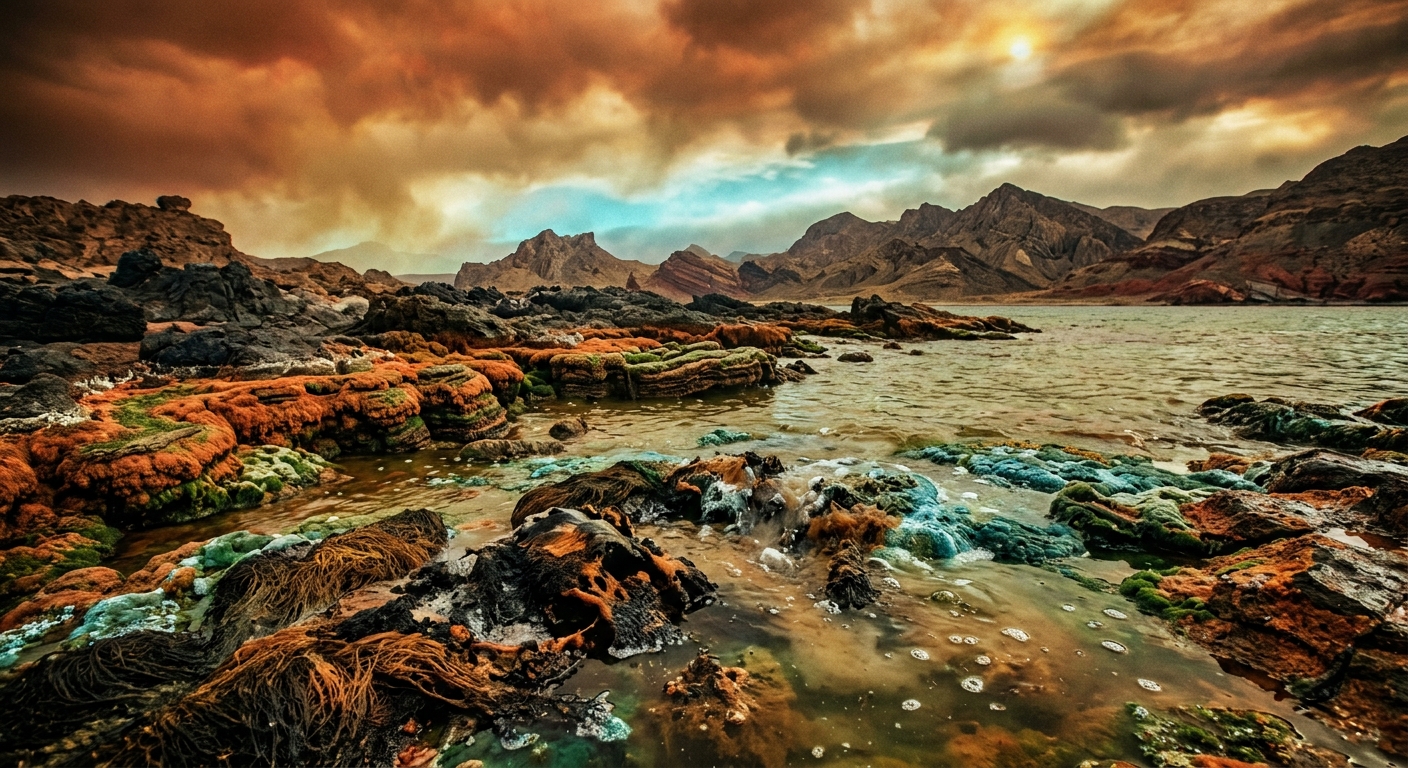
To understand this ancient apocalypse, we need to picture an Earth completely alien to the one we know today. The atmosphere contained virtually no oxygen, instead consisting mainly of methane, ammonia, and other gases that would be toxic to most modern life forms. The oceans were a rusty red-brown color, rich in dissolved iron, and the sky likely had a hazy orange tint.
In this strange world, life had already been thriving for over a billion years. But these weren’t the plants and animals we’re familiar with. Instead, the planet was dominated by anaerobic bacteria and archaea that had perfectly adapted to live without oxygen. In fact, oxygen was lethal to them, just as certain gases would be poisonous to us today.
The Tiny Organisms That Changed Everything
The villains of this story were actually heroes in disguise: cyanobacteria, also known as blue-green algae. These microscopic organisms had developed something revolutionary around 3.5 billion years ago: the ability to perform photosynthesis. Unlike the anaerobic life forms that dominated Earth, cyanobacteria could harness energy directly from sunlight.
But photosynthesis came with a deadly side effect. As these bacteria converted carbon dioxide and water into energy using sunlight, they released oxygen as waste. At first, this wasn’t a problem because the early Earth had plenty of “oxygen sinks” that absorbed the gas before it could accumulate:
- Dissolved iron in the oceans reacted with oxygen to form iron oxide (rust)
- Sulfur compounds in the atmosphere bonded with oxygen
- Volcanic gases neutralized much of the oxygen production
- Organic matter consumed available oxygen through decay processes
The Tipping Point
For over a billion years, this delicate balance held. Cyanobacteria pumped out oxygen, and Earth’s natural systems absorbed it almost as quickly as it was produced. But around 2.4 billion years ago, something shifted. Scientists believe that either cyanobacteria populations exploded, or the planet’s oxygen-absorbing capacity became saturated, or both.
Suddenly, oxygen began accumulating in the atmosphere at an unprecedented rate. Within a relatively short geological timespan of a few million years, atmospheric oxygen levels skyrocketed from nearly zero to significant concentrations. This dramatic change triggered what scientists now call the Great Oxidation Event, or sometimes the Oxygen Catastrophe.
Mass Extinction on an Unimaginable Scale
The results were catastrophic for existing life. Oxygen is highly reactive, and for organisms that had evolved in its absence, it was essentially a corrosive poison. The gas attacked cellular structures, broke down essential molecules, and disrupted metabolic processes that had worked perfectly for over a billion years.
Scientists estimate that approximately 99 percent of all life on Earth died during this period. Entire ecosystems collapsed as anaerobic bacteria and archaea that had dominated the planet for eons simply couldn’t adapt quickly enough to the toxic new conditions. The fossil record shows a dramatic decrease in the diversity of microbial life during this time.
The extinction was so severe that it makes even the asteroid impact that killed the dinosaurs look relatively minor by comparison. This was the closest life on Earth has ever come to complete annihilation, and it was caused not by an external cosmic event, but by life itself.
How Life Bounced Back
Remarkably, life not only survived this catastrophe but eventually thrived because of it. Some organisms managed to adapt to the new oxygen-rich environment through several strategies:
Evolutionary Adaptation
A small percentage of existing organisms developed ways to either tolerate oxygen or hide from it in oxygen-free environments like deep ocean sediments and underground locations. These survivors became the ancestors of modern anaerobic bacteria that still exist today in specialized environments.
The Rise of Aerobic Life
More importantly, some organisms evolved the ability to not just tolerate oxygen, but actually use it for energy production through cellular respiration. This process is far more efficient than anaerobic metabolism, providing up to 18 times more energy per glucose molecule.
This efficiency boost enabled the evolution of larger, more complex cells and eventually multicellular organisms. Without the Great Oxidation Event, complex life as we know it including plants, animals, and humans might never have evolved.
Lessons for Modern Environmental Change
The Great Oxidation Event offers sobering lessons about how dramatically life can alter planetary conditions. Just as cyanobacteria fundamentally changed Earth’s atmosphere through their biological processes, human activities are now rapidly altering our planet’s climate and atmospheric composition.
However, there are crucial differences. The original oxidation event occurred over millions of years, giving some organisms time to adapt. Current environmental changes are happening much faster, potentially outpacing the ability of many species to evolve and adapt.
The story of Earth’s first environmental disaster reminds us that our planet’s history is filled with dramatic changes and remarkable recoveries. While 99 percent of life perished during the Great Oxidation Event, the survivors ultimately gave rise to the incredible diversity of life we see today, proving that even the most catastrophic changes can sometimes lead to new possibilities and evolutionary innovations.

This is such a haunting way to frame it, and honestly it makes me think about the whales. Like, we talk about how humpbacks migrated the same routes for millennia, how they’ve adapted to every ocean on Earth, and now we’re fundamentally altering their world through noise pollution, warming waters, and chemical runoff. Those cyanobacteria accidentally changed everything without understanding the consequences, but we KNOW what we’re doing and we’re doing it anyway. The difference is terrifying to me.
Log in or register to replyThis is such a fascinating parallel to think about – those early bacteria had no idea they were literally reshaping the entire planet. It makes me wonder what unintended consequences we’re creating right now that future generations will have to adapt to. On a smaller scale, I see this happen with white-nose syndrome in bats, where a fungus from Europe spread globally and devastated North American bat populations – sometimes ecological dominoes fall in ways we never predicted. Anyway, great reminder that “disaster” and “progress” aren’t always opposites!
Log in or register to replyhonestly this post just gave me chills because yeah, those cyanobacteria were basically terraforming without knowing it, and brenda’s point really hits home. i spend so much time watching warblers and shorebirds following migration routes that havent changed in millennia, and then i see their wetland stopover habitats disappearing every year, and i keep thinking about what unintended consequences we’re creating right now that wont show up in bird populations or ecosystem collapse for decades. the irony is those ancient bacteria accidentally created the conditions for every feathered species i’ve logged in my 800+ sightings, and here we are potentially undoing that work in like 200 years.
Log in or register to reply