
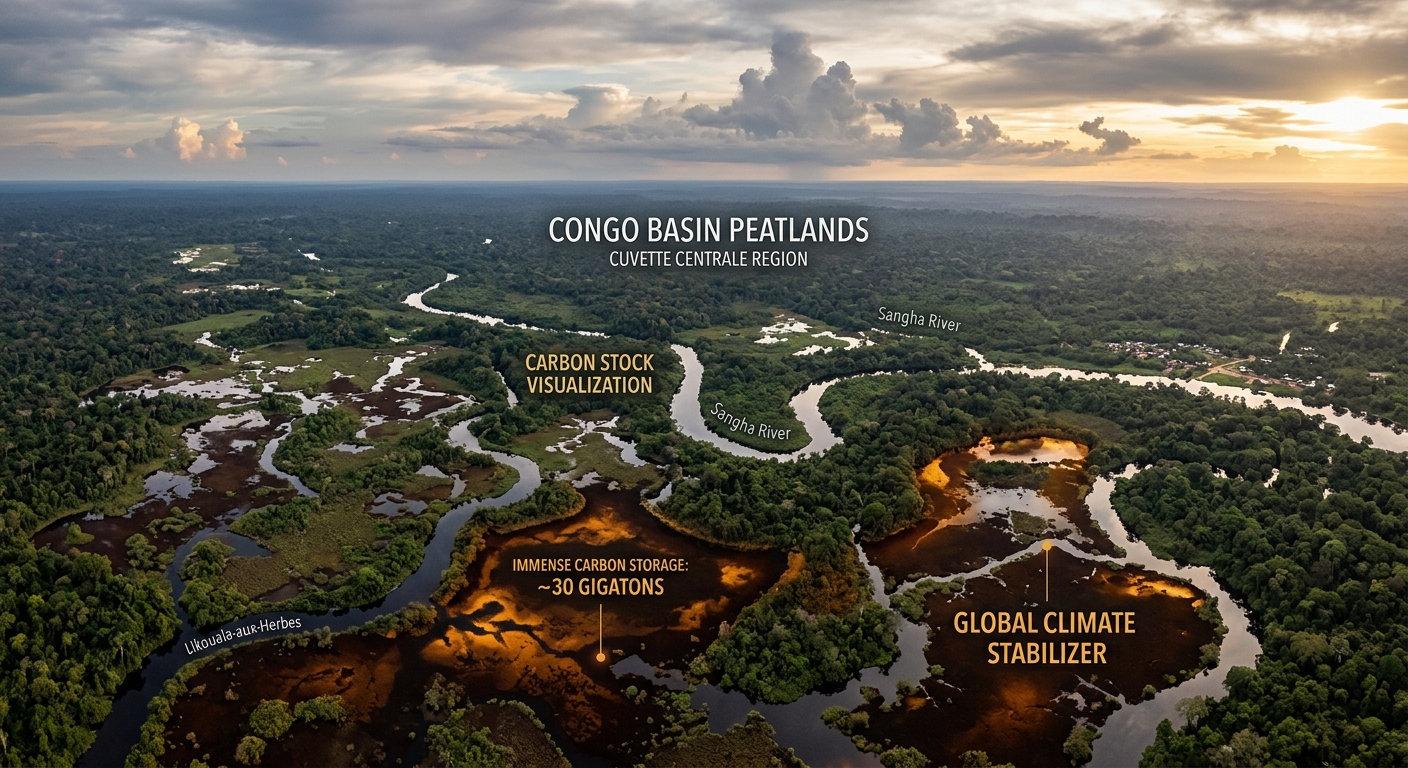
Deep in the heart of Africa lies a natural vault containing enough carbon to dramatically alter our planet’s climate trajectory. The Congo Basin rainforest, spanning across six nations and covering an area larger than Alaska, harbors a staggering secret: its soils and vegetation store approximately 60 billion tons of carbon, equivalent to three years of global fossil fuel emissions.
This mind-boggling fact transforms our understanding of climate stability and reveals how a single ecosystem holds the power to accelerate or slow global warming on a scale that dwarfs many human activities.
The World’s Second Lung Holds Its Breath
While the Amazon rainforest often steals the spotlight as the “lungs of the Earth,” the Congo Basin quietly performs an equally crucial role in regulating our planet’s atmospheric composition. Covering approximately 1.5 million square miles, this ancient ecosystem has been accumulating carbon for millennia through a complex process of plant growth, death, and decomposition.
The forest’s carbon storage occurs in two primary locations:
- Above-ground biomass: Living trees, understory vegetation, and dead plant matter
- Below-ground reserves: Organic-rich soils that have accumulated carbon over thousands of years
What makes the Congo Basin particularly remarkable is the efficiency of its carbon storage system. The region’s unique climate patterns, featuring distinct wet and dry seasons, create optimal conditions for carbon accumulation while minimizing natural release through decomposition.
A Carbon Calculation That Defies Imagination
To grasp the magnitude of the Congo Basin’s carbon reserves, consider this comparison: if this stored carbon were suddenly released into the atmosphere, it would be equivalent to burning every drop of oil, every chunk of coal, and every cubic foot of natural gas that humanity consumes in three entire years, all at once.
Recent satellite studies and ground-based research have revealed that the region stores carbon at a density of approximately 40 tons per acre. This concentration rivals and often exceeds that of other major tropical forests, making the Congo Basin one of the most carbon-rich ecosystems on Earth.
The peatlands within the Congo Basin add another layer to this carbon story. These waterlogged areas, where organic matter accumulates faster than it decomposes, contain an estimated 30 billion tons of carbon alone. Some of these peat deposits extend 20 feet deep, representing thousands of years of accumulated organic material.
The Domino Effect of Forest Loss
The release of the Congo Basin’s carbon stores wouldn’t happen overnight, but the potential for rapid acceleration exists through several mechanisms:
Fire Vulnerability
Climate change is making the region more susceptible to fires, which historically were rare due to high humidity levels. As temperatures rise and precipitation patterns shift, previously fire-resistant areas become vulnerable to burning.
Deforestation Cascade
When trees are cut down, the stored carbon in their biomass is released through burning or decomposition. More critically, deforestation exposes previously protected soil carbon to oxidation, leading to continued emissions for years after the initial forest clearing.
Soil Degradation
Agricultural conversion and mining operations disturb carbon-rich soils, accelerating decomposition rates and transforming long-term carbon sinks into active emission sources.
The Butterfly Effect on Global Climate
The potential release of the Congo Basin’s carbon reserves would trigger a cascade of climate effects that extend far beyond Africa:
- Temperature acceleration: Additional atmospheric CO2 would amplify global warming trends
- Weather pattern disruption: Changes in regional precipitation could affect agricultural zones worldwide
- Sea level implications: Enhanced warming would accelerate ice sheet melting and thermal expansion of oceans
- Ecosystem stress: Other carbon-storing ecosystems would face increased pressure under accelerated climate change
Current Threats to the Carbon Vault
The Congo Basin faces mounting pressure from multiple sources that threaten its carbon storage capacity:
Commercial logging operations target valuable timber species, often using methods that damage the broader forest structure. Agricultural expansion driven by growing populations converts forest land to cropland and pasture. Mining activities for minerals like cobalt and coltan create direct habitat destruction and soil disturbance.
Perhaps most concerning is the feedback loop created by climate change itself. As global temperatures rise, the Congo Basin experiences altered rainfall patterns, increased drought stress, and heightened fire risk, all of which threaten the stability of its carbon stores.
A Race Against Time
Understanding the Congo Basin’s role as a massive carbon reservoir has profound implications for global climate policy and conservation strategies. Protecting this ecosystem isn’t just about preserving biodiversity or maintaining local climate patterns; it’s about preventing the release of a carbon bomb that could accelerate climate change beyond current projections.
Recent international efforts have begun to recognize this critical connection. Carbon credit programs, sustainable forestry initiatives, and direct conservation funding are starting to flow toward Congo Basin protection, acknowledging that preserving these forests is equivalent to preventing massive fossil fuel emissions.
The Congo Basin rainforest represents one of nature’s most impressive achievements in carbon sequestration, holding enough stored carbon to remind us that our planet’s climate stability depends on ecosystems far from our daily experience. As we grapple with climate change, this ancient forest stands as both a crucial ally and a potential threat, depending entirely on how well we protect it in the coming decades.



You’re touching on something huge here – the Congo Basin isn’t just a carbon storage unit, it’s an irreplaceable habitat for thousands of species including some seriously incredible bat populations that are basically climate regulators themselves. Insectivorous bats alone consume massive amounts of forest pests, which helps keep the ecosystem stable, and if we lose that rainforest we’re losing both the carbon sink AND the natural pest control that keeps the whole system functioning. It’s all connected in ways people don’t usually think about!
Log in or register to replyThis is a genuinely sobering issue, though I gotta say the climate angle isn’t really my wheelhouse since I’m more of a toxicology and venom person. That said, the ecological collapse aspect fascinates me because you’re talking about disrupting one of Earth’s most complex chemical systems – all those plant alkaloids, defensive compounds, and predator/prey coevolution that took millennia to balance would vanish almost overnight. The rainforest is basically a massive library of natural chemistry we haven’t even catalogued yet, so losing it before we understand even a fraction of those compounds feels like torching a museum. Hopefully the urgency of carbon storage sinks into policy makers in a way that pure
Log in or register to replyAbsolutely, you’re touching on something I think about constantly – the Congo Basin is basically an unexplored pharmacopeia of venom and defensive chemistry we’ll never get to study if it burns. I’m talking compounds from arrow frogs, cone snails-adjacent predatory systems in insects, plant alkaloids that evolved specifically to deter herbivores and pathogens. Every species that goes extinct takes millions of years of chemical refinement with it, and honestly the loss to toxicology research alone (forget the climate implications) should be a wake-up call. We’ve only scratched the surface on how these organisms weaponize chemistry, and that knowledge could inform everything from medicine to materials science.
Log in or register to reply