
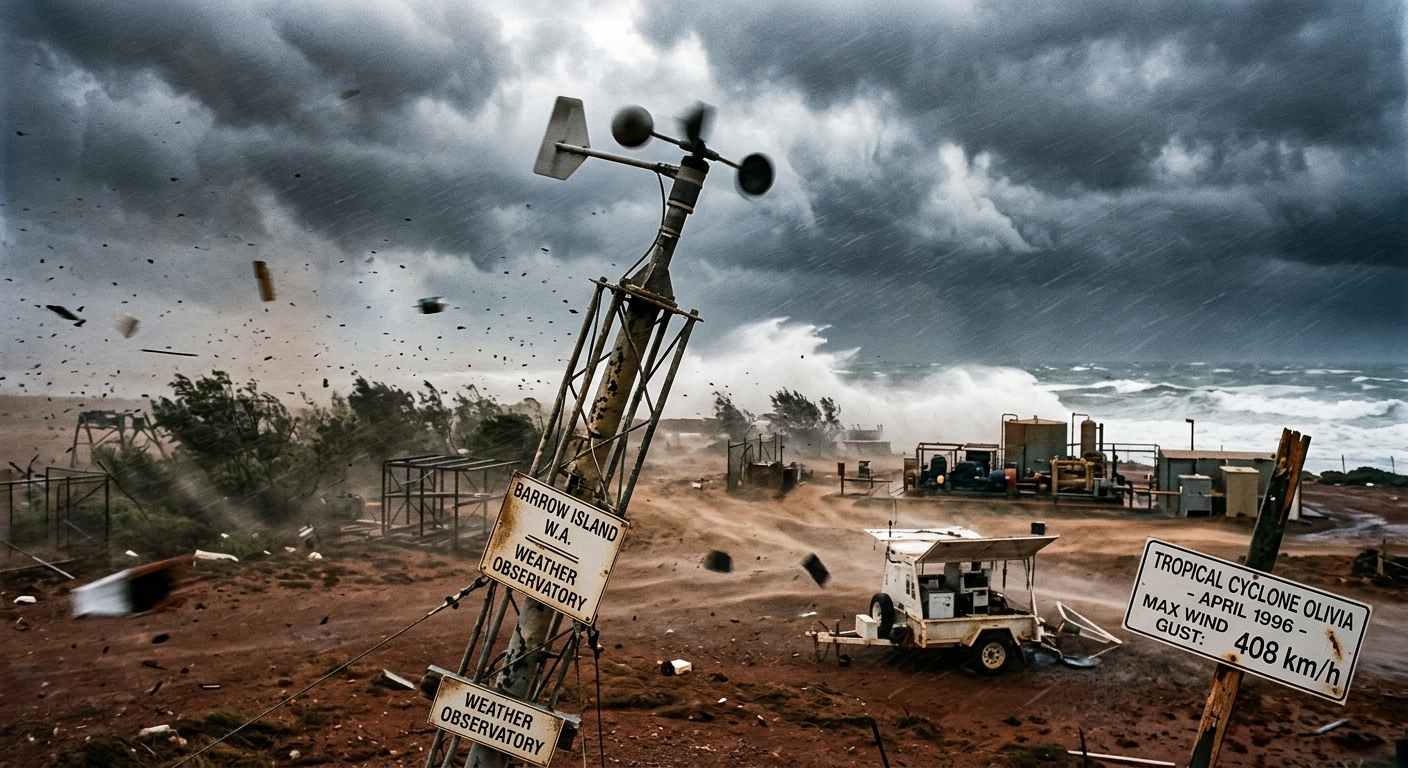
On May 3, 1999, nature unleashed one of its most terrifying displays of raw power near Moore, Oklahoma. The wind speeds recorded that day would shatter every previous measurement and redefine our understanding of what Earth’s atmosphere is truly capable of producing. At 408 kilometers per hour (253 miles per hour), these winds represent the fastest ever reliably measured on our planet’s surface.
To put this mind-bending speed into perspective, these winds were moving faster than a Formula 1 race car at top speed. They could pick up and hurl a full-sized automobile over 100 meters through the air. The sheer force behind such winds contains enough energy to level entire neighborhoods in seconds, which is exactly what happened that fateful spring evening in Oklahoma.
The Perfect Storm: How Nature Creates Wind Monsters
The 408 KPH winds didn’t appear out of nowhere. They were the product of a rare and violent meteorological phenomenon called a supercell thunderstorm. These atmospheric beasts form when specific conditions align in a deadly dance of temperature, pressure, and wind shear.
On that May evening, three critical ingredients came together over the Great Plains:
- Extreme temperature contrast: Cold, dry air from Canada collided with warm, moist air from the Gulf of Mexico
- Wind shear: Different wind speeds and directions at various altitudes created rotation
- Atmospheric instability: The perfect combination of pressure systems created an explosive environment
The result was an EF5 tornado, the most powerful classification on the Enhanced Fujita Scale. But even among EF5 tornadoes, the Moore tornado was exceptional. Most EF5s produce winds between 322-400 KPH, making the 408 KPH measurement truly extraordinary.
The Technology That Captured the Impossible
Measuring winds of such incredible velocity presents enormous technical challenges. Traditional weather instruments simply cannot survive the destructive forces of a major tornado. The breakthrough came with the deployment of mobile Doppler radar units that could track storms from a safe distance.
The record-breaking measurement was captured by a mobile radar operated by researchers from the University of Oklahoma. Using advanced Doppler technology, they were able to measure wind speeds at approximately 100 meters above ground level. This represented a quantum leap in our ability to study these violent storms without putting human observers directly in harm’s way.
The Doppler Advantage
Doppler radar works by sending out radio waves and analyzing how they bounce back from particles in the atmosphere. When those particles are moving rapidly, such as in tornado winds, the radar can detect the speed and direction of movement with remarkable precision. The technology can measure wind speeds from several kilometers away, allowing researchers to study phenomena that would otherwise be impossible to observe.
The Destructive Power of 408 KPH Winds
Numbers alone cannot convey the devastating reality of 408 KPH winds. At this speed, the wind pressure reaches approximately 2,400 pascals per square meter. This is enough force to:
- Strip the bark completely off trees
- Level well-constructed buildings
- Turn ordinary debris into deadly missiles
- Deform and twist steel structures
- Create a sound described by survivors as louder than a freight train
The Moore tornado carved a path of destruction 1.6 kilometers wide and traveled for over 60 kilometers. In its wake, entire subdivisions were reduced to splinters and foundations. The tornado claimed 36 lives and caused over $1 billion in damage, making it one of the most costly natural disasters in Oklahoma’s history.
Why Earth’s Winds Can’t Get Much Faster
While 408 KPH represents the fastest recorded surface wind, atmospheric scientists believe there are physical limits to how fast tornado winds can actually become. Computer models suggest that the maximum possible tornado wind speed is somewhere around 450-500 KPH.
Several factors create this upper limit:
- Centrifugal force: As rotation increases, the centrifugal force eventually overcomes the pressure gradient that drives the wind
- Friction: Even in the most intense tornadoes, surface friction creates drag that limits wind acceleration
- Atmospheric pressure limits: There are physical constraints on how low pressure can drop at Earth’s surface
Other Extreme Wind Phenomena on Earth
While the Moore tornado holds the record for surface winds, other locations on Earth regularly experience extreme wind speeds through different mechanisms. Mount Washington in New Hampshire recorded surface winds of 372 KPH during a winter storm in 1934, the highest non-tornado wind speed ever measured.
Hurricane winds, while not reaching tornado velocities, can sustain extreme speeds over much larger areas for extended periods. The strongest hurricane winds ever recorded reached 305 KPH in Hurricane Patricia in 2015.
Jet Stream Winds
High in the atmosphere, jet stream winds routinely exceed 400 KPH during winter months. These fast-moving rivers of air flow at altitudes of 9-15 kilometers above sea level and play crucial roles in global weather patterns. While not affecting surface conditions directly, jet stream winds demonstrate that Earth’s atmosphere is capable of producing sustained high-velocity flows under the right conditions.
The Ongoing Quest to Understand Extreme Weather
The record-setting Moore tornado measurement has contributed invaluable data to our understanding of severe weather. This information helps meteorologists improve tornado prediction models and assists engineers in designing more wind-resistant structures.
Modern storm chasing and research efforts continue to push the boundaries of what we know about extreme winds. Advanced radar systems, computer modeling, and even drone technology are providing unprecedented insights into the mechanics of these atmospheric monsters.
As climate patterns continue to evolve, understanding the limits of what nature can produce becomes increasingly important. The 408 KPH record stands as a sobering reminder of the incredible forces that our planet’s atmosphere can unleash, and the ongoing need to respect and prepare for nature’s most extreme displays of power.





okay this is absolutely wild and terrifying but also i cant help thinking about how plants in the path of something like that must experience it almost like a sudden shock to their whole system, like imagine the cellular stress on a Sequoia that survives that kind of force versus something more delicate. i wonder if any of the plants that got uprooted in moore managed to regenerate or if their root systems were just completely devastated – doesnt make it less horrific obvi but the ecology of recovery after something that extreme is kinda fascinating to me
Log in or register to replyoh wow yes the cellular stress angle is so interesting, and frederica youre onto something with the mycorrhizal networks too! i’m just thinking about how plants in tornado zones have actually evolved some wild adaptations like flexible wood structures and root systems that can basically go limp instead of snapping, its kind of like convergent evolution with how some animals do this whole passive survival thing when threatened. the deadliest part isnt always brute force resistance but knowing when to just… give way, which is honestly fascinating from an evolutionary perspective
Log in or register to replyThis is such a fascinating angle, Priya! I’ve been reading about how mycorrhizal networks actually help stabilize root systems against exactly this kind of catastrophic stress, and I wonder if fungi play some kind of shock absorber role during extreme weather events. The mycelium connecting different plants underground might distribute some of that sudden force rather than having each plant absorb it in isolation, though honestly I haven’t found much research on this specific scenario and would love to know if anyone’s studied tornado aftermath from a fungal ecology perspective.
Log in or register to reply