
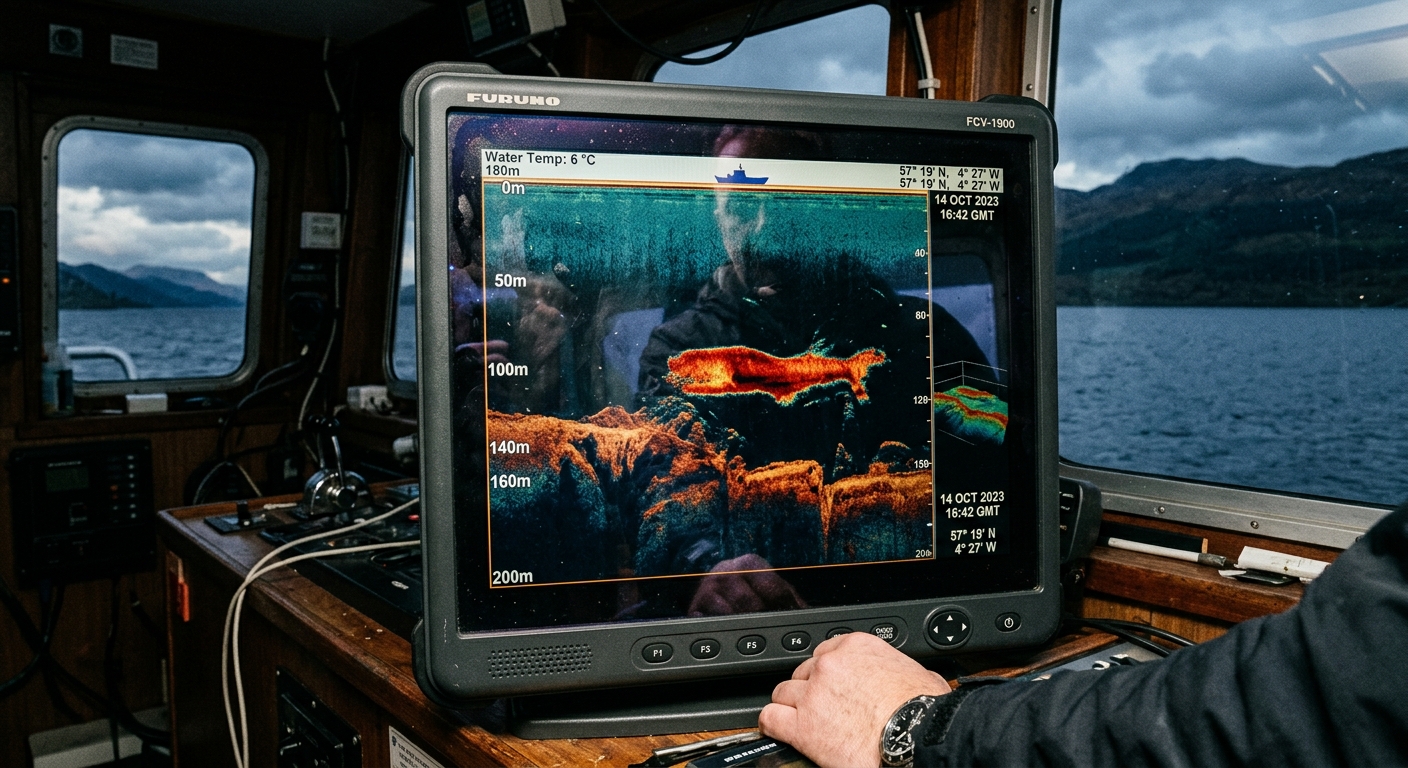
For nearly a century, Loch Ness has captivated the world with tales of an elusive monster lurking in its dark depths. While skeptics dismiss the legend as folklore and hoax, modern sonar technology continues to detect unexplained signals from the loch’s murky waters. These electronic readings, impossible to fake and difficult to explain, keep the mystery alive in ways that blurry photographs never could.
The Technology That Doesn’t Lie
Unlike eyewitness accounts or grainy photographs that can be dismissed as misidentification or fabrication, sonar readings provide concrete data that scientists must grapple with. Modern echo-location technology sends sound waves through water and measures their return, creating detailed maps of underwater terrain and detecting moving objects with remarkable precision.
The beauty of sonar lies in its objectivity. It cannot be influenced by wishful thinking, poor lighting conditions, or the human tendency to see patterns where none exist. When sonar equipment registers an anomaly, something real and physical has interacted with those sound waves.
Strange Signals from the Deep
Since the 1970s, multiple sonar expeditions have recorded puzzling readings from Loch Ness. These signals often share similar characteristics:
- Large moving objects, sometimes exceeding 20 feet in length
- Movement patterns inconsistent with known fish species
- Objects appearing to move at depths where large air-breathing animals shouldn’t survive
- Sudden appearances and disappearances that suggest rapid vertical movement
- Multiple objects moving in apparent coordination
One of the most famous incidents occurred in 2011 when tourist boat captain Marcus Atkinson detected a sonar contact over 5 feet wide moving beneath his vessel. The object maintained a steady course for several minutes before vanishing from the screen entirely.
The 2019 Environmental DNA Study Complications
In 2019, researchers conducted the most comprehensive DNA survey of Loch Ness waters ever attempted, hoping to catalog every living creature in the lake. The results were both illuminating and frustrating for monster hunters. The study found no evidence of large reptiles, sharks, or other exotic creatures often proposed as explanations for Nessie sightings.
However, the DNA study did reveal an unusual abundance of eel genetic material, leading some researchers to speculate about the possibility of exceptionally large eels. European eels can grow to impressive sizes under the right conditions, and Loch Ness provides an environment where they might reach extraordinary proportions.
The Physics of Loch Ness
Understanding the unusual sonar readings requires examining the unique characteristics of Loch Ness itself. This isn’t just any lake, it’s a geological anomaly that creates perfect conditions for both harboring large creatures and generating false readings.
Depth and Volume
Loch Ness contains more water than all the lakes in England and Wales combined. Its maximum depth reaches 755 feet, creating vast underwater spaces where large creatures could theoretically remain hidden from surface observation. The loch’s immense volume means that even sizeable animals might rarely encounter human observers.
Thermoclines and Acoustic Shadows
The loch’s depth creates distinct temperature layers called thermoclines, which can bend and distort sonar signals in unexpected ways. These acoustic anomalies might explain some unusual readings, but they also provide potential hiding spots where large creatures could avoid detection by staying within these acoustic shadows.
Underwater Topography
The loch’s bottom features dramatic underwater cliffs, caves, and crevices carved by ancient glacial activity. This complex terrain creates numerous hiding places and can generate confusing sonar echoes that might be misinterpreted as moving objects.
Recent Technological Advances
Modern sonar technology has become increasingly sophisticated, making it harder to dismiss anomalous readings as equipment malfunction or operator error. Recent investigations have employed:
- Multi-beam sonar systems that create detailed 3D maps
- Side-scan sonar for comprehensive bottom surveys
- Hydrophone arrays to detect underwater sounds
- Underwater cameras triggered by motion sensors
- Environmental DNA sampling at various depths
Despite these technological advances, unexplained contacts continue to appear on sonar screens. In 2020, researchers using state-of-the-art equipment detected a large, fast-moving object that appeared to change direction deliberately before disappearing near the loch’s deepest point.
Scientific Explanations vs. Remaining Mysteries
Marine biologists and acoustics experts have proposed several conventional explanations for the mysterious sonar readings. Schools of fish moving in tight formation can create large, seemingly solid contacts on sonar screens. Swimming deer or other terrestrial animals might occasionally cross the loch, generating unusual signatures.
Underwater gas emissions from decomposing organic matter could create bubble plumes that appear as moving objects on sonar. The loch’s geology might produce intermittent gas releases that coincidentally mimic the movement patterns of large creatures.
However, these conventional explanations struggle to account for all the observed phenomena. The size, speed, and apparent intelligence behind some movement patterns challenge simple explanations.
The Ongoing Investigation
Rather than definitively proving or disproving the existence of unknown creatures in Loch Ness, modern sonar technology has made the mystery more sophisticated. Today’s researchers focus less on finding monsters and more on understanding the loch’s complete ecosystem and the various factors that might contribute to anomalous readings.
The truth about Loch Ness may prove more interesting than simple monster stories. The lake’s unique characteristics create a natural laboratory for studying acoustic phenomena, underwater ecology, and the limits of detection technology. Whether the sonar contacts represent unknown species, unusual environmental phenomena, or something else entirely, they continue to challenge our understanding of what lurks beneath Scotland’s most famous waters.
Until someone definitively explains every anomalous sonar reading from Loch Ness, the mystery endures. Modern technology has simply given us more sophisticated ways to ask the same ancient question: what exactly is moving through those dark, deep waters?





I appreciate Beth’s ecological instinct here, because this is exactly where the phenology and population data would matter most. If there were a large predator in Loch Ness, we’d expect measurable shifts in fish species composition, spawning times, and abundance patterns over decades, and honestly the limnological records just don’t show the kind of disruption you’d need to support something genuinely massive living there. The sonar signals are interesting artifacts worth investigating, but they usually have mundane explanations, gas bubbles, thermal layers, equipment artifacts, which is way more parsimonious than a large unknown animal.
Log in or register to replyReally appreciate where you two are going with this, because honestly the ecological angle is way more interesting than the sonar blips themselves. I spend a lot of time watching how light pollution disrupts nocturnal fish behavior in freshwater systems, and if there were actually a massive predator in Loch Ness, the night activity patterns of smaller fish species would shift dramatically – they’d either avoid deeper waters after dark or change their vertical migration entirely. Plus, the impact on nocturnal invertebrates and aquatic insects would be impossible to hide in a system that’s been studied this intensely, so I’m genuinely curious what the actual population data shows when you look at it through that lens.
Log in or register to replyhonestly this is fascinating but i cant help thinking about what the actual ecosystem disruption would mean – ive spent enough time around large freshwater systems to know that if theres something genuinely massive down there, the fish populations and migration patterns would show some pretty serious stress markers, and i havent seen compelling data on that front. would love to see sonar cross referenced with actual ichthyological surveys because the loch ness char and salmon runs could tell us a lot if anyones looking. still beats some of the habitat destruction ive watched happen to real breeding grounds though, so at least this keeps public interest in preserving the ecosystem i guess?
Log in or register to reply