
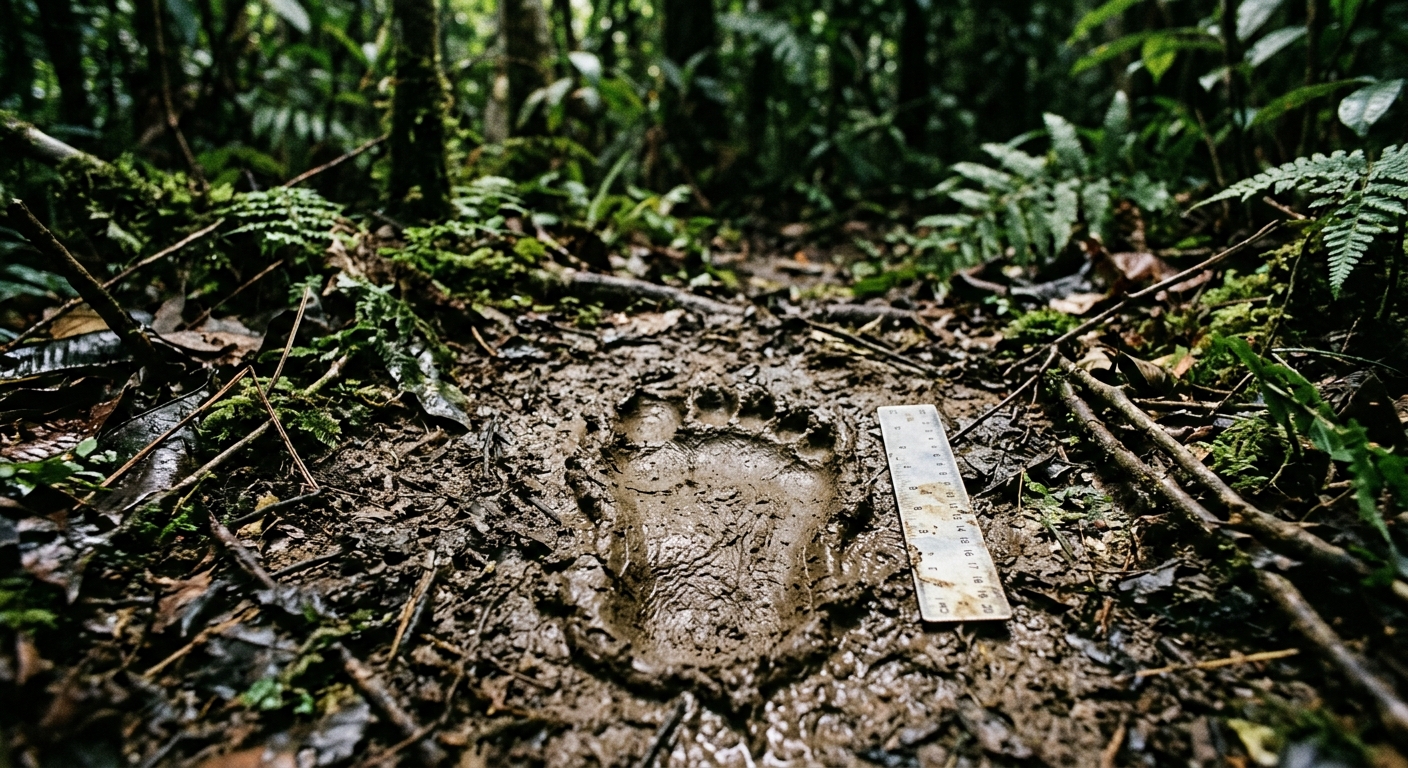
Deep in the misty rainforests of Sumatra, Indonesia, something extraordinary has been leaving behind evidence that continues to perplex the scientific community. The Orang Pendek, which translates to “short person” in the local language, represents one of the most compelling cryptozoological mysteries of our time. Unlike many legendary creatures that exist only in folklore, this elusive primate has left behind physical evidence that has captured the attention of serious researchers and primatologists worldwide.
The Legend Comes to Life
For generations, the indigenous people of Sumatra have spoken of a small, upright-walking ape that inhabits the dense jungles of their island. Standing approximately three to four feet tall, with reddish-brown hair covering its muscular frame, the Orang Pendek is described as remarkably human-like in its behavior and posture. What sets this creature apart from other cryptids is the sheer consistency of eyewitness accounts and the mounting physical evidence supporting its existence.
Local communities have coexisted with stories of this creature for centuries, treating it not as a mythical beast but as a natural part of their forest ecosystem. Farmers and hunters regularly report encounters, describing a shy, intelligent primate that walks upright through the undergrowth with surprising grace and speed.
The Footprint Evidence That Changed Everything
The most compelling evidence for the Orang Pendek’s existence comes in the form of footprints that have left scientists scratching their heads. These tracks, discovered throughout Sumatra’s Kerinci Seblat National Park, display characteristics that don’t match any known primate species in the region.
Unique Anatomical Features
The footprints measure approximately 6 to 8 inches in length and display several remarkable characteristics:
- A distinctive ridge running along the outside edge of the foot
- Toes that show a human-like arrangement but with ape-like proportions
- A flexible midfoot that suggests adaptation for both ground walking and tree climbing
- Pressure patterns indicating bipedal locomotion
- Heel-to-toe walking gait similar to humans but with different weight distribution
Dr. David Chivers, a primatologist from Cambridge University, examined plaster casts of these footprints and concluded that they represent “a foot that is not quite human and not quite ape.” The anatomical features suggest a primate that has evolved unique adaptations for its forest environment.
Scientific Investigation and Analysis
The most significant scientific expedition to investigate the Orang Pendek was led by British explorer Debbie Martyr in the 1990s. After spending years in the Sumatran wilderness, Martyr collected numerous footprint casts and hair samples that provided tangible evidence for analysis.
Footprint Analysis Results
When subjected to rigorous scientific analysis, the footprints revealed several fascinating details:
- The foot structure suggests a primate weighing between 100-150 pounds
- Gait analysis indicates efficient bipedal locomotion adapted for forest terrain
- The flexibility of the foot suggests retained climbing abilities
- Wear patterns on the footprints indicate regular use of established forest paths
Perhaps most intriguingly, the footprints show signs of dermal ridges, similar to human fingerprints, which are extremely difficult to fake and represent a strong indicator of authenticity.
Hair Sample Mystery
Accompanying the footprint evidence, researchers have collected hair samples attributed to the Orang Pendek. Initial DNA analysis of these samples produced puzzling results. While some samples were identified as belonging to known species like sun bears or orangutans, others yielded inconclusive results that didn’t match any catalogued primate DNA.
The hair samples that couldn’t be identified displayed characteristics consistent with eyewitness descriptions: coarse, reddish-brown fibers that appeared to come from a medium-sized primate. However, without a complete genetic profile, definitive identification remains elusive.
Ecological Plausibility
Sumatra’s biodiversity makes it an ideal candidate for harboring undiscovered species. The island’s rainforests are among the most biodiverse ecosystems on Earth, regularly yielding new species discoveries. The remote and largely unexplored regions of Kerinci Seblat National Park provide ample habitat for a small population of unknown primates.
Environmental Factors Supporting Existence
- Dense canopy cover providing protection from detection
- Abundant food sources including fruits, insects, and small animals
- Minimal human presence in core habitat areas
- Mountainous terrain creating isolated pockets for evolution
- Year-round tropical climate supporting continuous foraging
The Ongoing Scientific Debate
The scientific community remains divided on the Orang Pendek evidence. Skeptics argue that the footprints could belong to known species under unusual circumstances, such as orangutans walking on the ground or deformed individuals of recognized species. However, supporters point to the consistency of the evidence and the difficulty of explaining away the unique anatomical features revealed in the tracks.
Dr. Grover Krantz, a anthropologist who studied the footprints extensively, noted that the bone structure implied by the tracks would require “either a new species or a very unusual individual of a known species.”
Modern Research Efforts
Contemporary researchers continue to investigate the Orang Pendek mystery using advanced technology. Motion-activated cameras, improved DNA analysis techniques, and satellite mapping of potential habitats have all been employed in the search for definitive proof.
While conclusive evidence remains elusive, the accumulation of footprint casts, hair samples, and consistent eyewitness accounts continues to build a compelling case for further investigation. The possibility that a unknown primate species could exist in one of the world’s most biodiverse regions serves as a reminder of how much we still have to learn about our planet’s incredible biodiversity.
Whether the Orang Pendek represents a new species, a population of known primates displaying unusual behavior, or something else entirely, the evidence continues to challenge our understanding of Southeast Asian wildlife and reminds us that Earth still holds secrets waiting to be uncovered.






Okay so this is cool and all, but can we take a moment to appreciate that Sumatra ALSO has an incredible bat diversity that’s equally mysterious and way more documented? The region has over 100 bat species including some that are still being studied for their ecological roles, and nobody’s out here questioning their existence because, you know, we actually have specimens and research data. I’m not saying Orang Pendek isn’t real, just saying the truly weird and undocumented creatures already living in Southeast Asia deserve some of that cryptid energy too!
Log in or register to replyhonestly the habitat loss in sumatra is what gets me the most, whether this creature exists or not – ive been tracking orangutan populations there for years and every trip back the forest is smaller. if an undocumented primate is out there, we’re probably destroying its range faster than we can study it, which is kind of heartbreaking. Brenda makes a great point too about the bats, that whole ecosystem is criminally under-researched while the forest disappears around it.
Log in or register to replyYou’re hitting on something that really haunts me about these cryptid situations, honestly – we have GPS tracking data showing us exactly where known species like orangutans are struggling, but we’re still debating footprint morphology while their habitat shrinks in real time. If the Orang Pendek is real, it’s probably already ecologically trapped in fragments we haven’t even surveyed with camera traps yet, and you’re absolutely right that the bat diversity angle is criminally overlooked when those migration and movement patterns could tell us so much about ecosystem health. The heartbreaking part isn’t just that we might discover something new and lose it, it’s that we already have the technology to track and protect these populations but
Log in or register to reply