A Century-Old Mystery Dancing Across the Texas Horizon
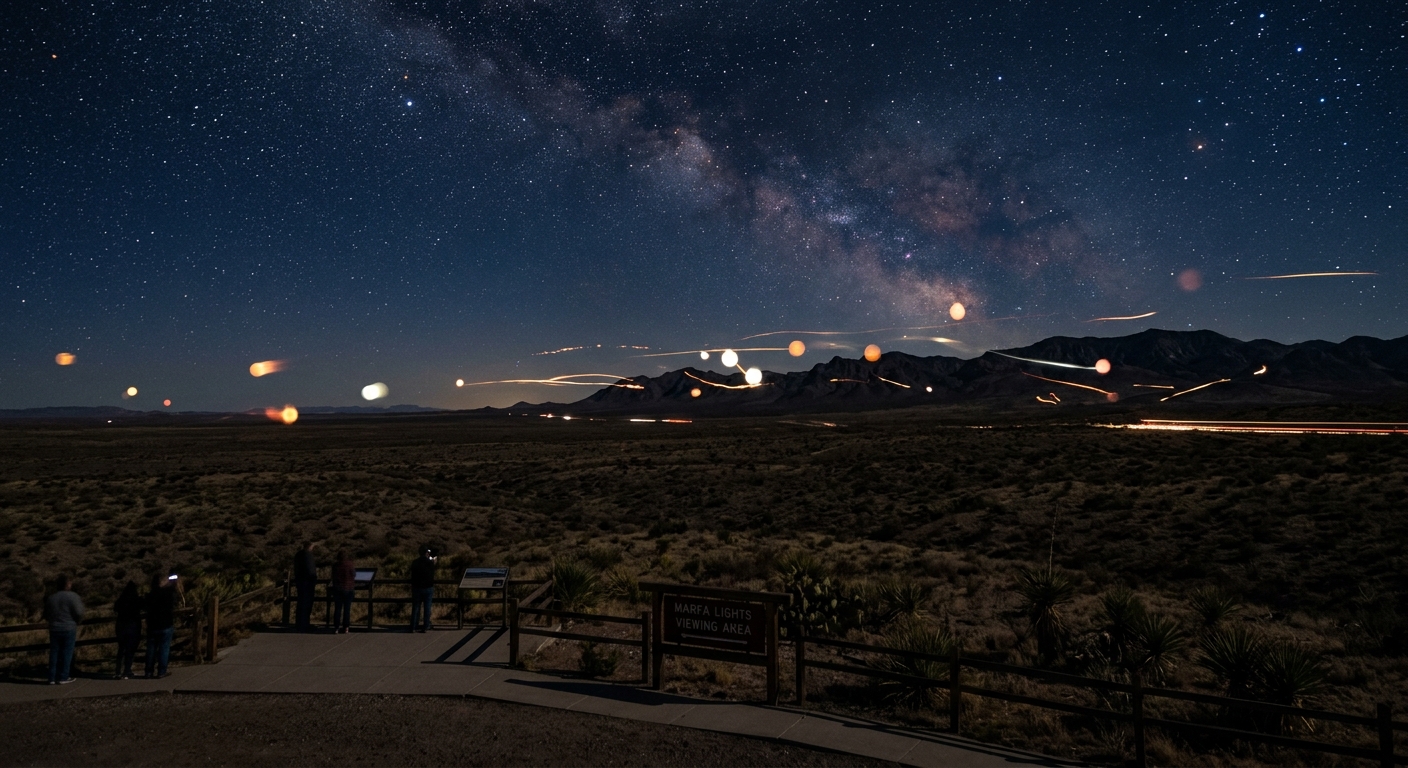
In the vast expanse of West Texas desert, near the small town of Marfa, an extraordinary phenomenon has been captivating witnesses for over 140 years. Known as the Marfa Lights, these mysterious orbs of light appear to dance, merge, split apart, and vanish without warning across the desert landscape. Despite hundreds of photographs, countless eyewitness accounts, and numerous scientific investigations, no one has been able to definitively explain what causes these enigmatic lights to appear.
The lights typically manifest as glowing orbs that range in color from white and yellow to red and blue. They hover anywhere from three to eight feet above the ground, moving erratically across the desert floor near Mitchell Flat, east of Marfa. Witnesses describe them as basketball-sized spheres that can suddenly appear, dance around each other, split into multiple lights, or simply fade away into the darkness.
The First Recorded Sighting and Growing Legend
The first documented sighting of the Marfa Lights dates back to 1883, when a young cowhand named Robert Reed Ellison spotted strange lights while driving cattle through the area. Ellison initially thought the lights were Apache campfires, but upon investigation, he found no evidence of any encampment. Word of his strange encounter spread throughout the region, and soon other settlers began reporting similar phenomena.
During World War II, pilots training at the nearby Midland Army Air Field frequently reported seeing unexplained lights in the Marfa area. These military witnesses, trained in aerial observation, provided some of the most credible early accounts of the phenomenon. Their reports helped establish the Marfa Lights as more than just local folklore.
Characteristics That Defy Easy Explanation
What makes the Marfa Lights particularly puzzling is their consistent behavior patterns that seem to defy conventional explanations:
- Intelligent Movement: The lights appear to move with purpose, often avoiding obstacles and responding to the presence of observers
- Variable Size and Intensity: They can range from dim glows to brilliant flashes visible from miles away
- Splitting and Merging: Single lights often divide into multiple orbs or merge together
- Consistent Location: The lights almost always appear in the same general area of Mitchell Flat
- Weather Independence: They appear regardless of weather conditions, from clear nights to overcast skies
Scientific Investigations and Attempted Explanations
Over the decades, numerous scientists, researchers, and curious investigators have attempted to solve the mystery of the Marfa Lights. The phenomenon has been studied by geologists, atmospheric physicists, and even paranormal researchers, each bringing their own theories and equipment to bear on the puzzle.
One of the most comprehensive studies was conducted by physicist Dr. Edson Hendricks in the 1970s. Using sensitive equipment to measure electromagnetic fields, temperature variations, and atmospheric conditions, Hendricks spent months in the desert trying to correlate environmental factors with light appearances. While he documented numerous sightings, he was unable to identify a consistent trigger or cause for the phenomena.
Popular Theories That Don’t Quite Fit
Several explanations have been proposed over the years, but each falls short of explaining all aspects of the Marfa Lights:
- Swamp Gas: While phosphine gas from decaying organic matter can create lights, the desert environment around Marfa lacks the marshy conditions necessary for significant gas production
- Piezoelectric Effects: Some suggest that pressure on quartz-bearing rocks could generate electrical discharges, but the lights appear too frequently and predictably for this geological explanation
- Atmospheric Refraction: Temperature inversions can cause distant lights to appear closer and behave strangely, but this doesn’t account for the lights’ apparent interaction with observers
- Ball Lightning: This rare electrical phenomenon could explain some characteristics, but ball lightning typically lasts only seconds, while Marfa Lights can persist for hours
Modern Documentation and Photography
In recent decades, improved photography and video equipment have allowed for better documentation of the Marfa Lights. Hundreds of photographs and videos have been captured, some showing remarkable detail of the lights’ behavior. However, these visual records have only deepened the mystery rather than solving it.
Digital analysis of photographs has revealed that the lights emit their own illumination rather than reflecting existing light sources. Spectral analysis has shown that the lights produce a broad spectrum of wavelengths, suggesting they are not simple reflections or refractions of distant artificial lights.
The Marfa Lights Viewing Center
Recognizing the phenomenon’s significance as both a scientific mystery and tourist attraction, Texas built an official Marfa Lights Viewing Center along Highway 90. The facility provides an unobstructed view of the area where the lights most commonly appear and includes historical information about the sightings.
Visitors to the viewing center report success rates of approximately 30-40% for witnessing the lights, with the best viewing times typically occurring after sunset on clear nights. The lights appear most frequently during certain times of the year, particularly in late summer and early fall, though the reason for this seasonal variation remains unknown.
The Enduring Mystery
Despite more than a century of investigation and hundreds of documented sightings, the Marfa Lights remain one of America’s most persistent natural mysteries. The phenomenon continues to attract scientists, photographers, and curious visitors from around the world, all hoping to witness or explain these dancing desert lights.
What makes the Marfa Lights particularly compelling is their consistency. Unlike many unexplained phenomena that rely on scattered, unreliable accounts, the Marfa Lights appear regularly enough that they have become a reliable tourist attraction. This consistency suggests a natural phenomenon with identifiable causes, yet those causes continue to elude scientific explanation.
The mystery of the Marfa Lights serves as a humbling reminder that our planet still holds secrets that modern science has yet to unlock. In an age where we can photograph black holes and land rovers on Mars, these simple lights dancing across a Texas desert continue to mystify us, proving that some of Earth’s most fascinating phenomena might be hiding in plain sight.



ive been out to marfa twice for these lights and honestly i cant decide if theyre more fascinating or frustrating, like the skeptic in me wants it to be car headlights or swamp gas or whatever but the lights i saw didnt move like anything ive tracked through binoculars before, which is saying something after 30+ years of fieldwork. either way the desert habitat out there is incredible, wish they’d protect more of it since light pollution is killing migrating warblers and shorebirds way more than any mystery orbs ever could.
Log in or register to replyhonestly you both are touching on something cool here, because whether it’s headlights or something genuinely unexplained, the real magic is that you two went out there at night to actually look – that’s when the desert shows you what it’s really about, and I bet you noticed way more than just the lights, like the nocturnal animals coming alive or how different the stars look away from cities. the frustration/fascination thing makes total sense because that’s kind of the whole experience of night observation, you’re always sitting with both possibilities at once, and honestly either way it’s worth going back out there when there’s no moon.
Log in or register to replyI totally get that tension you’re describing, Beth – imagine if it turned out to be something mundane like headlights, but then you’d have to explain why the phenomenon was documented in the 1880s before cars were common in that area. The tricky part with Marfa is that we keep wanting it to be *one* answer when it might actually be several different things happening at once, which is way less satisfying but probably more honest. Have you noticed if the lights behave differently depending on atmospheric conditions or time of year?
Log in or register to reply