
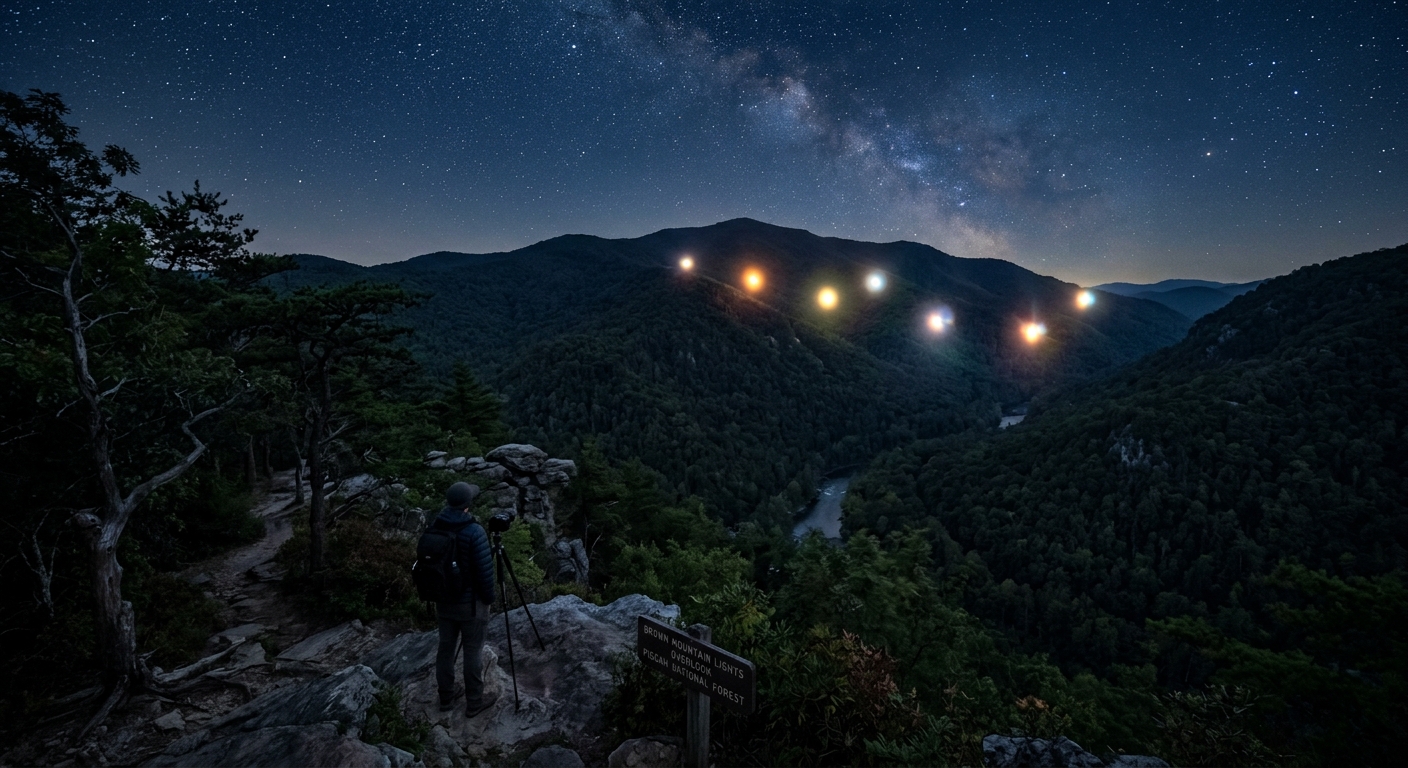
Deep in the Appalachian Mountains of North Carolina, a phenomenon has been captivating witnesses for over 800 years. The Brown Mountain Lights, appearing as glowing orbs that dance across the night sky, have defied scientific explanation and sparked countless theories ranging from the supernatural to the extraterrestrial. What makes these lights so remarkable isn’t just their mysterious nature, but their incredible longevity as one of America’s oldest documented unexplained phenomena.
A Mystery Older Than the United States
The first recorded accounts of the Brown Mountain Lights date back to 1200 CE, when Cherokee and Catawba Native American tribes reported seeing strange lights hovering over the mountain. According to Cherokee legend, the lights were the spirits of Cherokee and Catawba warriors who died in a great battle, forever searching the mountainside for their fallen comrades.
German engineer John William Gerard documented the phenomenon in 1771, making it one of the earliest written accounts by European settlers. Gerard described seeing lights that appeared to rise from the mountain and hover in the air before disappearing. His detailed observations helped establish the Brown Mountain Lights as a legitimate phenomenon worthy of scientific investigation.
The Science Behind the Search
Over the centuries, numerous scientific expeditions have attempted to solve the mystery of Brown Mountain. The U.S. Geological Survey conducted investigations in 1913 and again in 1922, initially attributing the lights to locomotive headlights reflecting off low-hanging clouds. However, this theory was quickly debunked when the lights continued to appear during a flood that knocked out all train service in the area for weeks.
Modern researchers have proposed several compelling theories:
- Piezoelectric activity: The compression of quartz crystals in the mountain’s granite could generate electrical charges that manifest as visible light
- Plasma formations: Electromagnetic fields created by underground fault lines might produce ball lightning or plasma phenomena
- Marsh gas: Decomposing organic matter could create phosphine gas that ignites when exposed to oxygen
- Atmospheric refraction: Temperature inversions could bend light from distant sources, creating the illusion of floating orbs
The Characteristics That Baffle Scientists
What makes the Brown Mountain Lights particularly puzzling is their consistent behavior patterns. Witnesses describe orbs of light that:
- Range in color from white and yellow to red and blue
- Vary in size from basketball-sized to as large as automobiles
- Move in seemingly intelligent patterns, sometimes following the mountain’s contours
- Appear most frequently on clear nights after rainy days
- Maintain visibility for anywhere from a few seconds to several hours
Dr. Daniel Caton, an astronomer from Appalachian State University, has spent decades studying the phenomenon. His research team has documented the lights using sophisticated equipment, confirming that they do indeed exist but remaining unable to definitively explain their origin.
Cultural Impact and Modern Investigations
The Brown Mountain Lights have become deeply embedded in North Carolina’s cultural identity. The phenomenon has inspired countless books, documentaries, and even a ballad recorded in the 1960s. The mysterious lights have drawn thousands of tourists to the area, with designated viewing spots along the Blue Ridge Parkway and Highway 181 offering optimal vantage points.
In recent years, amateur investigators equipped with modern technology have joined the quest for answers. Night vision cameras, electromagnetic field detectors, and spectrographic equipment have all been employed in attempts to capture and analyze the lights. Some investigators have reported correlations between the lights’ appearances and seismic activity, suggesting a possible connection to geological processes.
The Technology Challenge
One of the most frustrating aspects of studying the Brown Mountain Lights is their unpredictable nature. Unlike other natural phenomena that occur on regular schedules, these lights appear sporadically, making systematic scientific observation extremely challenging. When they do appear, they often last for such brief periods that researchers struggle to gather meaningful data before they vanish.
Advanced imaging technology has captured some compelling footage, but the lights’ distant location and the limitations of night photography continue to hamper definitive analysis. Thermal imaging has detected temperature variations in areas where lights appear, but whether these represent cause or effect remains unclear.
Theories That Don’t Quite Fit
While scientists continue searching for rational explanations, some aspects of the Brown Mountain Lights resist conventional theories. The lights’ apparent ability to change direction abruptly, their consistent appearance in the same general area over centuries, and their seeming independence from weather patterns all challenge simple explanations.
Some researchers have noted similarities between the Brown Mountain Lights and other unexplained light phenomena reported worldwide, such as the Marfa Lights in Texas and the Min Min Lights in Australia. These global parallels suggest that whatever causes these phenomena might be more common than previously thought.
The Ongoing Mystery
Despite centuries of observation and decades of scientific investigation, the Brown Mountain Lights remain one of nature’s most enduring puzzles. Their persistence through changing landscapes, advancing technology, and evolving scientific understanding makes them a unique phenomenon in the study of unexplained natural occurrences.
Whether the ultimate explanation proves to be geological, atmospheric, or something entirely unexpected, the Brown Mountain Lights continue to remind us that our planet still holds secrets waiting to be discovered. For now, they remain a beautiful mystery, dancing across the North Carolina sky just as they have for over eight centuries, defying our understanding and inspiring our imagination.
The next time you find yourself in the North Carolina mountains on a clear night, take a moment to scan the horizon above Brown Mountain. You might just witness a phenomenon that has puzzled humanity for longer than most civilizations have existed.





Dave R., you’ve just articulated something I think about constantly! The deep ocean is basically an alien world on our own planet, and we discover bioluminescent organisms doing things we thought impossible almost every year. If chemiluminescence and bacterial colonies can create sustained light under crushing pressure and darkness, why do we assume mountains would be exempt from unusual biological light production? I’d love to see actual spectroscopic analysis of Brown Mountain compared to what we know about deep sea bioluminescence, because the scale difference might actually help us understand both better.
Log in or register to replyok tbh this is fascinating but the real mystery is why we arent comparing this more to bioluminescent organisms / reactions were seeing at 2000+ meters in the ocean, where conditions are way more extreme and we STILL find new creatures producing light every year lol. deep sea isnt “paranormal” just because its unfamiliar, but thats exacty the problem with brown mountain – we assume land = well understood. your ocean floor has more alien life than any mountain, and i say that with genuine love for both lmao
Log in or register to replyDave’s absolutely right here, this is such a better framework than the paranormal angle. We’ve got entire ecosystems at hydrothermal vents around 2.5 billion years ago that we’re still discovering organisms in, and nobody calls those haunted – we just call them poorly studied. Brown Mountain’s got way less extreme conditions than the deep ocean yet somehow we treat it as more mysterious, which is kind of backward honestly. The real question isn’t “what supernatural force,” it’s probably “what combination of geological, atmospheric, and biological factors haven’t we adequately measured yet,” which is way less spooky but infinitely more interesting to me.
Log in or register to reply