
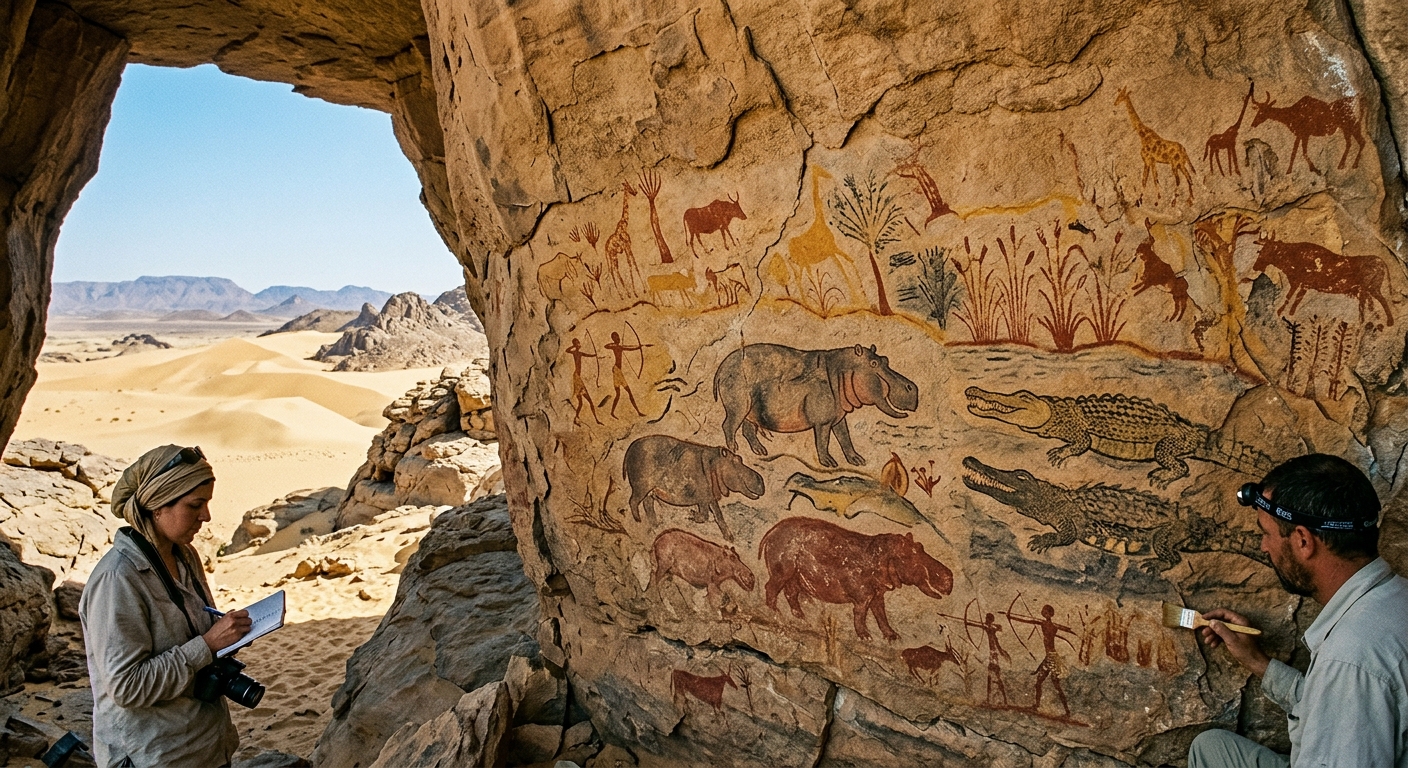
Imagine standing in the heart of the Sahara Desert today, surrounded by endless dunes of scorching sand, and trying to picture hippos wallowing in crystal-clear lakes nearby. It sounds impossible, yet this exact scene was reality just 6,000 years ago. The world’s largest hot desert was once a thriving green paradise that would be unrecognizable to us today.
The Green Sahara: A Lost World Beneath the Sand
Scientists call it the “Green Sahara” or “Sahara Wet Period,” and it represents one of the most dramatic climate transformations in recent Earth history. From roughly 11,000 to 5,000 years ago, what we now know as the Sahara Desert was a lush savanna teeming with life. Rivers flowed year-round, lakes dotted the landscape, and vegetation covered an area larger than the entire United States.
This wasn’t just a slightly greener version of today’s desert. The Green Sahara was a completely different ecosystem. Archaeological evidence reveals that early humans thrived in this environment, creating some of the world’s most stunning rock art that still exists today, hidden in remote canyon walls across the desert.
What Evidence Reveals This Hidden History
The proof of the Sahara’s green past comes from multiple sources that paint a vivid picture of this lost world:
Fossil Records Tell the Tale
Paleontologists have uncovered fossilized remains of creatures that seem utterly out of place in today’s Sahara. Hippo bones, crocodile skulls, and fish fossils lie buried beneath the sand dunes. These weren’t isolated specimens either, but evidence of thriving populations that lived in the region for thousands of years.
Even more surprising are the plant fossils. Scientists have discovered pollen grains from tropical trees, grass species that require abundant rainfall, and aquatic plants that could only survive in permanent water bodies. The diversity of plant life was staggering, supporting complex food webs that sustained large mammals.
Ancient Lake Beds Hidden in Plain Sight
Satellite imagery and ground surveys have revealed the ghostly outlines of ancient lake systems scattered across the modern desert. Lake Chad, which today is a fraction of its former size, was once part of a vast network of interconnected water bodies. Some of these ancient lakes were enormous, with Lake Mega-Chad covering an area larger than the Caspian Sea.
Sediment cores from these dried lake beds contain layers of organic material, fish scales, and microscopic organisms that could only have thrived in freshwater environments. Each layer tells a story of seasonal changes, flood cycles, and the gradual transition from wet to dry conditions.
The Incredible Speed of Transformation
Perhaps the most mind-blowing aspect of the Green Sahara story is how quickly it disappeared. Climate data suggests that the transition from lush savanna to barren desert happened with shocking speed, possibly within just a few centuries rather than gradually over millennia.
This rapid change was likely triggered by shifts in Earth’s orbital patterns, which affected the intensity and position of the African monsoon. As the monsoons weakened and moved south, the life-giving rains that sustained the Green Sahara simply stopped coming. The vegetation died back, soil eroded away, and the feedback loop of desertification accelerated.
Human Witnesses to Catastrophic Change
What makes this transformation even more remarkable is that humans were there to witness it. The famous rock art sites of Tassili n’Ajjer in Algeria and similar locations across North Africa document this environmental collapse in stunning detail.
Early paintings show scenes of abundant wildlife: elephants, giraffes, rhinoceros, and cattle grazing peacefully. Human figures are depicted fishing, hunting, and herding livestock. But later artworks tell a different story, showing increasingly arid conditions and the gradual disappearance of large animals.
What the Green Sahara Looked Like
Reconstructing the Green Sahara reveals an ecosystem that would rival today’s East African savannas. The landscape was a mosaic of different environments:
- Grasslands covered vast areas, supporting herds of large mammals including elephants, giraffes, and antelope
- Gallery forests lined the riverbanks, providing habitat for primates and countless bird species
- Wetlands and lakes teemed with fish, crocodiles, and hippos, while their shores attracted migrating animals
- Wooded savannas created a parkland landscape similar to modern-day Kenya or Tanzania
The climate was dramatically different too. Annual rainfall probably exceeded 200-400mm in most areas, compared to less than 25mm today. Temperatures were more moderate, and humidity levels supported the growth of vegetation that required consistent moisture.
Why This Matters for Our Future
The story of the Green Sahara isn’t just a fascinating glimpse into the past, it’s a crucial lesson about the speed and scale of climate change. The transformation of the Sahara demonstrates that major ecosystems can shift dramatically within human timescales, not just over geological periods.
Scientists study the Green Sahara to understand how quickly climate systems can flip from one state to another. This research is vital for predicting how current climate change might affect other regions of our planet. The Sahara’s rapid transition serves as both a warning and a reminder of Earth’s incredible dynamism.
The Desert’s Secret Memory
Today, if you know where to look, you can still find traces of the Green Sahara. Underground aquifers contain water that fell as rain thousands of years ago. Occasional flash floods reveal ancient riverbeds carved into bedrock. And in the most remote locations, you might stumble upon a piece of pottery or a stone tool, dropped by someone who lived in this vanished paradise.
The Sahara Desert keeps its secrets well, but beneath the sand lies the memory of a time when this vast wilderness was one of the most vibrant ecosystems on Earth. It’s a reminder that our planet’s story is far stranger and more dynamic than we often imagine, and that even the most permanent-seeming landscapes are constantly changing in ways that can boggle the mind.
This is absolutely haunting to think about, especially when you consider how quickly planetary conditions can shift – it reminds me of how we’re discovering that habitability windows on exoplanets might close just as fast. I keep wondering if there are other worlds out there right now in their “green Sahara” phase, teeming with life that we’ll never witness, and it makes me feel both grateful and sobered about how fragile Earth’s sweet spot really is.
Log in or register to replyImagine if we could zoom out and see Earth’s climate history like a time lapse movie, because honestly the Sahara flip really drives home how unstable these systems can be once you push them past certain thresholds. I’m curious whether there’s still debate about how much of that collapse was orbital wobbles versus feedback loops with vegetation loss itself, since that difference matters a lot for thinking about our own situation now.
Log in or register to replyThis is wild and honestly kind of terrifying when you think about how fast ecosystems can flip, you know? I’ve seen climate shifts happen in real time underwater – coral reefs that were vibrant when I first dove them a decade ago are now bleached ghostlands – and it makes me realize we’re not as far from another major tipping point as we’d like to think. The Sahara didn’t have a choice, but we do, and I’m hoping we actually use it before we’re explaining to future generations what the ocean used to look like.
Log in or register to reply