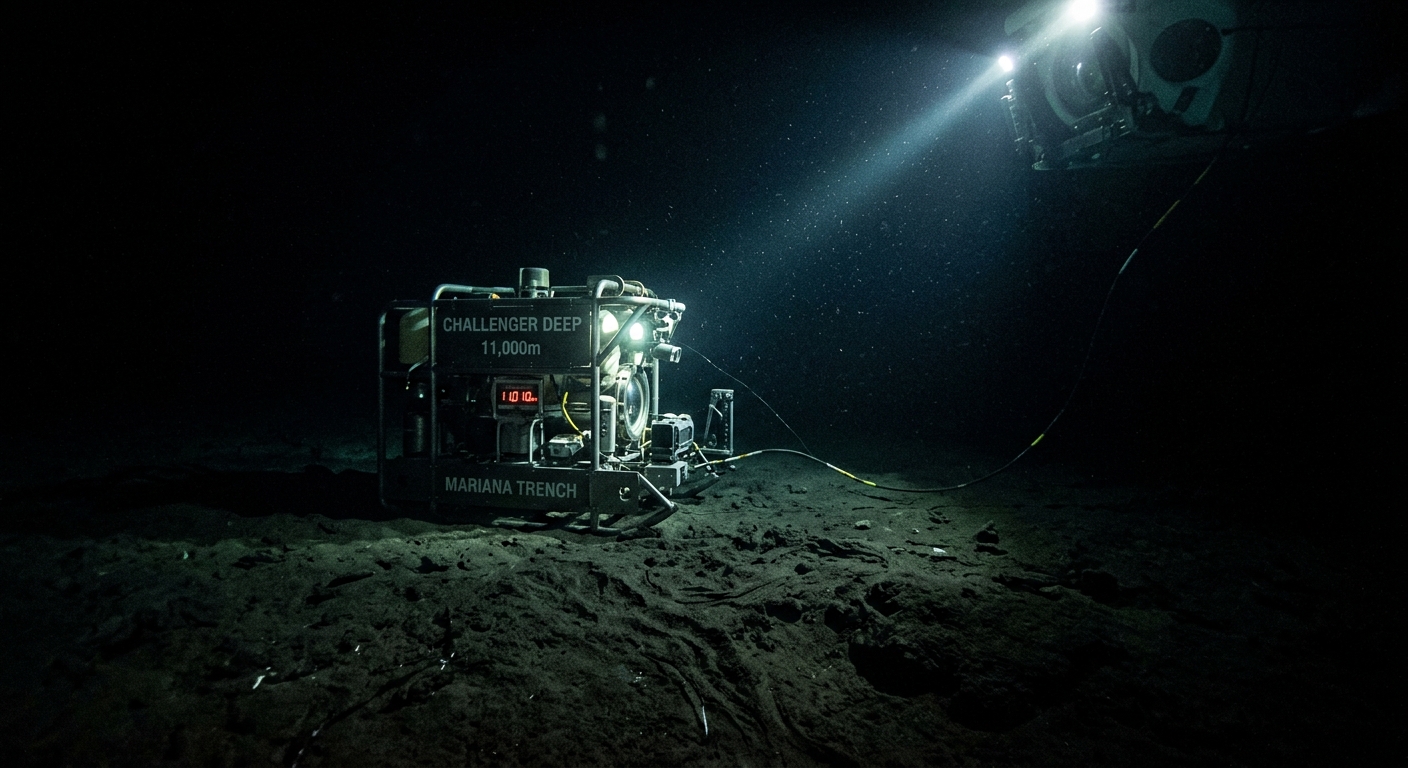
Imagine a place so deep, so utterly removed from our surface world, that no photon of sunlight has ever touched its floor. Welcome to the Challenger Deep, the deepest known point in Earth’s oceans and perhaps the most alien environment on our planet. Located in the Mariana Trench in the Pacific Ocean, this abyssal realm plunges nearly 11 kilometers below sea level, creating conditions so extreme they rival those found in outer space.
The Abyss That Swallows Light
The Challenger Deep sits at a staggering depth of approximately 10,994 meters (36,070 feet) below the ocean surface. To put this mind-boggling distance into perspective, if Mount Everest were placed at the bottom of this trench, its peak would still be over a mile underwater. But perhaps the most fascinating aspect of this underwater canyon isn’t its depth alone, but rather what that depth creates: a world of perpetual, absolute darkness.
Sunlight penetration in the ocean follows a predictable pattern. In the clearest tropical waters, sunlight can reach depths of about 1,000 meters, but by 200 meters, nearly all visible light has been absorbed. The Challenger Deep exists more than 50 times deeper than this limit, creating a realm where darkness isn’t just the absence of light, it’s the complete and total negation of any photon that has ever left our sun.
A World Built on Eternal Night
This perpetual darkness has shaped every aspect of life in the Challenger Deep. Unlike the surface world, where photosynthesis drives the foundation of nearly all ecosystems, the deepest parts of our oceans operate on entirely different principles. Here, chemosynthesis reigns supreme, with bacteria converting chemicals like hydrogen sulfide and methane into energy, forming the base of a food web that has never known sunlight.
The creatures that call this abyss home have evolved remarkable adaptations to thrive in this alien environment:
- Bioluminescence: Many deep-sea organisms create their own light through chemical reactions, turning themselves into living lanterns in the eternal night
- Massive eyes or no eyes at all: Some species have developed enormous eyes to capture any trace of bioluminescent light, while others have abandoned vision entirely
- Transparent bodies: Many deep-sea creatures have evolved transparent or translucent bodies to avoid detection by predators
- Extreme pressure resistance: Life here withstands pressure over 1,000 times greater than at sea level
The Crushing Reality of the Deep
The absence of sunlight is just one of several extreme conditions that make the Challenger Deep so inhospitable to surface life. The water pressure at this depth reaches an incomprehensible 1,086 times greater than atmospheric pressure at sea level. This means every square inch experiences pressure equivalent to having 50 jumbo jets stacked on top of it.
Temperatures hover just above freezing, typically between 1-4 degrees Celsius (34-39 degrees Fahrenheit). The water moves slowly in deep currents that can take centuries to complete their circulation patterns, carrying nutrients and oxygen from far distant surface waters.
Discovering the Undiscoverable
Human exploration of the Challenger Deep began in earnest in 1960 when Jacques Piccard and Don Walsh made the first manned descent in the bathyscaphe Trieste. Since then, only a handful of humans have visited this underwater alien world, making it more exclusive than space travel. The extreme conditions require specially designed vessels capable of withstanding the crushing pressure while providing life support in an environment more hostile than the surface of Mars.
Recent expeditions using advanced deep-sea vehicles have revealed surprising discoveries. Rather than finding a barren wasteland, scientists have documented a surprisingly diverse ecosystem. Microorganisms thrive in the sediment, while specialized fish, crustaceans, and even some larger organisms have been observed navigating this perpetual night.
Life in the Lightless Realm
Perhaps the most remarkable aspect of the Challenger Deep is how life has not just survived but flourished in conditions that would instantly kill most surface organisms. Scientists have discovered bacteria and archaea that have evolved unique metabolic pathways, essentially eating chemicals that would be toxic to surface life.
Single-celled organisms called foraminifera, some as large as 10 centimeters across, carpet parts of the seafloor. These giants of the microbial world have evolved to massive sizes in the absence of the predation pressure found in shallower waters. Amphipods, small crustaceans, scavenge the seafloor in swarms, while specialized fish with antifreeze proteins in their blood patrol the water column above.
The Bioluminescent Symphony
In this world without sunlight, life creates its own illumination. The darkness of the Challenger Deep is occasionally punctuated by the ethereal glow of bioluminescent organisms. These living lights serve various purposes: attracting prey, confusing predators, or communicating with potential mates. The result is an alien light show that plays out in the deepest darkness on Earth.
A Window into Earth’s Past and Future
The Challenger Deep offers scientists a unique laboratory for understanding life’s limits and possibilities. The conditions here may mirror those found on other worlds, making this lightless realm a testing ground for theories about extraterrestrial life. Some researchers believe that studying these extreme ecosystems could provide insights into how life might exist on moons like Europa or Enceladus, where subsurface oceans exist in perpetual darkness beneath miles of ice.
Additionally, the deep ocean serves as Earth’s largest carbon sink, and understanding how these ecosystems function is crucial for predicting how our planet will respond to climate change. The organisms living in the Challenger Deep represent some of the most ancient lineages on Earth, offering clues about how life evolved and adapted to extreme conditions over billions of years.
The Challenger Deep stands as a testament to life’s incredible resilience and adaptability. In a place where no sunlight has ever penetrated, where pressure would crush any surface dweller instantly, and where temperatures hover near freezing, complex ecosystems thrive in ways that continue to astound scientists. This underwater alien world, existing just miles beneath familiar ocean surfaces, reminds us that our planet still holds mysteries as profound as those we seek among distant stars.



wow this is wild, ive been so focused on tracking shorebird migration patterns that i dont think ive really wrapped my head around just how extreme life can be down there. makes me think about how much we’re still destroying with ocean acidification and deep sea trawling when we barely understand whats even living in those places. have you seen any documentaries that actually capture what its like down there? im genuinely curious because the depths seem so much more alien than even the most remote habitats where i do my birding
Log in or register to replyThis is such a great example of why I drag people to the museum’s deep sea exhibit, honestly – once folks actually *see* a giant squid or a preserved anglerfish up close, something clicks about just how wild Earth’s diversity really is. Beth, you’re touching on something important though: we’re destroying habitats we’ve barely begun to understand, which is kind of the tragedy of it all. The hadal zone reminds us that wonder about nature has to come first, or we’ll never care enough to protect it.
Log in or register to replyomg the hadal zone is absolutely insane, right?? ive watched every bbc doc on the deep sea like three times and im still blown away by stuff like amphipods and those spooky viperfish just existing in complete darkness lol. the pressure alone would crush you like a grape but there they are thriving, its honestly humbling when you think about what we’re losing before we even discover it. have you seen footage of the giant squid or dumbo octopus down there – thier adaptations are just otherworldly!
Log in or register to reply