In June 2019, something extraordinary happened on a remote Russian island that left scientists stunned and the International Space Station capturing images of one of the most dramatic volcanic events in recent history. The Raikoke volcano didn’t just erupt – it literally punched a hole through Earth’s atmosphere that was visible from space.
When a Sleeping Giant Awakens
Raikoke volcano sits on a small, uninhabited island in the Kuril chain between Russia and Japan. For 95 years, this volcanic giant had been dormant, quietly slumbering beneath the Pacific waters. Then, on June 22, 2019, it suddenly roared back to life in a spectacular display of Earth’s raw power.
What made this eruption particularly remarkable wasn’t just its intensity, but the way it interacted with our planet’s atmosphere. The explosion was so powerful that it created a phenomenon rarely captured so clearly: a massive atmospheric hole that astronauts could photograph from the International Space Station.
The Mechanics of Atmospheric Destruction
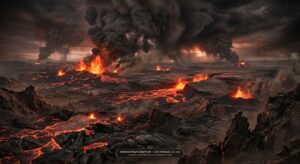
When Raikoke erupted, it didn’t just send lava flowing down its slopes. The volcano launched an enormous column of ash, gas, and volcanic material straight up into the sky at incredible speeds. This vertical column, known as an eruption column, reached heights of up to 17 kilometers (10.5 miles) into the atmosphere.
The sheer force of this eruption was equivalent to detonating thousands of nuclear bombs. The volcanic column moved so fast and with such violence that it literally pushed through atmospheric layers, creating a visible “hole” in the cloud cover and atmospheric density above the volcano.
What Astronauts Saw
From their unique vantage point 408 kilometers above Earth, astronauts aboard the International Space Station witnessed something truly extraordinary. The images they captured showed:
- A perfectly circular hole in the cloud layer surrounding the volcano
- Dark volcanic ash spreading in a massive umbrella-shaped plume
- Brilliant white steam and gas clouds contrasting against the dark ash
- Lightning bolts crackling through the volcanic column
The photographs revealed the eruption’s incredible scale and the way volcanic forces can literally reshape our atmosphere in real-time.
The Science Behind the Spectacle
Volcanic eruptions create atmospheric holes through a process called explosive decompression. When magma rapidly transforms into gas and expands, it creates an upward blast so powerful that it displaces enormous volumes of air. Think of it as nature’s version of a supersonic jet breaking the sound barrier, but instead of creating a sonic boom, it creates a temporary vacuum in the atmosphere.
The Raikoke eruption demonstrated several fascinating atmospheric phenomena:
Umbrella Cloud Formation
As the vertical column of volcanic material reached its maximum height, it began to spread horizontally, creating what volcanologists call an “umbrella cloud.” This happens when the eruption column reaches a point where it’s no longer buoyant enough to continue rising, so it spreads outward instead, creating a mushroom-like shape visible from space.
Volcanic Lightning
One of the most mesmerizing aspects captured in the space-based photographs was the presence of volcanic lightning. These electrical discharges occur when ash particles, ice, and volcanic gases collide within the eruption column, creating static electricity that manifests as dramatic lightning bolts threading through the volcanic cloud.
Environmental Impact Beyond the Island
The Raikoke eruption’s effects extended far beyond its remote island location. The massive injection of volcanic material into the atmosphere had global consequences:
Atmospheric Chemistry Changes
The eruption pumped approximately 1.5 teragrams of sulfur dioxide into the stratosphere. This gas can remain in the upper atmosphere for years, gradually converting to sulfuric acid aerosols that can affect global climate patterns by reflecting sunlight back to space.
Aviation Disruption
The volcanic ash cloud posed significant dangers to aircraft engines and forced the rerouting of numerous international flights across the Pacific. Volcanic ash can damage jet engines and reduce visibility for pilots, making it a serious aviation hazard.
Why This Eruption Was Scientifically Precious
Raikoke’s 2019 eruption provided scientists with an unprecedented opportunity to study explosive volcanism in real-time. Unlike many active volcanoes that erupt regularly, Raikoke’s 95-year dormancy meant that modern monitoring technology had never captured such an event from this particular volcano.
The combination of satellite imagery, International Space Station photography, and ground-based monitoring equipment gave researchers a comprehensive view of how explosive eruptions interact with Earth’s atmosphere. This data is invaluable for improving volcanic hazard prediction and understanding climate impacts.
The Bigger Picture: Earth’s Violent Beauty
The Raikoke eruption serves as a powerful reminder of the dynamic forces constantly at work beneath our planet’s surface. While we go about our daily lives, enormous geological processes are building pressure, moving continents, and occasionally exploding with enough force to punch holes in the sky.
These events, while potentially dangerous, also play crucial roles in Earth’s long-term climate regulation and the creation of new land. Volcanic eruptions have been shaping our planet for billions of years, contributing to the atmosphere we breathe and the fertile soils that support life.
The next time you look up at the sky, remember that it’s not as permanent and unchanging as it appears. Sometimes, our planet’s inner fire burns so bright and fierce that it can literally reach up and reshape the heavens themselves, creating spectacles so incredible that they can only be fully appreciated from the cosmic perspective of space.