The Mind-Bending Scale of Earth’s Greatest Ocean
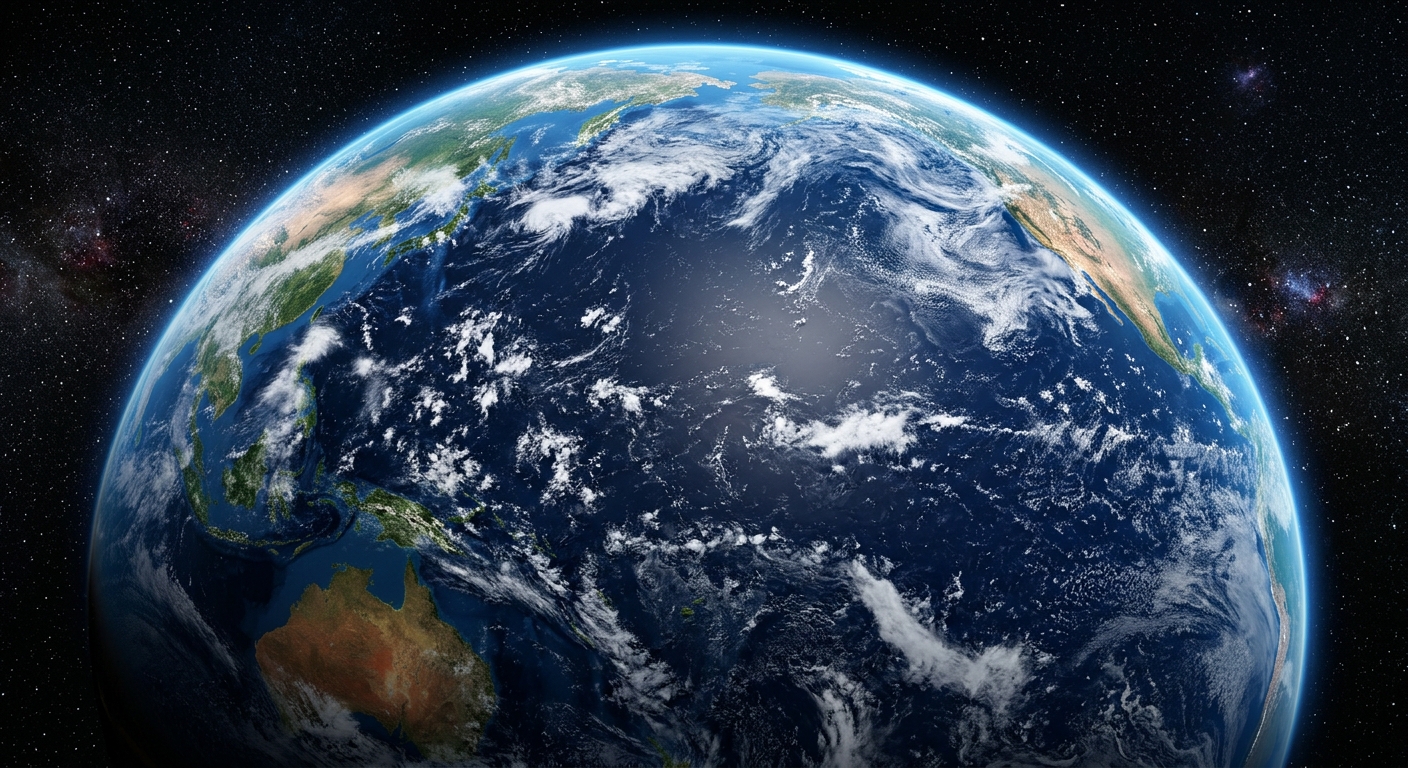
Imagine trying to fit every single piece of land on Earth into one massive container. Every mountain range, desert, forest, city, and island. Now imagine that container is actually an ocean, and it still has millions of square miles left over. This isn’t science fiction: it’s the staggering reality of the Pacific Ocean.
The Pacific Ocean covers an astounding 63.8 million square miles (165.2 million square kilometers) of our planet’s surface. To put this in perspective, all the land on Earth combined, including every continent and island, totals just 57.5 million square miles (148.9 million square kilometers). The Pacific alone is larger than all terrestrial surface area by more than 6 million square miles.
Numbers That Break Your Brain
Let’s dive deeper into just how incomprehensibly vast the Pacific really is:
- The Pacific Ocean represents 46% of the world’s total water surface
- It contains more than half of the free water on Earth
- You could fit the entire landmass of Asia (the largest continent) into the Pacific three times over
- The Pacific is larger than the Atlantic and Indian Oceans combined
- At its widest point, from Indonesia to Colombia, the Pacific stretches nearly 12,300 miles
To truly grasp this scale, consider that if you were flying in a commercial airliner at cruising speed directly across the Pacific at its widest point, the journey would take approximately 15 hours of continuous flight over nothing but open ocean.
A Ocean So Large It Defies Comprehension
The Pacific’s enormity becomes even more remarkable when you consider its depth alongside its surface area. The average depth of the Pacific Ocean is 14,040 feet (4,280 meters), but its deepest point, the Challenger Deep in the Mariana Trench, plunges down 36,200 feet (11,034 meters). If Mount Everest were placed in this trench, its peak would still be more than a mile underwater.
This three-dimensional vastness means the Pacific Ocean contains roughly 710,000 cubic miles of water. That’s enough water to cover the entire United States to a depth of nearly 2 miles, or to fill a sphere with a diameter of roughly 1,000 miles.
The Ring of Fire: Where Size Meets Power
The Pacific’s massive size directly contributes to some of Earth’s most dramatic geological phenomena. The Pacific Ring of Fire, a horseshoe-shaped zone of volcanic activity and earthquakes, encircles much of the Pacific basin. This ring contains 75% of the world’s active volcanoes and is responsible for 90% of the world’s earthquakes.
The sheer size of the Pacific allows for the formation of massive tectonic plates beneath its waters. The Pacific Plate alone covers 63 million square miles, making it the largest tectonic plate on Earth. As this enormous plate moves and interacts with surrounding plates, it generates the seismic activity that defines the Ring of Fire.
Climate Control on a Planetary Scale
The Pacific’s vast expanse makes it Earth’s most influential climate regulator. Its enormous surface area allows it to absorb and redistribute heat on a scale that affects weather patterns across the globe. The El Niño and La Niña phenomena, which originate in the Pacific, can trigger droughts in Australia, floods in South America, and alter storm patterns across North America.
The ocean’s massive thermal mass acts like a planetary thermostat. During summer, the Pacific absorbs enormous amounts of solar energy, preventing extreme temperature spikes on nearby landmasses. In winter, it slowly releases this stored heat, moderating global temperatures and preventing even more dramatic seasonal variations.
Biodiversity in an Endless Blue Desert
Despite often being called an ocean desert due to its vast, seemingly empty expanses, the Pacific’s enormous size actually enables it to host an incredible diversity of life. From the microscopic phytoplankton that produce much of our planet’s oxygen to massive blue whales that can reach lengths of 100 feet, the Pacific’s scale provides niches for life forms found nowhere else on Earth.
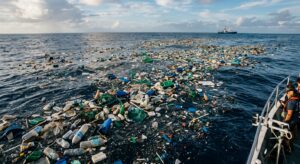
The Great Pacific Garbage Patch, while an environmental concern, also demonstrates the ocean’s immense scale. This collection of marine debris, often described as twice the size of Texas, represents less than 0.1% of the Pacific’s total surface area, illustrating just how vast this body of water truly is.
Putting the Pacific in Perspective
Here are some final comparisons that highlight the Pacific’s mind-boggling size:
- The Pacific Ocean is larger than the Moon’s entire surface area
- It’s approximately 15 times larger than the United States
- You could fit Africa, Asia, and North America into the Pacific simultaneously
- The Pacific contains more water than the Atlantic, Indian, and Arctic Oceans combined
The next time you look at a world map or globe, take a moment to truly appreciate the Pacific Ocean’s dominance. This single body of water, larger than every piece of land on Earth combined, serves as a humbling reminder of just how much of our “Earth” is actually ocean. In many ways, calling our planet “Earth” might be a misnomer. Perhaps “Ocean” would be more accurate, with the Pacific Ocean standing as the ultimate proof of our world’s aquatic nature.
I’m obsessed with this perspective but I gotta say, as someone who spends more time thinking about rivers than the deep ocean, what really gets me is how the Pacific’s massive freshwater inputs from systems like the Columbia, Fraser, and Amur are basically the life support systems for entire coastal ecosystems, and we keep damming them up without understanding what we’re destroying. Yeah, giant squids are cool, but the salmon runs that feed into that ocean are declining because we’ve fragmented every major tributary and nobody’s losing sleep over it the way they do about undiscovered megafauna!
Log in or register to replydude i totally get the frustration with the megafauna obsession overshadowing the actual ecological collapse happening in real time, and youre right that rivers are basically the foraging highways that feed the entire coastal system. but heres what gets me, the way ants structure their supply lines through tunnels and chemical trails is SO similar to how these river systems function as nutrient pathways, and when you cut those pathways like we do with dams you dont just lose the salmon runs, you lose the entire information network that tells the ecosystem how to function. its not that squids arent cool, its that we romanticize the unknown while actively destroying the known systems that actually keep everything alive, which somehow feels
Log in or register to replyok but this is literally what makes me think about how many undiscovered giant squids are probably just chillin down there lol. like we know more about the moon than the deepest parts of the pacific and thats wild. colossal squid sightings are probably just regular deep sea stuff being misidentified but still… your telling me theres 63.8 million square miles of basically unexplored territory and we’re not finding more?? the giant squid vs kraken thing is so fascinating because sailors probably DID see something real, we just didnt have the biology to explain it back then
Log in or register to reply