
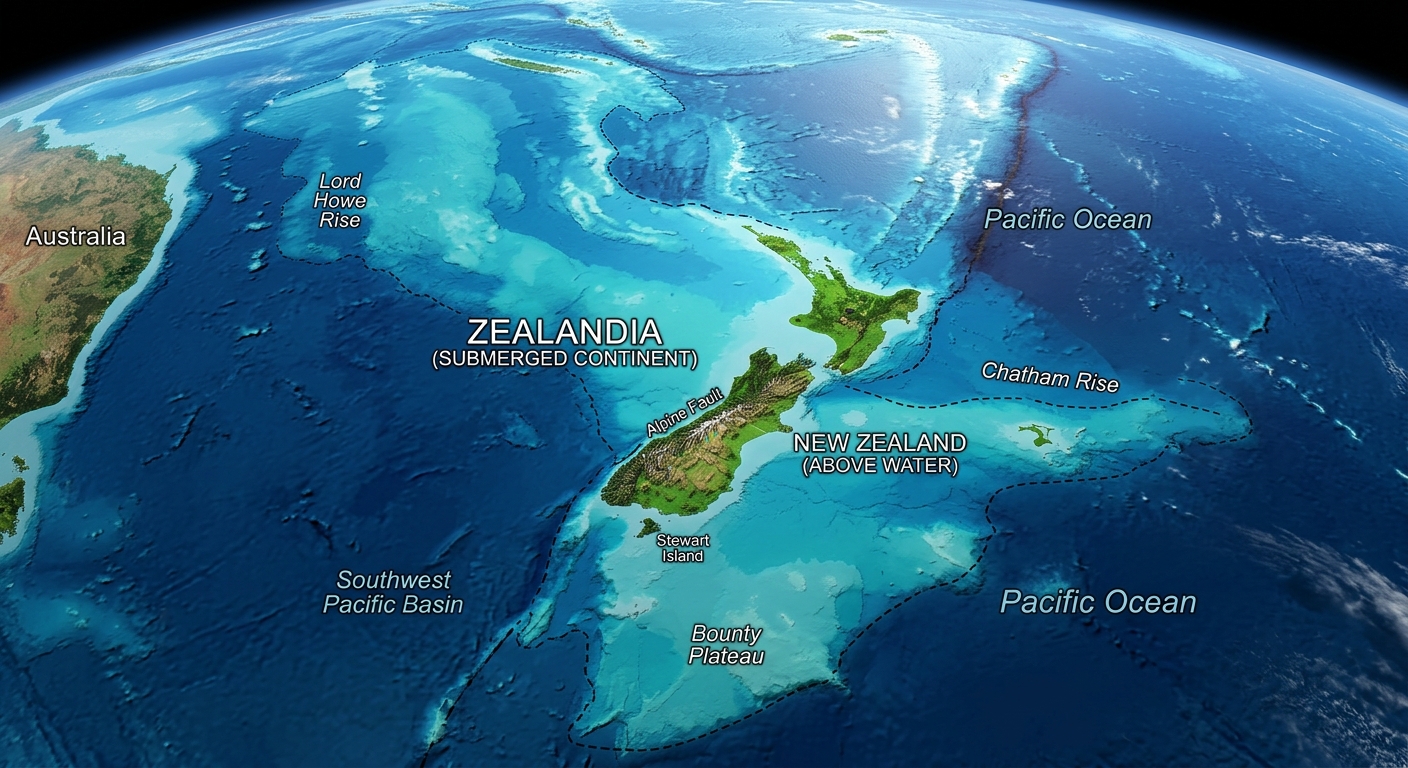
Beneath the crystal-clear waters of the southwestern Pacific Ocean lies one of Earth’s most extraordinary geological secrets: a massive continent that has been hiding in plain sight for millions of years. Zealandia, our planet’s eighth continent, stretches across an area roughly half the size of Australia, yet remains almost entirely submerged beneath the ocean’s surface.
This drowned landmass challenges everything we thought we knew about continental geography and reveals a fascinating chapter in Earth’s geological history that remained hidden until scientists pieced together the clues in recent decades.
What Makes Zealandia a True Continent?
For decades, geologists debated whether this submerged landmass qualified as a true continent. The answer lies in understanding what actually defines a continent beyond simple size or elevation. Zealandia meets all the geological criteria that distinguish continents from oceanic crust:
- Continental crust composition: Unlike the dense basaltic rock of ocean floors, Zealandia consists of lighter granitic and metamorphic rocks typical of continental crust
- Elevated topography: Despite being submerged, Zealandia rises significantly above the surrounding oceanic crust
- Crustal thickness: The continent’s crust measures 10-30 kilometers thick, much thicker than typical oceanic crust
- Clear boundaries: Well-defined edges separate Zealandia from the surrounding oceanic regions
In 2017, an international team of geologists officially recognized Zealandia as Earth’s eighth continent, ending a debate that had simmered in scientific circles for years. This recognition fundamentally changed our understanding of Pacific Ocean geology and continental distribution.
The Great Submersion: How a Continent Disappeared
Zealandia wasn’t always hidden beneath the waves. This massive landmass began its journey to the ocean floor through a complex geological process that unfolded over tens of millions of years.
The Breakup of Gondwana
Around 100 million years ago, Zealandia was part of the supercontinent Gondwana, connected to what would become Australia and Antarctica. As tectonic forces began pulling Gondwana apart, Zealandia started its slow separation from Australia, beginning a geological odyssey that would ultimately send it beneath the ocean surface.
Crustal Stretching and Subsidence
The key to Zealandia’s submersion lies in a process called crustal extension. As the continent separated from Australia, enormous tectonic forces stretched and thinned Zealandia’s crust. This stretching caused the continent to subside, gradually sinking lower and lower until ocean waters could flood across its surface.
Unlike a dramatic sinking event, this process occurred incredibly slowly, over millions of years. The gradual nature of this submersion meant that any life forms present had ample time to adapt or migrate to higher ground as their habitat slowly transformed from terrestrial to marine.
New Zealand: The Tip of the Iceberg
Today, only about 6% of Zealandia remains above sea level, forming the islands we know as New Zealand and New Caledonia. These landmasses represent the highest peaks of the submerged continent, like mountain tops rising above a vast underwater plain.
New Zealand’s unique geological features make much more sense when viewed as part of this larger continental structure. The country’s diverse rock formations, mountain ranges, and mineral deposits reflect its position as the exposed portion of a much larger geological entity.
Mapping the Hidden Continent
Modern technology has allowed scientists to map Zealandia’s submerged features in remarkable detail. Using advanced sonar, satellite measurements, and seafloor sampling, researchers have revealed:
- Underwater mountain ranges that once stood as terrestrial peaks
- Submerged river valleys that carved the landscape when it was dry land
- Continental shelf areas that would have been coastal plains
- Deep basins that may have once been inland seas or large lakes
Scientific Treasures Hidden Below
Zealandia’s submerged landscape holds invaluable clues about Earth’s geological history and past climate conditions. Scientists have discovered fossilized remains of ancient land plants and terrestrial animals in rocks that now lie thousands of meters below the ocean surface, providing direct evidence that this region was once dry land with thriving ecosystems.
Climate History Preserved in Stone
The continent’s rocks contain a detailed record of past environmental conditions, including evidence of tropical climates, ice ages, and major extinction events. This geological archive helps scientists understand how our planet’s climate system has evolved over millions of years.
Biodiversity and Evolution
Zealandia’s gradual submersion created unique evolutionary pressures that shaped the development of life in the region. The isolation of remaining land areas contributed to the evolution of New Zealand’s distinctive flora and fauna, many species of which exist nowhere else on Earth.
The Future of Zealandia Research
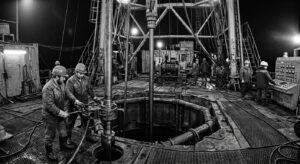
As technology continues to advance, scientists are gaining unprecedented access to Zealandia’s hidden secrets. Deep-sea drilling projects are extracting core samples from the ocean floor, revealing new details about the continent’s geological history and the timing of its submersion.
Understanding Zealandia also has practical implications for resource exploration, as the continent likely contains significant mineral and energy resources. However, the environmental challenges of accessing these underwater deposits raise important questions about sustainable exploitation of this unique geological treasure.
The story of Zealandia reminds us that our planet still holds incredible secrets waiting to be discovered. This hidden continent, larger than many countries yet almost entirely invisible, demonstrates that Earth’s geological wonders extend far beyond what we can see from the surface. As we continue to explore and understand Zealandia, we gain new insights into the dynamic forces that have shaped our world and continue to influence its future.
This is so cool to think about, especially since I spend most of my time underwater and still feel like we’re just scratching the surface with what we actually know down there. I wonder if there are unique ecosystems on Zealandia’s slopes that we haven’t documented yet, kind of like how we keep finding new species in deep ocean trenches. It’s a good reminder that the ocean covers 71% of our planet and we’ve mapped Mars better than our own seafloor, which honestly makes me want to push harder for more ocean research funding.
Log in or register to replyThis is absolutely mind-bending, honestly. I keep thinking about how Zealandia has been sitting there this whole time, mostly underwater, and we’re only really mapping it now with modern tech, which makes me wonder what else we’re missing on our own planet that might give us clues about habitability elsewhere. Like, if microbial life can thrive in Earth’s deep ocean vents and extreme environments, imagine what could be hiding in the subsurface oceans of places like Europa or Enceladus, you know?
Log in or register to replyYou’re totally onto something with the extreme environment angle, honestly it’s wild how we keep discovering life thriving in conditions we thought were impossible. I’m obsessed with this stuff from the cave perspective, too – we keep finding whole ecosystems of blind fish and albino crustaceans in isolated cave systems that have been separated from the surface for millions of years, which honestly shows how much untapped biodiversity is literally right under our feet. The fact that we’re mapping underwater geology better than we know our own cave networks is kind of insane, and yeah, if we can’t even fully explore Earth’s subsurface yet, Europa’s oceans are def gonna blow our minds when we figure out how to look closer.
Log in or register to reply