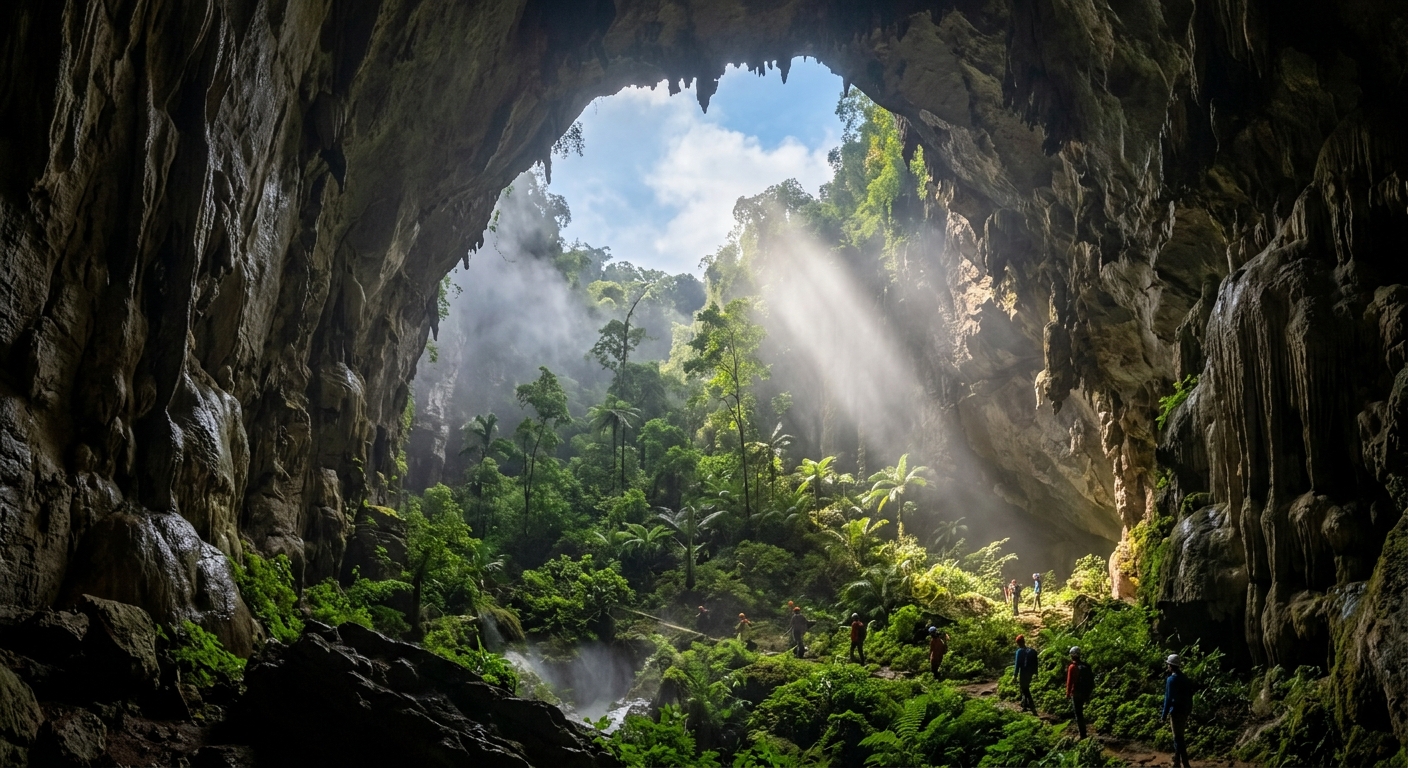
Deep beneath the Vietnamese jungle lies a subterranean universe so vast and alien that it defies everything we thought we knew about caves. Son Doong Cave stretches through the darkness like an underground continent, harboring secrets that seem pulled from science fiction: towering stalagmites the size of skyscrapers, underground rivers that could swallow city blocks, and most incredibly of all, its very own weather systems and thriving jungle ecosystems.
Discovered only in 2009 by British cavers, Son Doong has shattered our understanding of what’s possible in the world beneath our feet. This isn’t just a cave; it’s an entire hidden biosphere that operates by its own rules, where rain falls from stone ceilings and trees grow in eternal twilight.
A Cathedral Carved by Time
Son Doong Cave, located in Phong Nha-Ke Bang National Park in Vietnam, holds the title of the world’s largest cave passage by volume. To truly grasp its immensity, consider this: the cave is so enormous that a Boeing 747 could fly through its largest chambers without touching the walls or ceiling. Some sections tower over 650 feet high and stretch more than 450 feet wide.
The cave extends for at least 5.5 miles, though much of it remains unexplored. Its total volume exceeds 38.4 million cubic meters, making it larger than some cities. Walking through Son Doong isn’t like traversing a typical cave; it’s like journeying through an alien landscape where the laws of surface geology simply don’t apply.
The Birth of a Giant
This underground colossus was carved over millions of years by the relentless power of the Rao Thuong River. The cave formed in soluble limestone, where acidic groundwater gradually dissolved the rock, creating increasingly larger passages. What makes Son Doong unique is the sheer scale of this process; geological conditions aligned perfectly to create chambers of unprecedented size.
Weather in the Underworld
Perhaps the most mind-bending aspect of Son Doong is its internal climate system. The cave generates its own weather patterns, complete with clouds, wind currents, and precipitation. This phenomenon occurs due to the dramatic temperature differences between the cave’s interior and the outside world.
During certain times of the year, warm, humid air from the jungle above meets the cooler air within the cave’s vast chambers. This temperature differential creates condensation on such a massive scale that clouds actually form inside the cave. These underground clouds drift through the chambers like ghostly apparitions, occasionally producing light rainfall that patters on the cave floor hundreds of feet below the earth’s surface.
The Science Behind Underground Storms
The cave’s weather system operates on principles similar to those found in large valleys or canyons. Air pressure differentials create wind currents that flow through the passages, carrying moisture and creating microclimates within different chambers. Temperature variations of up to 20 degrees Fahrenheit between different areas of the cave contribute to these atmospheric phenomena.
Researchers have documented fog banks so thick they obscure visibility, underground breezes strong enough to extinguish flames, and humidity levels that fluctuate dramatically as you move through different sections. It’s as if Son Doong has developed its own atmospheric personality, independent from the world above.
A Jungle in Perpetual Twilight
Where Son Doong’s ceiling has collapsed, creating openings called dolines, shafts of sunlight penetrate the darkness and work magic. These natural skylights have allowed entire jungle ecosystems to establish themselves deep underground, creating some of the most surreal landscapes on Earth.
Trees reaching heights of 100 feet grow in these illuminated chambers, their canopies stretching toward distant cave ceilings instead of open sky. Ferns, vines, and flowering plants carpet the cave floor in areas where enough light penetrates. The result is a lost world scenario that would make Arthur Conan Doyle weep with wonder.
Unique Adaptations
The plants and animals that call Son Doong home have developed fascinating adaptations to their unusual environment. The vegetation shows characteristics typical of both jungle and cave ecosystems. Plants near the dolines exhibit normal photosynthesis, while those in darker areas have evolved to maximize their use of limited light.
The cave hosts various species of bats, insects, and other creatures that have adapted to the unique conditions. Some areas remain so unexplored that scientists believe undiscovered species may still inhabit the deeper recesses of this underground world.
Geological Wonders Beyond Imagination
Son Doong’s geological features read like a fantasy novel. Stalagmites rise from the cave floor like ancient towers, some reaching heights of over 260 feet. These formations, taller than the Statue of Liberty, took millions of years to develop, growing drop by drop from mineral-rich water.
The cave contains underground rivers that flow year-round, their waters carving ever-deeper channels through the limestone. Rapids and waterfalls exist in complete darkness, their sounds echoing through chambers so large that calling out produces echoes that take several seconds to return.
The Great Wall of Vietnam
One of the most spectacular features in Son Doong is a massive calcite formation that explorers have dubbed the “Great Wall of Vietnam.” This natural barrier rises over 200 feet from the cave floor and effectively blocks further exploration in certain directions. The formation’s surface resembles flowing stone, frozen in time as mineral deposits created rippling patterns that catch and reflect light in mesmerizing ways.
A Fragile Underground Eden
Despite its massive size, Son Doong represents a delicate ecosystem that requires careful protection. The Vietnamese government strictly limits access to the cave, allowing only a handful of visitors each year through specialized expedition companies. This protection ensures that the cave’s unique environment remains pristine for future scientific study and preservation.
Climate change and human activity above ground could potentially impact the cave’s delicate weather systems and underground jungle. Researchers continue to study how changes in surface conditions might affect this remarkable subterranean world.
Son Doong Cave stands as a testament to the incredible diversity and wonder of our planet. In an age when we assume every corner of Earth has been explored and catalogued, this underground universe reminds us that mysteries still exist, waiting in the darkness below our feet. It’s a place where the impossible becomes reality, where jungles thrive without sky and weather exists without seasons, challenging our very understanding of what defines the natural world.

dude this is so cool but honestly it reminds me that we literally know more about the surface of mars than we do about whats happening 2000 meters down in our own oceans, and THAT gets me emotional ngl. like son doong is incredible for sure, but the abyssal zones have entire ecosystems we’ve barely even catalogued, creatures that make bioluminescent light shows that would blow you’re mind, and we send maybe a handful of submersibles down there per year. the deep ocean is literally an alien world that dosent require us leaving the planet to explore it.
Log in or register to replyYou’re totally right that deep ocean exploration gets criminally underfunded, and honestly the same goes for cave systems too, honestly we’re barely scratching the surface on cataloguing what’s actually living in these places. I keep thinking about how every new cave expedition finds species nobody’s ever documented before, and then you’ve got cave-adapted reptiles like the Stygochelys and other endemics that are probably out there completely unknown to science, which is wild. The bioluminescence thing though, man, that’s incredible, but caves have their own lighting ecosystems we don’t fully understand yet too, so maybe we need funding and attention for BOTH instead of it being a zero sum game. Either way,
Log in or register to replyThis is absolutely wild, and I love how it shows that ecosystems can thrive wherever conditions allow, even miles underground! It makes me think about how much we limit our thinking about what “habitat” means – like, if a cave can support an entire rainforest, then my suburban yard conversion to native plants is just working with the same basic principles on a smaller scale. Have you ever wondered what the pollinator situation is like in there, or if the cave life has totally different versions of the insects and birds we’d see above ground?
Log in or register to reply