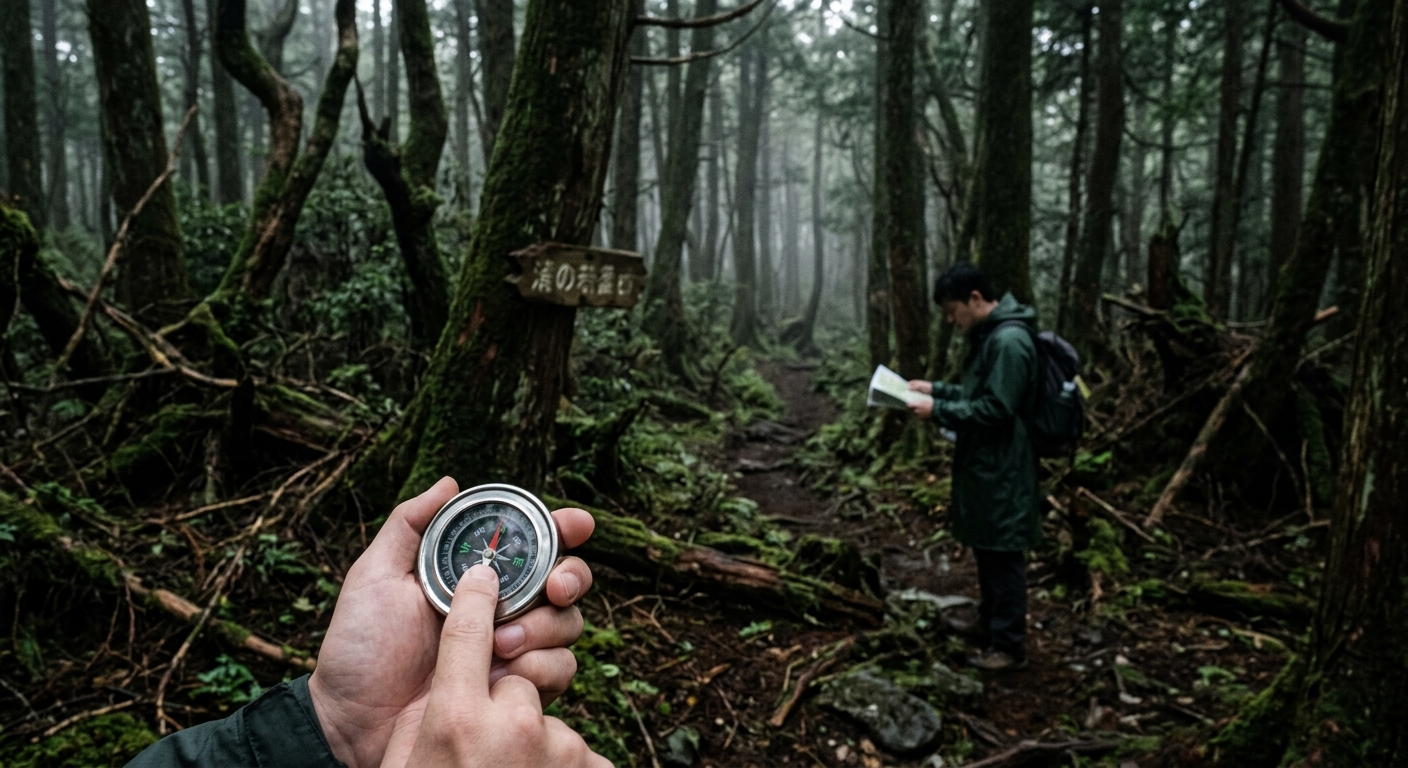
Deep within Japan’s Mount Fuji region lies a place where navigation instruments lose their minds, compasses spin wildly, and even the most experienced hikers find themselves hopelessly lost. The Aokigahara Forest, known locally as the “Sea of Trees,” harbors one of Earth’s most perplexing magnetic mysteries that continues to confound scientists and terrify visitors.
Where Compasses Go to Die
Imagine stepping into a forest where your most trusted navigation tool becomes utterly useless. In Aokigahara, compasses don’t just point in the wrong direction, they dance erratically, spin without purpose, or point to entirely fictional magnetic north poles. This 35-square-kilometer woodland has earned its reputation as a place where technology fails and human intuition becomes the only guide.
The magnetic anomalies in Aokigahara are so severe that experienced mountaineers and forest rangers strongly advise against relying on any magnetic navigation equipment. GPS devices, while more reliable than traditional compasses, can also experience interference, leaving visitors with only marked trails as their lifeline back to civilization.
The Science Behind the Magnetic Chaos
The culprit behind Aokigahara’s compass-confusing properties lies beneath the forest floor: massive deposits of iron-rich volcanic rock. Mount Fuji’s violent volcanic history created this natural phenomenon when lava flows rich in magnetite and other ferromagnetic minerals cooled and solidified into solid rock formations.
Magnetite: Nature’s Magnetic Disruptor
Magnetite, a naturally occurring mineral with the chemical formula Fe₃O₄, acts like countless tiny magnets scattered throughout the forest’s underground landscape. These mineral deposits create localized magnetic fields that interfere with compass needles, causing them to point toward the strongest nearby magnetic source rather than magnetic north.
- The volcanic substrate contains unusually high concentrations of magnetite
- Iron-rich lava flows created complex magnetic field patterns
- Multiple magnetic anomalies exist throughout the forest
- The magnetic interference varies in intensity across different areas
A Forest Born from Fire
Aokigahara’s magnetic mysteries trace back approximately 1,200 years to a massive eruption of Mount Fuji. The volcanic event spewed iron-rich lava across the region, creating the foundation for what would become one of Japan’s most magnetically active locations. As the lava cooled, magnetite crystals aligned with Earth’s magnetic field at the time, creating permanent magnetic imprints in the rock.
Over centuries, this volcanic foundation became covered with dense vegetation, creating the sprawling forest we see today. The trees themselves contribute to the disorienting nature of the forest, growing so densely that they block wind and muffle sound, creating an eerily quiet environment where even bird songs seem muted.
More Than Just Magnetic Mysteries
The magnetic anomalies represent just one layer of Aokigahara’s fascinating characteristics. The forest exhibits several other unusual properties that make it a unique ecosystem:
Acoustic Anomalies
The dense tree coverage creates natural sound dampening, making the forest unusually quiet. This acoustic isolation can be disorienting for visitors accustomed to using sound cues for navigation and spatial awareness.
Underground Cave Systems
Beneath the forest floor lies an extensive network of lava tubes and caves formed during Mount Fuji’s eruptions. These underground passages can create additional magnetic interference and contribute to the overall sense of spatial confusion visitors often experience.
Unique Vegetation Patterns
The volcanic soil creates distinct growing conditions that support specific plant species while limiting others. The resulting vegetation is so dense and uniform that it creates a maze-like environment where landmarks become difficult to distinguish.
Scientific Research and Ongoing Studies
Researchers continue to study Aokigahara’s magnetic properties to better understand how volcanic activity creates lasting geomagnetic anomalies. Geophysicists use specialized equipment to map the magnetic field variations throughout the forest, creating detailed charts that reveal the complex underground magnetic landscape.
These studies have revealed that the magnetic anomalies aren’t uniform across the forest. Some areas show stronger interference than others, and the patterns of magnetic disruption provide valuable insights into the historical volcanic activity that shaped the region.
Practical Implications for Visitors
Understanding Aokigahara’s magnetic properties is crucial for anyone planning to visit this remarkable forest. Local authorities and forest rangers provide specific guidance for safe navigation:
- Always stay on marked trails and use ribbon markers for additional safety
- Carry multiple navigation methods, including non-magnetic alternatives
- Travel in groups and inform others of your planned route
- Carry emergency communication devices when possible
A Window into Earth’s Magnetic Complexities
Aokigahara Forest serves as a fascinating natural laboratory for understanding how geological processes can create lasting magnetic anomalies. The forest demonstrates that Earth’s magnetic field is far more complex and variable than many people realize, with local geological features capable of creating significant deviations from the planet’s overall magnetic patterns.
This remarkable location reminds us that nature still holds mysteries that can humble our technology and challenge our understanding of the world around us. In an age of GPS satellites and digital navigation, Aokigahara stands as a place where ancient volcanic forces continue to confound modern instruments, creating one of Earth’s most magnetically mysterious forests.





This is wild – I had no idea that kind of magnetic interference could be so intense in nature! I’m wondering if this could actually be helpful for understanding underwater magnetic phenomena too, since a lot of marine life navigates using Earth’s magnetic field and I’ve seen some research suggesting ocean acidification might be affecting their ability to sense it. Either way, it’s a good reminder that the Earth is so much more complex than we give it credit for, and we’ve barely scratched the surface of how these natural systems actually work.
Log in or register to replyThat’s a fascinating connection Connie – migratory birds and sea turtles definitely rely on magnetoreception in ways we’re still unpacking! I’ve hiked through forests with intense iron oxide concentrations in Borneo and the Congo Basin, and you really do feel disoriented when your instruments go haywire, but what gets me is how these magnetic zones might actually affect the animals living there too. Wonder if the creatures in Aokigahara have adapted their navigation instincts over generations, or if they just avoid the worst hotspots the way we try to with our compasses!
Log in or register to replyThe magnetite deposits are genuinely cool, though the “compasses spinning wildly” thing tends to get exaggerated in pop media, fun fact. What’s actually interesting is how these anomalies have probably existed for thousands of years since those eruptions, so any organisms living there have likely evolved to work around the magnetic chaos, which makes you wonder what we’re missing about how sensitive navigation really is in nature.
Log in or register to reply