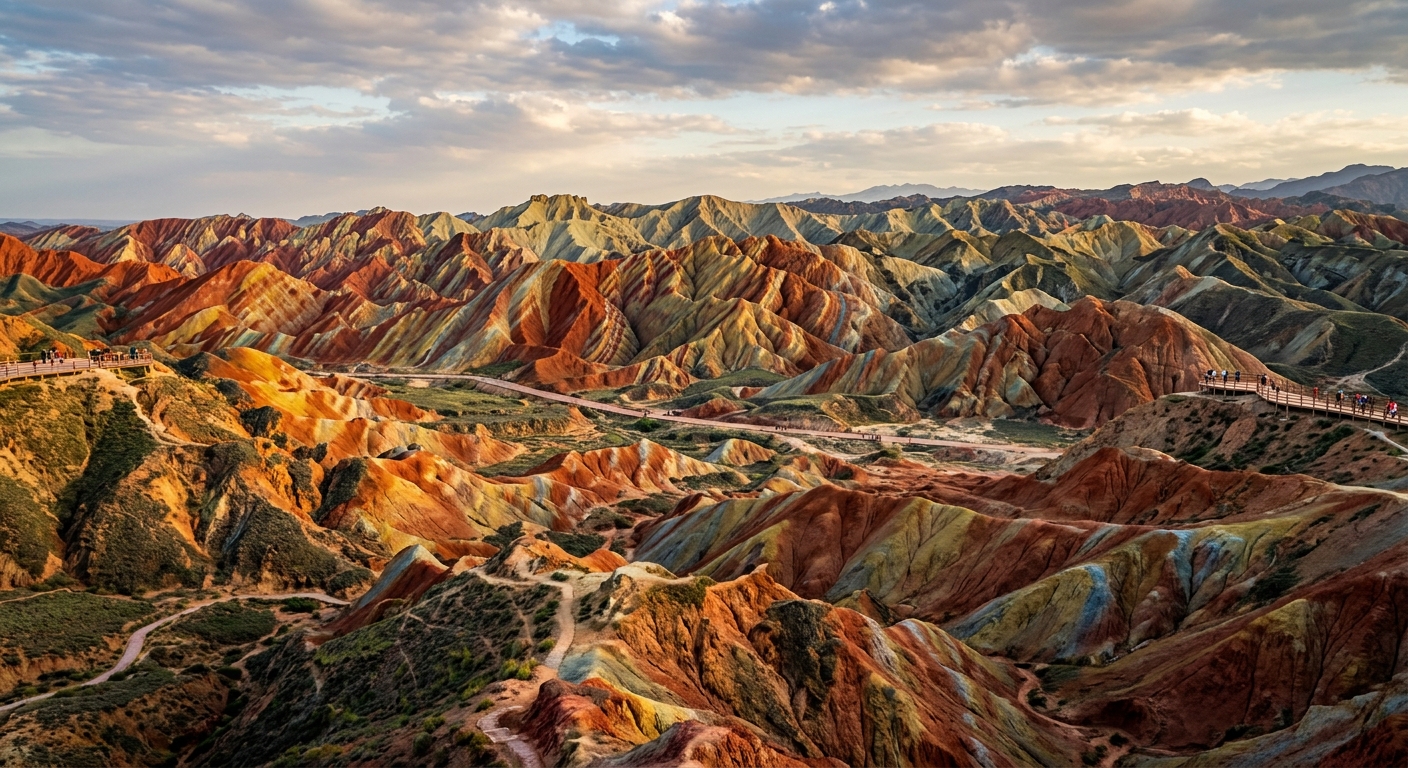
Imagine stumbling upon a landscape that looks like someone spilled an entire artist’s palette across towering rock formations. The Zhangye Danxia Landform in China’s Gansu Province presents exactly this mind-bending reality, where mountains appear to be painted in vivid stripes of red, orange, yellow, green, and blue. This geological masterpiece challenges everything we think we know about how nature colors our world.
A Canvas Millions of Years in the Making
The Zhangye Danxia formations didn’t appear overnight like some divine art project. This stunning landscape represents over 100 million years of geological artistry, beginning during the Cretaceous Period when dinosaurs still roamed the Earth. What we see today started as layers upon layers of sedimentary rock, each deposited during different climatic periods and containing unique mineral compositions.
The process began when ancient rivers carried sediments from surrounding mountains, depositing them in vast prehistoric lakes and floodplains. Over millions of years, these sediments compressed into distinct layers of sandstone and siltstone. Each layer tells a story of ancient climates, with red layers indicating arid conditions rich in iron oxide, while other colors reveal different environmental conditions and mineral content.
The Science Behind Nature’s Paint Job
The spectacular colors that make Zhangye Danxia look like a painted masterpiece come from a fascinating combination of chemistry and physics. Iron oxide, commonly known as rust, creates the dominant red hues that stripe through the formations. But the rainbow effect comes from much more complex processes:
Mineral Magic
- Iron compounds: Create reds, oranges, and yellows depending on oxidation levels
- Copper deposits: Produce striking green and blue-green streaks
- Manganese: Contributes purple and darker hues
- Sulfur compounds: Add yellow tints to certain layers
- Organic matter: Creates darker bands and influences color intensity
The intensity and vibrancy of these colors depend on factors like moisture levels, temperature fluctuations, and exposure to sunlight. During certain times of day, particularly at sunrise and sunset, the colors become so vivid they appear almost fluorescent.
Tectonic Forces: The Master Sculptor
While chemical processes created the colors, it took massive geological forces to reveal this underground rainbow to the world. Around 55 million years ago, the collision between the Indian and Eurasian tectonic plates began forming the Himalayas. This same tectonic activity created tremendous pressure that folded, twisted, and uplifted the colorful sedimentary layers at Zhangye.
The result is a landscape where rock layers that were once horizontal now stand nearly vertical, creating dramatic ridges and valleys that expose the colorful cross-sections like pages in a geological book. Erosion from wind, water, and ice has further sculpted these formations, creating the smooth, flowing shapes that enhance the painted appearance.
Weathering: The Final Artist’s Touch
The smooth, flowing appearance of the Danxia formations comes from millions of years of weathering. Unlike sharp, jagged mountain peaks formed by volcanic activity, these colorful hills have been gently sculpted by:
- Wind erosion carrying away softer sediments
- Temperature fluctuations causing expansion and contraction
- Chemical weathering from rainfall
- Freeze-thaw cycles smoothing rough edges
A Landscape That Changes by the Hour
One of the most remarkable aspects of Zhangye Danxia is how dramatically its appearance changes throughout the day. The interplay between sunlight and the mineral-rich rock creates an ever-shifting display of colors and shadows. Early morning light brings out subtle pastels and soft hues, while midday sun intensifies the reds and oranges. The most spectacular displays occur during the golden hour before sunset, when the entire landscape seems to glow with inner fire.
Weather conditions also play a crucial role in the visual drama. After rainfall, the colors become more saturated and vibrant. Mist and fog can create mysterious, ethereal effects, while clear skies provide sharp contrast between the colorful rocks and deep blue heavens.
More Than Just Pretty Rocks
Beyond their stunning beauty, the Zhangye Danxia formations serve as an incredible record of Earth’s climatic history. Scientists can read these colorful layers like a book, learning about ancient environments, climate changes, and even prehistoric life. Fossils found within the formations provide glimpses into ecosystems that existed millions of years ago.
The area also supports unique ecosystems adapted to the unusual geological conditions. Specialized plants and animals have evolved to thrive on the mineral-rich soils derived from the colorful rocks, creating biodiversity hotspots in this painted landscape.
Conservation of a Natural Wonder
Recognizing the global significance of this geological wonder, UNESCO designated Zhangye Danxia as a World Heritage Site in 2010. The Chinese government has implemented strict conservation measures to protect the formations from erosion caused by tourism and development.
Today, visitors can explore designated viewing platforms and hiking trails that provide spectacular vistas while minimizing environmental impact. The site has become a photographer’s paradise and a testament to the incredible artistry that geological processes can create given enough time and the right conditions.
The Zhangye Danxia Landform stands as proof that reality can be more spectacular than any human imagination. These painted mountains remind us that our planet is constantly creating art on a scale and timeline that dwarfs human creativity, using chemistry, physics, and time as its brushes to craft masterpieces that leave us speechless.

This is making me think about the cave systems I’ve mapped in similar mineral-rich regions, and honestly the subsurface geology here is probably just as wild as what’s visible above, just hidden from us. Those iron oxides and other minerals creating the striations above are also shaping underground passages below, creating different colored mineral deposits that the troglobiotic fauna have evolved alongside, like blind fish developing heightened lateral line sensitivity to navigate past differently-textured mineral walls. Alex and Beatrice’s point about color perception is super interesting too, because it makes me wonder if cave-adapted organisms in the area have completely different sensory priorities than surface animals since they’ve lost the visual processing altogether, which is honestly a reminder of
Log in or register to replyI love where your head’s at with this! The wavelengths those mineral deposits are reflecting definitely would register differently for birds with their tetrachromatic vision, though I’m curious if the stratified nature of the landscape actually helps create natural “shadow zones” for rest rather than disrupting it. What really gets me thinking is whether those vibrant geological colors have any relationship to the region’s light pollution patterns now, since I spend so much time frustrated watching human artificial light erase the bioluminescent displays of fireflies and dinoflagellates elsewhere, and I wonder if places like this with such striking natural chromatic variation actually resist light pollution a bit better because the landscape itself is doing the visual “work.”
Log in or register to replyok this is genuinely stunning but now im wondering if anyone has studied whether animals perceive these colors differently and if it affects their rest patterns in the region, like imagine being a bird trying to sleep on a mountain that looks like someone spilled a paint factory everywhere. unihemispheric sleep might actually be an advantage there because you could literally keep one half of your brain alert to the visual chaos while the other half rests, its such an unexplored intersection of landscape chromatics and sleep neuroscience
Log in or register to reply