
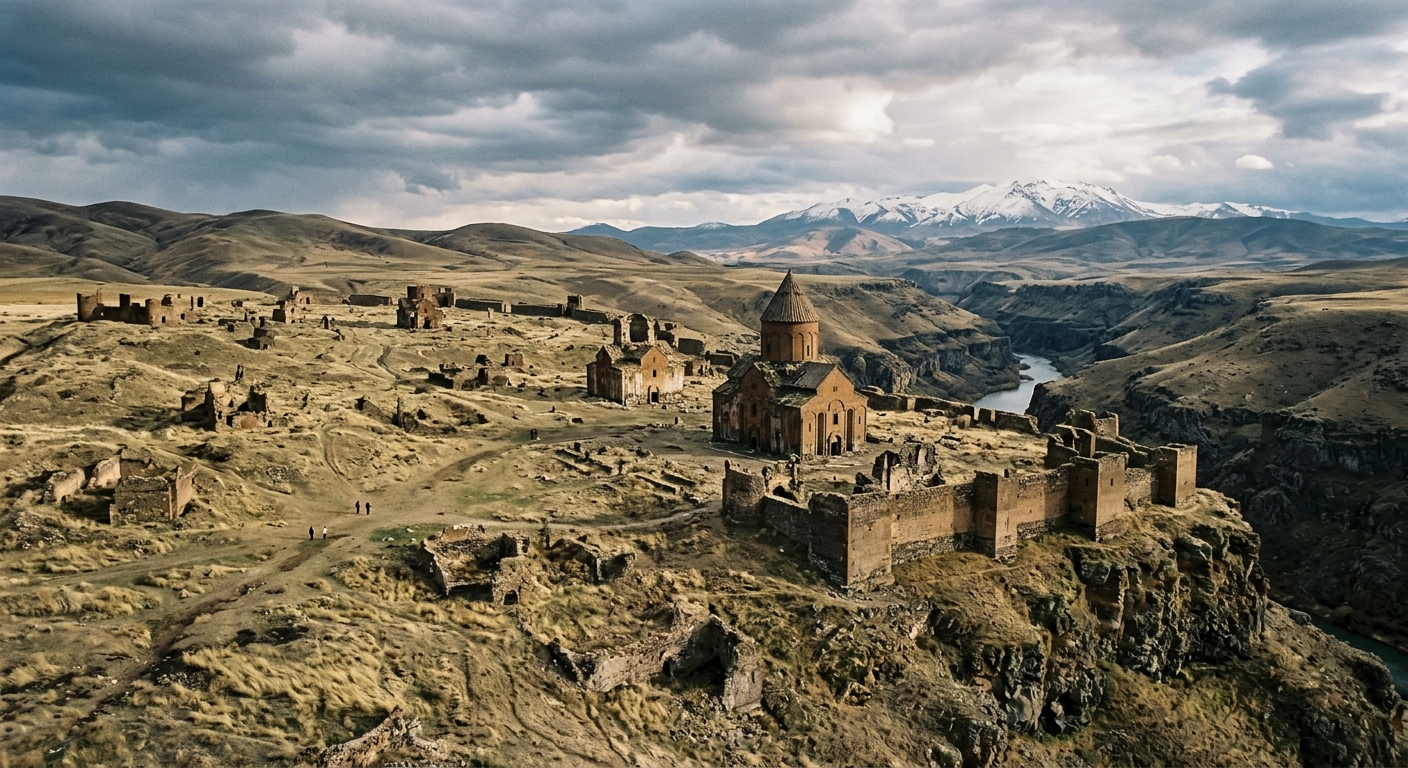
In the remote borderlands between Turkey and Armenia lies one of archaeology’s most haunting mysteries: the ruins of Ani, a medieval metropolis that once rivaled Constantinople and Baghdad in size and splendor. Today, visitors encounter only crumbling stone walls, collapsed churches, and the whisper of wind through empty doorways where a bustling city of 100,000 people once thrived.
The Rise of a Medieval Superpower
During the 10th and 11th centuries, Ani wasn’t just another medieval settlement. It was the crown jewel of the Armenian Kingdom of Bagratid, serving as both capital and commercial powerhouse. The city’s strategic location along the Silk Road trading routes transformed it into a cosmopolitan hub where merchants from across the known world converged to exchange goods, ideas, and cultures.
At its peak around 1000 CE, Ani’s population exceeded that of Paris, London, and most other European capitals. The city sprawled across a triangular plateau, protected by deep ravines on two sides and massive fortifications on the third. Within these walls, residents enjoyed amenities that wouldn’t become common in other medieval cities for centuries.
Architectural Marvels That Defied Their Time
What made Ani truly extraordinary wasn’t just its size, but its sophisticated urban planning and revolutionary architecture. The city boasted:
- Over 1,000 churches, each showcasing innovative Armenian architectural techniques
- Advanced sewage and water systems that supplied clean water to every district
- Multi-story buildings with intricate stone carvings and frescoes
- Public baths, libraries, and educational institutions
- Workshops producing textiles, metalwork, and manuscripts renowned across the medieval world
The Cathedral of Ani, completed in 1001 CE, featured engineering innovations that predated similar techniques in Western European Gothic architecture by decades. Its soaring dome and flying buttresses created an interior space that left medieval visitors awestruck.
The Economic Engine of Medieval Trade
Ani’s wealth derived from its position as a critical link in the Silk Road network. Caravans carrying silk from China, spices from India, and precious metals from Central Asia passed through the city’s gates. Local artisans transformed raw materials into luxury goods, while merchants facilitated trade between East and West.
The city’s mint produced coins that circulated from the Black Sea to the Persian Gulf. Archaeological evidence reveals that Ani’s markets sold goods from as far away as Scandinavia and Southeast Asia, making it one of the world’s first truly global commercial centers.
A Melting Pot of Cultures and Faiths
Despite being the heart of Armenian Christianity, Ani welcomed people of various backgrounds and beliefs. The city housed Armenian Apostolic churches, Georgian Orthodox monasteries, and even Islamic mosques. This religious tolerance, unusual for the medieval period, contributed to Ani’s prosperity and cultural dynamism.
Manuscripts from Ani’s scriptoriums influenced artistic traditions across the region. The city’s scholars preserved and transmitted classical knowledge, serving as a bridge between Byzantine, Islamic, and Western European intellectual traditions.
The Swift and Devastating Decline
Ani’s golden age ended abruptly in the 11th century when a perfect storm of disasters struck. Political instability weakened the Armenian kingdom just as new trade routes bypassed the city. The devastating earthquake of 1319 toppled many of Ani’s architectural marvels, while subsequent invasions by various powers left the population decimated.
By the 14th century, this once-great metropolis had transformed into a minor town. By the 18th century, Ani was completely abandoned, leaving only ruins as testament to its former glory.
Modern Rediscovery and Archaeological Revelations
Russian archaeologists rediscovered Ani in the 19th century, uncovering evidence of the city’s remarkable sophistication. Excavations revealed:
- Underground tunnel networks connecting major buildings
- Sophisticated heating systems in wealthy districts
- Evidence of advanced metallurgy and textile production
- Artistic masterpieces that influenced medieval art across three continents
Recent archaeological work using ground-penetrating radar and satellite imaging has revealed that much of medieval Ani still lies buried, potentially containing treasures that could rewrite our understanding of medieval urban development.
A Lost City in a Disputed Land
Today, Ani’s ruins occupy a sensitive border zone between Turkey and Armenia, with access strictly controlled by both governments. The site’s location in this geopolitical no man’s land has both protected it from modern development and limited conservation efforts.
UNESCO recognized Ani as a World Heritage Site in 2016, but the ruins continue to deteriorate due to harsh weather conditions and limited maintenance. Climate change and seismic activity threaten structures that have survived for over a thousand years.
The story of Ani serves as a powerful reminder of how quickly human civilizations can rise and fall. This ghost city, once larger than medieval London or Paris, now stands as one of archaeology’s most poignant examples of lost grandeur, offering visitors a haunting glimpse into a forgotten chapter of human achievement.






oh this is such a cool example of how cities rise and fall based on trade routes and geopolitical shifts rather than any mysterious forces – the “mystery” usually comes down to pretty practical stuff like the silk road trade shifting or military conflicts making it less viable as a settlement hub. and yeah the architecture there is genuinely incredible, the Menucehr Church is wild for its time. sometimes i think people want these abandoned places to be mysterious when theyre actually fascinating case studies in how human societies adapt and move, which honestly is way cooler imo
Log in or register to replyThe scale of this gets me every time – a thriving metropolis of 100,000 souls reduced to silent stone, and here we are trying to find evidence of life on Mars when we can’t even fully understand what happened to our own civilizations. I’d love to know what the actual conditions were like when Ani was thriving, because that kind of advanced urban planning makes me wonder what other sophisticated societies we’ve forgotten about. There’s something both sobering and oddly hopeful about it, you know? Like maybe life, intelligent life, is fragile everywhere in the universe, but that’s exactly why we should treasure and study these remnants.
Log in or register to replyyeah totally get the sobering feeling, and youre right that studying how civilizations actually function and decline teaches us a ton. tho i think the “we cant understand our own civilizations” part might be selling archaeology and historical research short a bit? like we actually know pretty well what happened to ani – the silk road trade shifted, there were political instability and invasions, and eventually the location just wasnt economically viable anymore. its less mysterious and more like, pragmatic historical forces at work, which honestly makes it MORE fascinating to me bc it shows how interconnected everything was. and yeah theres probably tons of sophisticated societies we dont have detailed records of, but thats more about limitations of the archaeological record than our inability
Log in or register to reply