
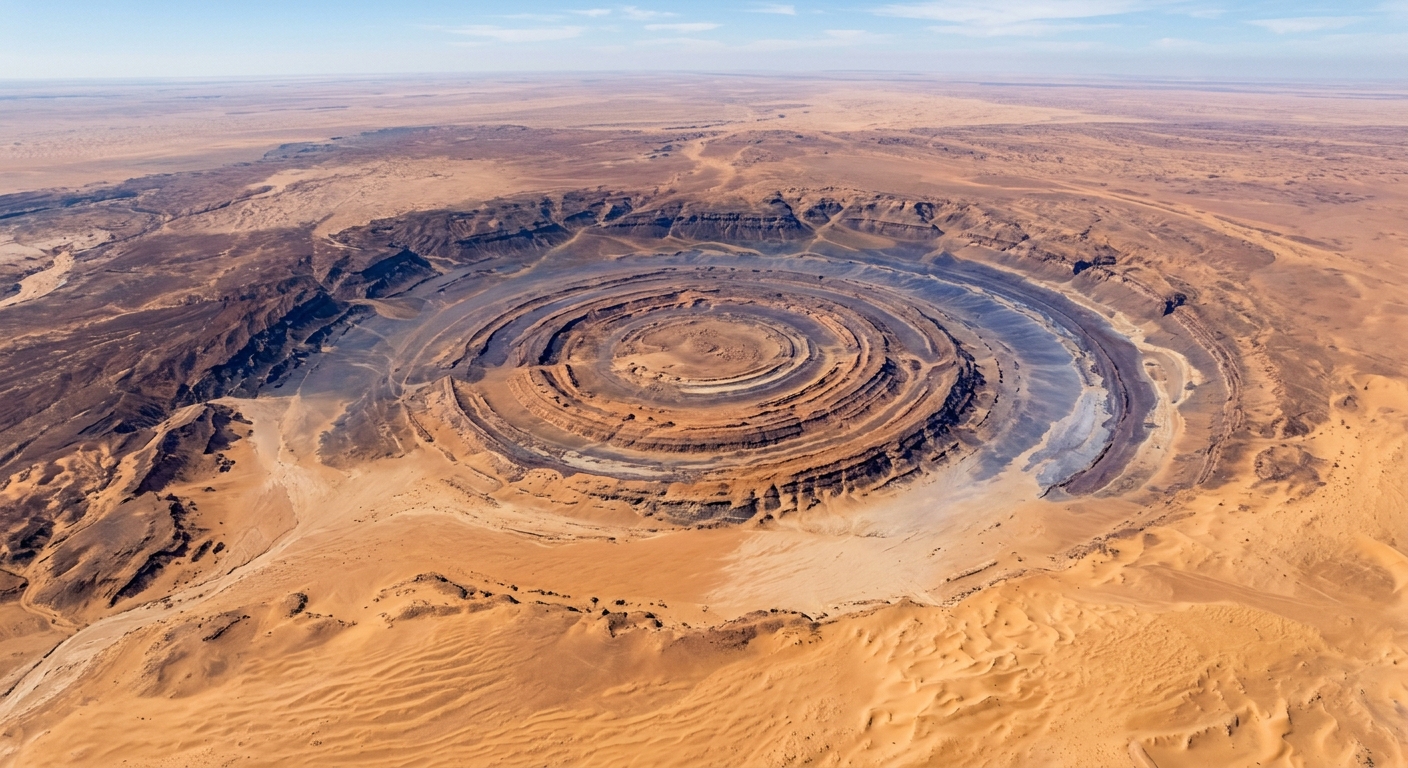
Deep in the heart of the Mauritanian Sahara lies one of Earth’s most perplexing geological formations: a colossal circular structure so perfectly formed and so impossibly large that it was initially mistaken for evidence of an ancient asteroid impact. The Richat Structure, also known as the “Eye of the Sahara,” stretches an astounding 25 miles across, making it visible from space and turning it into one of the most photographed landmarks by astronauts.
A Cosmic Mistake That Changed Everything
When scientists first observed the Richat Structure from aerial photographs in the 1960s, the conclusion seemed obvious. Here was a perfect bull’s-eye pattern carved into the desert, with concentric rings radiating outward from a central point. The formation looked exactly like what you’d expect to see from a massive asteroid or meteorite impact, similar to other famous impact craters around the world.
For decades, this theory dominated scientific thinking. The structure’s near-perfect circular shape, combined with its enormous size, seemed to fit the profile of an impact crater perfectly. Scientists theorized that millions of years ago, a massive space rock had slammed into this part of Africa, creating the distinctive rings we see today.
However, there was just one problem: the evidence didn’t add up.
The Mystery Deepens: Missing Pieces of the Puzzle
As geological surveys became more sophisticated, researchers began to notice critical elements missing from the Richat Structure that should have been present if it were truly an impact crater. Most notably, they found no shocked minerals or rocks that had been subjected to the extreme pressures typical of asteroid impacts.
Impact craters leave behind telltale signs: shattered quartz crystals, melted rock formations, and specific mineral compositions that form under intense pressure and heat. The Richat Structure had none of these characteristics. Instead, the rocks found within the formation were surprisingly ordinary, showing no signs of the violent cosmic collision that should have created such a massive crater.
The Volcanic Theory Takes Hold
By the 1980s and 1990s, scientists had largely abandoned the impact theory in favor of a volcanic origin. This new hypothesis suggested that the Richat Structure was the result of ancient volcanic activity, specifically a large volcanic dome that had been eroded over millions of years to reveal the concentric ring pattern we see today.
The volcanic theory explained many of the structure’s features more convincingly than the impact hypothesis. The different rock layers, each with distinct compositions and ages, suggested a complex geological history involving multiple episodes of volcanic activity and subsequent erosion.
The Truth Revealed: A Geological Masterpiece
Modern geological analysis has revealed the true origin of the Richat Structure, and it’s perhaps even more fascinating than either the impact or volcanic theories suggested. The formation is actually the result of a geological process called uplift, followed by millions of years of erosion.
Here’s what actually happened: Around 100 million years ago, molten rock began pushing upward from deep within the Earth’s crust, creating a massive dome-shaped bulge in the surface. This wasn’t explosive volcanic activity, but rather a slow, steady upward pressure that gradually lifted layers of sedimentary rock into a dome formation.
The Great Unveiling
Over the following millions of years, the relentless forces of wind and water erosion began wearing away this dome. Because different rock layers have varying resistance to erosion, some wore away faster than others. The harder, more resistant layers formed the ridges we see today, while the softer layers eroded into the valleys between them.
This differential erosion created the spectacular concentric ring pattern that makes the Richat Structure so visually striking. Each ring represents a different geological layer, with some dating back over 600 million years.
A Window Into Deep Time
What makes the Richat Structure truly remarkable is that it essentially functions as a cross-section through hundreds of millions of years of Earth’s geological history. The exposed rock layers tell the story of ancient oceans, changing climates, and the slow but inexorable movement of continents.
The outer rings contain some of the oldest rocks in the formation, dating to the Proterozoic Era when complex life was just beginning to emerge on Earth. Moving inward, each successive ring represents progressively younger geological periods, creating a natural timeline of our planet’s deep past.
Visible From the International Space Station
The Richat Structure’s immense size, approximately 40 kilometers in diameter, makes it easily visible to astronauts aboard the International Space Station. Its distinctive appearance has made it a favorite photographic subject for space travelers, and it serves as a useful landmark for navigation when flying over the largely featureless Sahara Desert.
The contrast between the structure’s organized ring pattern and the surrounding desert creates a stunning visual that has captured imaginations around the world. Some have compared it to a giant eye staring up from the Earth’s surface, hence its nickname “Eye of the Sahara.”
Scientific Significance and Ongoing Research
Today, the Richat Structure continues to provide valuable insights for geologists studying processes of uplift and erosion. The formation serves as a natural laboratory for understanding how these geological forces interact over vast timescales to create some of Earth’s most spectacular landforms.
Research at the site has also contributed to our understanding of how to distinguish between impact craters and other circular geological formations, knowledge that proves valuable when studying similar structures on other planets. The lessons learned from the Richat Structure have been applied to interpreting satellite images of Mars and other celestial bodies.
The story of the Richat Structure reminds us that our planet is full of surprises, and that even our best scientific theories must sometimes give way to new evidence and better understanding. What once seemed like clear evidence of a cosmic collision turned out to be something equally remarkable: a testament to the incredible power of geological forces operating over deep time to create one of Earth’s most spectacular natural wonders.






This is such a great example of how our pattern-recognition brains can fool us, right? We see that perfect bullseye from orbit and immediately jump to “impact crater,” but it turns out the Earth was just doing some slow, methodical sculpting work for hundreds of millions of years – which is honestly way more mind-bending to me than a single cosmic collision. Imagine if we had better satellite data from the 1960s, we might’ve solved this mystery decades earlier, or maybe we’d have kept the misconception even longer. What gets me is how many other geological features we might still be misinterpreting just because we’re looking at them from one angle.
Log in or register to replyhonestly this reminds me of how we keep discovering these incredible formations in the deep ocean that turn out to be way more complex than we thought, tbh. like yeah the richat structure is cool but the abyssal plain has these same kind of geometric formations – hydrothermal vent fields, mid ocean ridges – and we’re still figuring out how they form. its kind of humbling how patient geology is, you know? nature doesnt need drama to be stunning, it just needs 600 million years and some good erosion lol.
Log in or register to replyThis is a really cool example of how nature can create patterns that look intentional! You’re spot on about our brains jumping to the dramatic explanation first, haha. It reminds me of how people do the same thing with bats – we see them flying at night and immediately think “vampire!” when like 99% of bat species are just out there eating insects and pollinating plants. Sometimes the slow, boring geological or biological processes are way more fascinating once you actually dig into them!
Log in or register to reply