
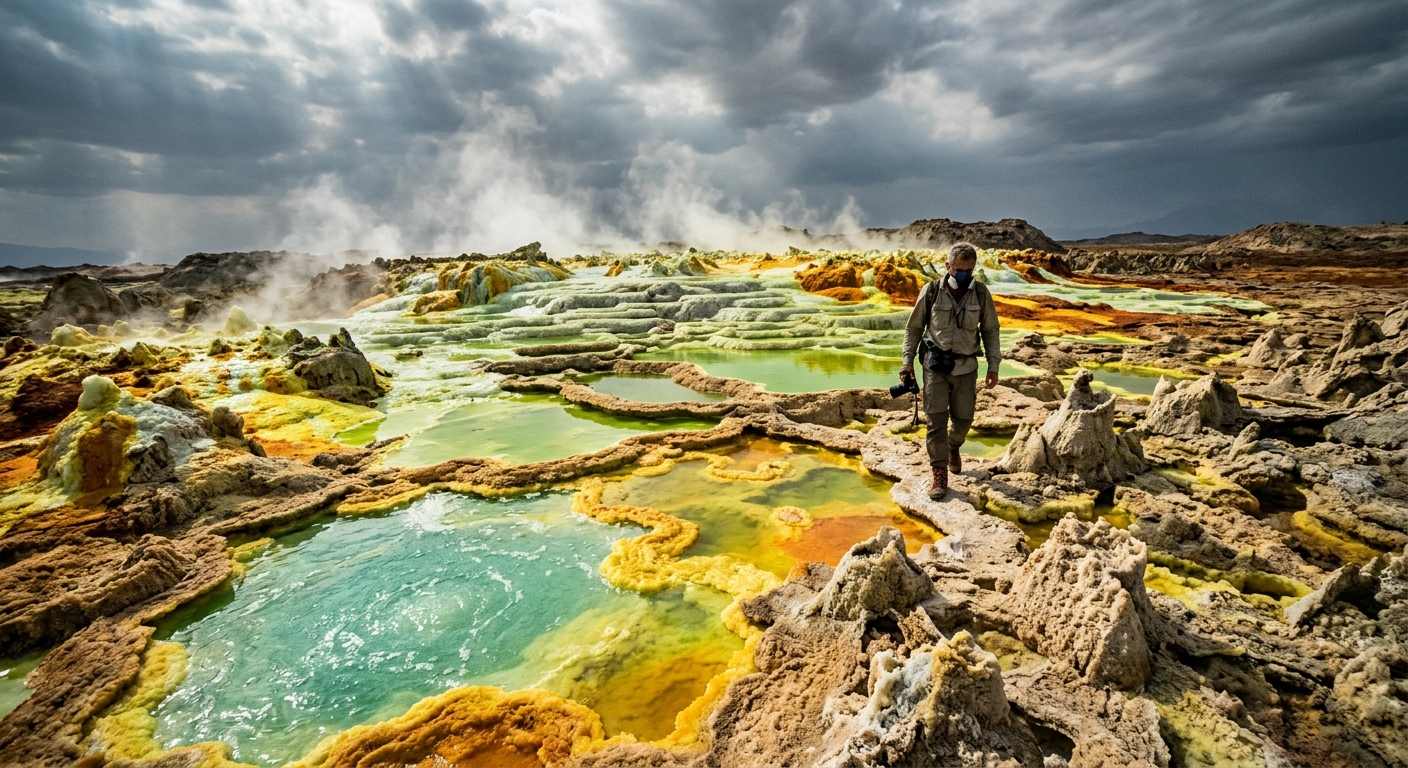
Hidden in the remote Danakil Depression of northeastern Ethiopia lies a landscape so otherworldly that NASA scientists use it as a testing ground for Mars exploration. The Dallol Hydrothermal Field stretches across miles of what can only be described as Earth’s most convincing impression of an alien planet, complete with toxic gas clouds, impossible colors, and life forms that shouldn’t exist.
Welcome to Earth’s Most Hostile Paradise
At 410 feet below sea level, the Dallol Hydrothermal Field sits in one of the lowest and hottest places on Earth. Daily temperatures regularly soar above 125°F (52°C), making it one of the most consistently hot inhabited places on the planet. But extreme heat is just the beginning of this geological nightmare’s impressive resume of hostility.
The landscape resembles a fever dream painted in impossible colors. Bright yellow sulfur deposits create alien coral gardens, while emerald green pools bubble with acidic brine. Orange and red iron oxide formations tower like monuments to some forgotten Martian civilization. Steam rises from countless hot springs, creating an perpetual haze that makes the entire area shimmer like a mirage.
A Toxic Cocktail of Geological Violence
What makes Dallol so uniquely alien isn’t just its appearance, but the deadly chemistry bubbling beneath its colorful surface. The hydrothermal field sits atop a complex geological intersection where the African, Arabian, and Somali tectonic plates are literally tearing the continent apart.
This geological violence creates a toxic wonderland:
- Hypersaline pools: Water so salty it would instantly dehydrate any normal life form
- Sulfuric acid springs: Natural pools with pH levels that could dissolve metal
- Toxic gas emissions: Hydrogen sulfide, chlorine, and other deadly gases constantly vent from the ground
- Extreme mineral concentrations: Salt, sulfur, potash, and iron create a chemical soup unlike anywhere else on Earth
The combination of these factors creates an environment so hostile that even wearing protective equipment, researchers can only work in short intervals before the conditions become life-threatening.
Life in Hell: The Impossible Organisms of Dallol
Perhaps most mind-blowing of all, life has found a way to thrive in this chemical hellscape. Scientists have discovered extremophile microorganisms that not only survive but flourish in conditions that would instantly kill most life on Earth.
The Polyextremophiles
The microbes living in Dallol’s toxic pools are called polyextremophiles because they survive multiple extreme conditions simultaneously. These remarkable organisms can withstand:
- Temperatures that would cook most bacteria
- Acid levels that would dissolve human tissue
- Salt concentrations higher than the Dead Sea
- Toxic metal concentrations that would poison normal cells
- Complete absence of oxygen
Some of these organisms actually eat sulfur and excrete sulfuric acid, contributing to the landscape’s alien appearance. Others feed on iron, creating the rusty red formations that dot the terrain like Martian sculptures.
Mars on Earth: Why NASA Studies Dallol
The similarities between Dallol and what scientists believe ancient Mars looked like are so striking that multiple space agencies use the site for Mars analog research. The hydrothermal field provides researchers with a unique opportunity to study how life might survive in the harsh conditions of other planets.
Martian Parallels
Several features make Dallol an ideal Mars analog:
- Mineral composition: Similar sulfate and chloride deposits found on Mars
- Hydrothermal activity: Evidence suggests Mars once had similar hot spring systems
- Extreme chemistry: The toxic, acidic conditions mirror what life on Mars would face
- UV exposure: High altitude and minimal atmosphere create Mars-like radiation levels
By studying how life survives in Dallol, scientists hope to understand what biosignatures to look for when searching for life on Mars and other potentially habitable planets.
The Ever-Changing Alien Landscape
One of Dallol’s most fascinating features is its constantly evolving nature. Unlike static geological formations, the hydrothermal field changes daily. New hot springs bubble up overnight, colorful mineral deposits shift and grow, and toxic pools appear and disappear like alien weather patterns.
This dynamic environment is created by the ongoing geological activity beneath the surface. As underground water systems change course and new mineral-rich springs emerge, they paint the landscape in new patterns of impossible colors. What visitors see today may be completely different from what existed just months earlier.
A Window into Earth’s Violent Past
Beyond its alien appearance and astrobiological significance, Dallol offers scientists a glimpse into what Earth might have looked like billions of years ago. The extreme conditions and unique life forms mirror theories about early Earth’s environment when the planet was young and hostile.
Some researchers believe studying Dallol’s extremophiles could provide clues about how life first emerged on our planet. These hardy organisms might be similar to Earth’s first life forms, offering insights into the origins of biology itself.
The Future of Dallol Research
Despite its remote location and dangerous conditions, Dallol continues to attract researchers from around the world. New discoveries are made regularly, from novel extremophile species to unique mineral formations that challenge our understanding of geology and chemistry.
As technology advances, scientists are developing new ways to study this alien landscape safely. Remote sensing equipment, specialized protective gear, and robotic sampling devices allow researchers to probe deeper into Dallol’s secrets without risking human life.
The Dallol Hydrothermal Field stands as a testament to both Earth’s incredible geological violence and life’s remarkable tenacity. In this toxic, alien landscape, we find not only a window into other worlds but also profound insights into the very nature of life itself. For those seeking the truly extraordinary, Dallol proves that sometimes the most alien landscapes in the universe are hiding right here on our own planet.


You’re touching on something really important here, Connie – that resilience is real, but it’s also a double edged sword when it comes to conservation. I study river systems and the extremophiles we find in acid mine drainage or heavily polluted sections show similar adaptability, but here’s the thing: just because organisms *can* survive those conditions doesn’t mean ecosystems *should* exist in them. A river full of acid tolerant bacteria isn’t a healthy river, it’s a degraded one. The hope I’d point to instead is that when we actually restore water quality and remove dams, we see native species roar back faster than anyone expects, which tells me nature’s resilience works best when we
Log in or register to replyhonestly this post got me thinking about the whole reason i got my telescope in the first place / if life can be this stubborn and creative in dallol’s acid pools, then somewhere in the subsurface of europa or enceladus, maybe something equally wild is doing its thing right now. the fact that we’re using earth’s harshest places to prep for mars missions just feels like such a beautiful reminder that life keeps finding ways, and that gives me so much hope for what we might discover out there.
Log in or register to replyThis is so cool, honestly / those extremophiles surviving in conditions that would destroy basically everything else kind of give me hope that life is way more resilient than we think, which we desperately need to remember when we’re trashing actual habitable ecosystems. I’d love to know more about what makes these organisms tick, especially since understanding extreme adaptation might help us figure out how to protect species that are running out of time thanks to climate change and pollution.
Log in or register to reply